
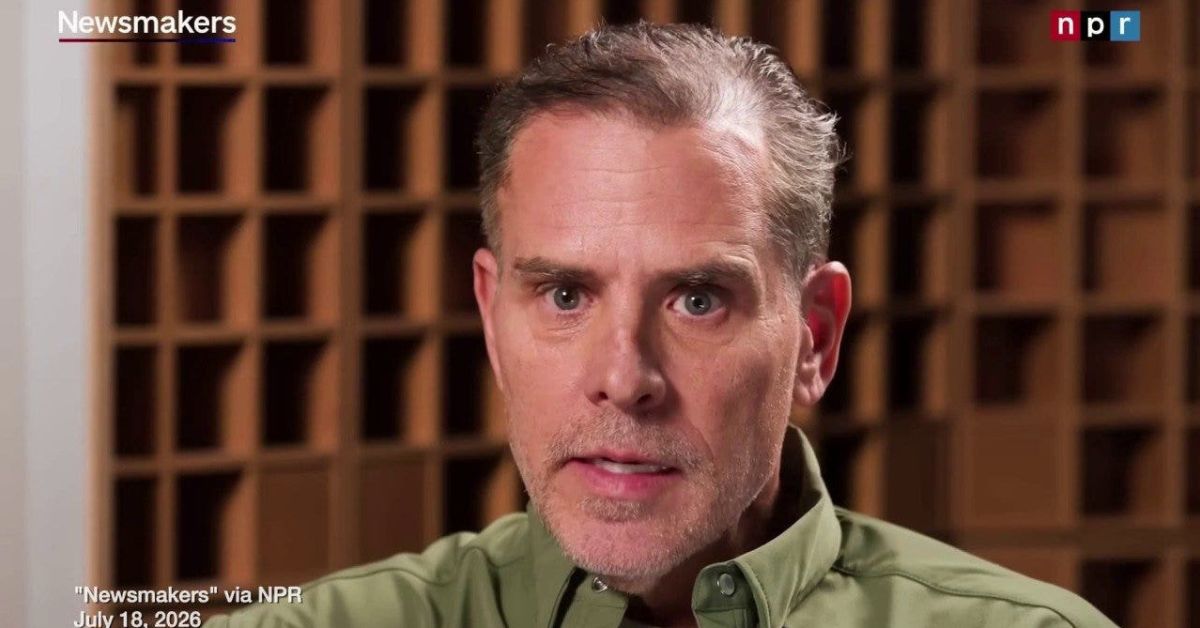
A man who once leveraged his last name to secure lucrative foreign deals, sell high-priced artwork to undisclosed buyers, and rely on a Hollywood fixer to keep his finances afloat now insists he cannot afford even a car or a cell phone.
Under oath, Hunter Biden testified that he holds no stocks, bonds, or savings account, claiming that his artwork is the only property he still owns that might carry any real value. According to RedState, these revelations emerged during a Feb. 9 deposition in his legal dispute with the law firm Winston Taylor, formerly Winston & Strawn, which had represented him in a series of criminal and civil matters.
His attorneys released the deposition transcript as they fought the firms demand for records of communications with individuals who may have been approached to help cover his mounting legal fees. Pressed about what assets might be available to satisfy his obligations, Biden did not equivocate: I dont have any assets. I dont own a car. I dont own a phone.
He then broadened his claim of financial distress to encompass the entire Biden clan, asserting, My family doesnt have any money, and its not their debt anyway. The statement sits uneasily beside years of reporting on the Biden familys lucrative speaking fees, book deals, and consulting arrangements, raising questions about whether the political dynasty that profited from his access is now content to leave him to fend for himself.
Winston & Strawn filed suit against Biden in June 2025 after guiding him through two federal criminal prosecutions, congressional inquiries, and multiple civil lawsuits, asserting that he owed the firm more than $50,000. Biden has estimated that his total legal exposure ran far higher, placing his overall costs somewhere between $14 million and $17 million, a staggering sum for any defendant but particularly striking for a man who once moved in elite international circles.
The price tag was driven in part by the caliberand costof his legal team. Abbe Lowell, the high-profile attorney who led Bidens defense while at the firm, billed at $1,510 per hour, while other partners charged as much as $1,945 per hour, rates that underscore how aggressively Biden lawyered up as his legal troubles deepened.
Those troubles culminated in a June 2024 conviction on three federal gun charges, followed by a guilty plea on tax offenses tied to roughly $1.4 million in unpaid taxes. Before either case reached sentencing, former President Joe Biden intervened with the most powerful tool at his disposal, issuing a presidential pardon that wiped away his sons criminal exposure.
The pardon spared Hunter Biden from the possibility of prison, but it did nothing to erase the financial wreckage left behind. The invoices remained, as the saying goes, and the law firm that once defended him is now pursuing him in court, a reversal that highlights the limits of political power when it comes to private debts.
Hunter Biden now argues that Lowell assured him the money issue would be resolved over time, suggesting he relied on informal assurances rather than hard commitments. He has also shifted blame toward Lowell and the firm for pursuing an aggressive legal strategy that included lawsuits against IRS whistleblowers Gary Shapley and Joseph Ziegler, Rudy Giuliani, and former Trump White House aide Garrett Ziegler.
Several of those cases were dropped as Bidens finances deteriorated and the cost of sustained litigation became untenable. In March 2025, he moved to dismiss his lawsuit against Garrett Ziegler, telling the court, I do not have the financial resources to continue litigating this case.
His art career, once touted by allies as a fresh start, has not delivered the windfall some expected. Biden testified that he has sold only one painting for $36,000 since December 2023, a sharp decline from the previous two or three years, when he sold 27 works at an average price of nearly $55,000 each, a pricing structure that had already raised ethical concerns about influence-buying.
Lowell acknowledged that he sought assistance from third-party donors and individuals within what he called the Democratic ecosystem to help shoulder Bidens legal costs. He further discussed establishing a legal defense fund and a 501(c)(4) organization with Bob Bauer, a former Obama White House counsel and Joe Bidens personal attorney, a sign that the effort to keep Hunter afloat reached deep into the Democratic Partys institutional network.
That is not a footnote, the account notes, emphasizing that Bauers involvement shows that conversations about financing Hunter Bidens defense were taking place at the highest levels of the Biden inner circle, with the sitting presidents own lawyer participating. Winston Taylor is now seeking access to communications related to those fundraising efforts, arguing that Biden has not produced all relevant messages, while Biden insists he has complied with his obligations.
Despite his claims of near-destitution, Hunter Biden recently secured a $1.7 million default judgment against former Overstock CEO Patrick Byrne, prompting Winston Taylor to move swiftly to place a lien on the award. He also obtained employment at a luxury addiction treatment facility, a position that some may view as a hopeful sign of rehabilitation and others as yet another example of the Biden name opening doors that would remain closed to ordinary Americans.
Neither development, however, alters the basic financial reality: creditors are poised to intercept virtually every dollar that comes his way before he can spend it. Hunters assertion that the broader Biden family is without means is difficult to reconcile with public reports that Joe Biden received a $10 million book advance and that Jill Biden secured her own advance for a memoir that reached number one on the New York Times bestseller list, aided by bulk purchases.
For years, the Biden brand was monetized through speaking fees, publishing deals, and international business ventures, with Hunter often at the center of those arrangements. Now, as he tells it, all he has left are his paintings and a family that doesnt have any money and wont pick up the tab, a portrait that raises uncomfortable questions about personal responsibility, political privilege, and who ultimately pays the price when influence is treated as a family business.
Login