
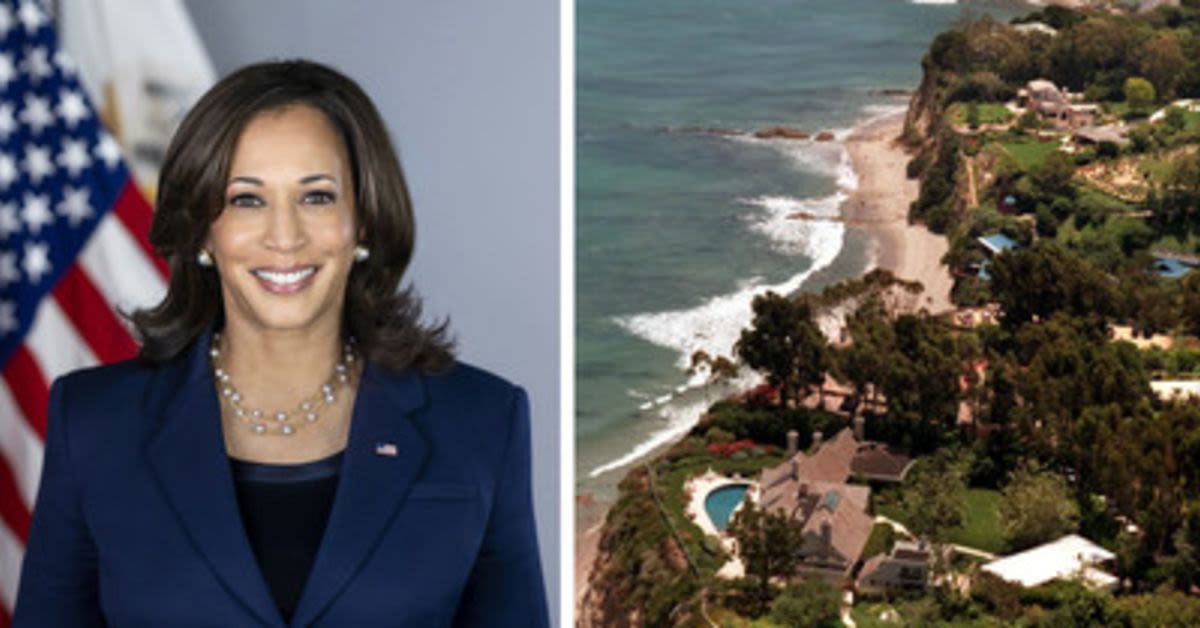
Former Vice President Kamala Harris, who has spent decades decrying racial inequities in housing and extolling the virtues of living among Black Americans, has quietly purchased a multimillion-dollar California mansion in a neighborhood that is almost entirely White.
According to Fox News, Harris new 4,000-square-foot residence, reportedly bought for $8.15 million, sits in the elite seaside enclave of Point Dume, a Malibu-area community known for its ocean vistas and celebrity residents. The property boasts sweeping coastal views, multiple wine refrigerators, private golf greens and parking space for five vehicles, amenities far removed from the struggling minority neighborhoods she has long held up as central to her political mission.
Point Dume lies wholly within Census tract 8004.08, which the U.S. Census Bureaus American Community Survey estimated in 2019 was just 0.2% Black and roughly 94% White. For a politician who has repeatedly framed herself as a champion of racial integration and equity, the decision to settle in one of the least diverse corners of Californias coastline raises fresh questions about the gap between her rhetoric and her personal choices.
Harris move appears especially discordant when contrasted with her past reflections on the importance of living among other Black Americans. "When youre at (a historically Black college or university), and especially one with the size and with the history of Howard University and also in the context of also being in D.C., which was known forever as being Chocolate City it just becomes about you understanding that there is a whole world of people who are like you," Harris told a Washington Post reporter in 2019, describing how attending Howard reshaped her sense of identity after growing up in largely White environments.
She went further in that same interview, emphasizing that sheer numbers of Black peers mattered more to her than generic diversity. "It was more, for me, about the numerosity than it was the diversity, I grew up in a community where there were many representations of diversity," she added. "Going to Howard, there were so many (Black people)! And theyre all in your age group, in your phase of life."
Yet Harris has now chosen to plant roots in a coastal enclave that critics say has long been unwelcoming to minorities, particularly on its beaches. "Despite the veneer of a laid back community of surfers who are one with nature, there are barriers to access that keep most BIPOC people away," a pair of non-White surfers wrote in a 2025 review of Harriss new neighborhood, underscoring longstanding complaints that Malibus culture and geography function as informal gates.
The irony is sharpened by Harris professional record, which she has frequently framed as a crusade against structural barriers in housing. In 2012, as Californias attorney general, she joined a Supreme Court brief arguing that the Fair Housing Act can be enforced when policies have a "disparate impact" across different racial groups, even if the policies themselves are racially neutral.
On the campaign trail, Harris leaned heavily into that record to bolster her progressive credentials on race and housing. As a presidential candidate, she proposed $100 billion in assistance for families in historically redlined communities and as vice president she promoted the Biden administrations efforts to combat racial bias in home appraisals.
Her personal narrative has long been a point of contention, particularly among critics who question how authentically she embodies the African American experience she invokes politically. During Harris 2020 presidential campaign, she faced questions about the authenticity of her African American identity due to her Indian and Jamaican heritage and upbringing in affluent, primarily White areas, and the attacks resurfaced in 2024, when then-candidate Donald Trump accused Harris of using her Black identity for political gain.
Harris also drew criticism in 2024 for repeatedly identifying with Oakland, California, a city with a storied Black history, even though she spent most of her childhood in nearby Berkeley, which was significantly less racially diverse. As a teenager, she moved with her mother to Montreal, another predominantly White city, and later married Doug Emhoff, who is also White, further complicating the carefully curated image of rootedness in Black communities.
Her latest real estate purchase comes as Harris returns to the political spotlight amid speculation that she may mount a third bid for the presidency in 2028.
Login