
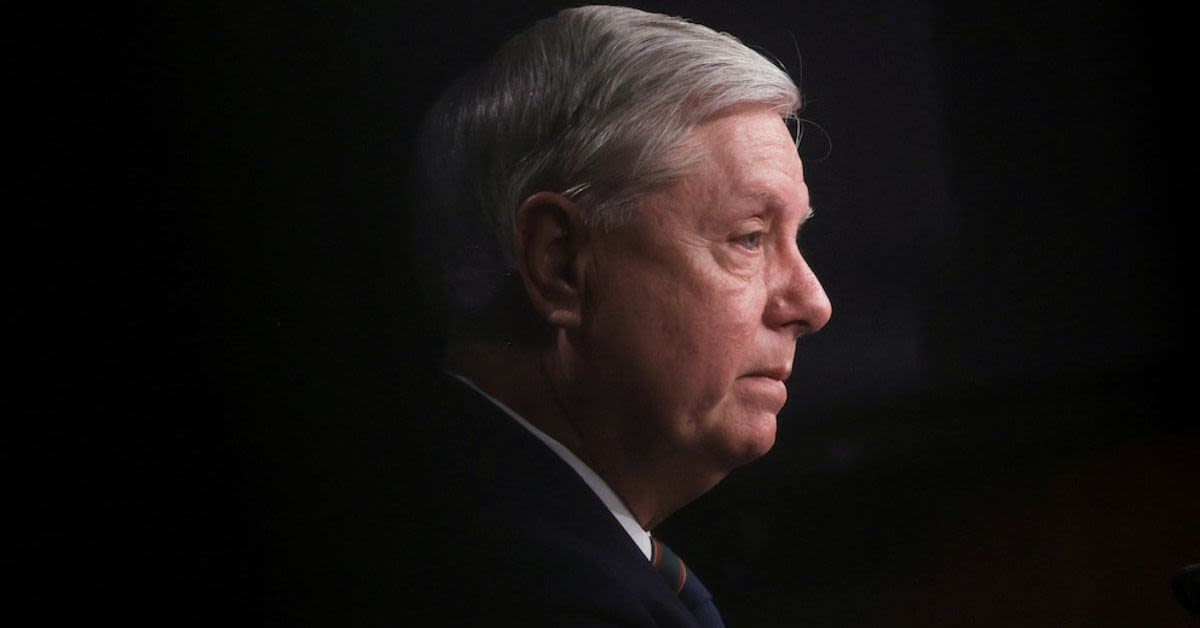
Monica Lewinskys public tribute to the late Sen. Lindsey Graham has reopened a chapter of American political history that many on the left would prefer to forget: a Democratic presidents abuse of power, a Republican Party willing to confront it, and a young woman whose life was nearly destroyed in the process.
According to Fox News, Lewinsky, now 53, offered her respects to the South Carolina Republican shortly after his death on July 11, following what his office described as a "brief and sudden illness." Her message, posted on X, surprised many observers not because it was partisan, but precisely because it was not, and because it underscored Grahams role in exposing a smear campaign against her during the Clinton impeachment saga.
Her non-partisan reflection quickly drew online backlash from users who demanded ideological purity over personal gratitude. Yet communications experts argued that her comments were an authentic expression of a long-held belief that human decency should not be erased by political disagreement, a view that stands in stark contrast to the unforgiving, hyper-partisan culture that now dominates the left.
Graham, one of the Republican Partys most influential voices for more than three decades, left behind a record of hawkish foreign policy, judicial conservatism, and a willingness to challenge Democratic presidents on ethics and the rule of law. His death prompted thousands of tributes, but one of the most striking came from the former White House intern whose scandal became a defining test of presidential accountability.
"I've disagreed with many (many) of Lindsey Grahams choices and beliefs, but he was also as one of the house managers on the '98 impeachment the one who worked tirelessly to prove there was a smear campaign against me from inside the WH," Lewinsky wrote on X. Her acknowledgment cut against the narrative that Republicans in the Clinton era were motivated solely by partisanship, instead highlighting Grahams insistence that the young woman at the center of the scandal was being targeted by the very administration that had exploited her.
When critics on X attacked her for expressing even limited appreciation for a conservative senator, Lewinsky did not retreat. She reminded followers that her experience with Grahams efforts had been "healing" after years of trauma and public degradation tied to the Clinton scandal, a trauma that many progressives still minimize or excuse in the name of protecting a Democratic presidents legacy.
"Come on. He did not do it for you. The man was evil," one user wrote, encapsulating the reflexive demonization that now passes for political discourse on the left. Lewinsky responded with a pointed but measured reply: "I know he didnt do it for me. i didnt whitewash his history. but those actions were healing for me (and my family) thanks for sharing your opinion."
Adrienne Uthe, founder of Kronus Communications, told Fox News Digital that Lewinskys message "fits her clearly identified personal philosophy to a tee." Uthe emphasized that Lewinsky was not suddenly embracing Grahams broader politics, but was instead refusing to let ideological differences erase a specific act of fairness that mattered deeply to her.
"She's not suddenly a Lindsey Graham fan she's just honest enough to say he did one thing that mattered to her, and she's not going to let political disagreement erase that," Uthe said. "It works in her favor, and it's the kind of nuance that actually means something."
Uthe observed that Lewinskys post was "nonchalant, direct, and completely unpolished in the best way." In her view, "There's no performance to it it reads like: 'Hey, he wasn't perfect, I disagreed with most of what he did, but he did this one thing for me and I appreciated it.' That's it. It's classy, and it's a stand-up thing to highlight in someone's death."
"She's not suddenly a Lindsey Graham fan she's just honest enough to say he did one thing that mattered to her, and she's not going to let political disagreement erase that." That repeated line, Uthe suggested, underscores a rare willingness to separate personal gratitude from ideological alignment, something increasingly absent in progressive circles that demand total conformity.
Lewinsky was just 21 when she began an unpaid internship at the White House in July 1995, turning 22 that summer. Her sexual relationship with then-President Bill Clinton, who was 49 at the time, began in November 1995, a stark example of the power imbalance that many on the left now claim to oppose, yet long downplayed when it involved a Democratic icon.
The affair became public only after Lewinsky confided in Pentagon co-worker Linda Tripp, who secretly recorded their conversations. Those recordings were later used in Paula Jones sexual harassment lawsuit against Clinton, transforming a private scandal into a national reckoning over truth, power, and presidential misconduct.
During a January 1998 White House news conference, Clinton famously lied to the American people, declaring, "I did not have sexual relations with that woman, Miss Lewinsky." In the aftermath, Lewinsky went into hiding, subjected to a level of public humiliation that would today be described as bullying and abuse, yet was often excused by liberals as collateral damage in defense of a Democratic presidency.
Graham was one of 13 House members appointed to manage Clintons impeachment trial in the Senate. From that position, he not only condemned the president for lying under oath, but also argued that the process was about restoring "honor and integrity to the office," a standard that conservatives have long insisted must apply regardless of party.
"You dont even have to be convicted of a crime to lose your job in this constitutional republic if this body determines that your conduct as a public official is clearly out of bounds in
Login