
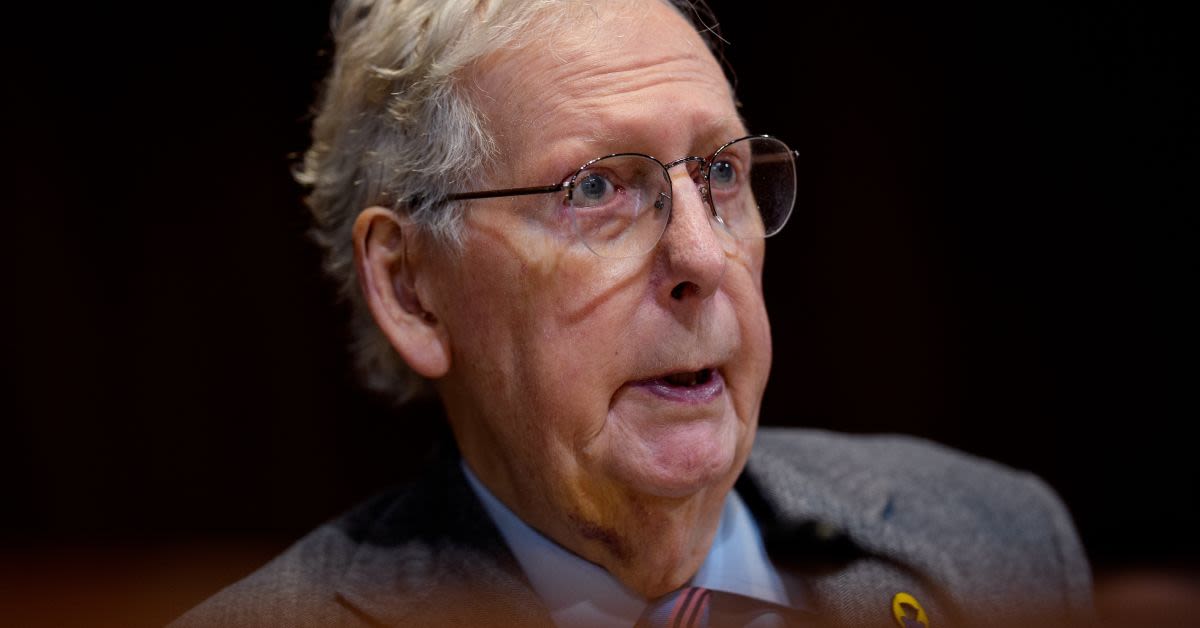
Pressure is intensifying on Sen. Mitch McConnell, R-Ky., to disclose more about his health as his absence from the U.S. Capitol approaches the six-week mark following a June fall that resulted in hospitalization.
According to Newsmax, the 84-year-old former Senate Republican leader has not cast a vote since mid-June, and the sparse medical details released by his office have fueled speculation across the political spectrum and online, prompting both allies and opponents to demand greater transparency. McConnell revealed on July 12 that he fell at his Kentucky home on June 14, briefly lost consciousness, and subsequently developed a mild case of pneumonia while hospitalized, a sequence of events that has raised questions about both his current condition and his capacity to resume full duties.
In that July 12 statement, McConnell stressed that physicians had ruled out some of the most serious possibilities, saying doctors concluded he had not suffered a heart attack, stroke, concussion, hemorrhage, or broken bones, and that he was later moved to a rehabilitation facility. He acknowledged at the time that he was not yet prepared to return to the Senate floor for votes, but he declined to offer any timetable for when he might be back in Washington, leaving colleagues and constituents to speculate in the vacuum.
Kentuckys Democratic governor, Andy Beshear, has publicly underscored that he has received no direct communication from McConnell since the senator entered the hospital, despite sending a letter requesting an update on his status. Beshear has urged the veteran lawmaker to make at least a brief public appearance or release a short video to address his health, arguing that such a gesture would reassure Kentuckians and the broader public.
Beshear framed the matter in terms familiar to ordinary working Americans, insisting that McConnell owes voters a candid explanation about his prolonged absence from the job. When you've been in a hospital for a month and you've missed all the votes you owe your boss, like anybody else out there who works, an explanation of what's been going on and when you'll get back, Beshear said, casting the electorate as the senators employer and suggesting that accountability should not be optional for senior officials.
Scott Jennings, a longtime McConnell ally and former campaign aide, has echoed the call for more openness, even as he remains supportive of the senator. Jennings argued that the political fallout could have been mitigated if McConnells team had been more forthcoming from the outset, rather than allowing rumors and partisan narratives to fill the information void.
Truthfully, I think a little transparency on the front end here would have saved him a whole lot of grief, Jennings told CNN's The Arena with Kasie Hunt. But that didn't happen and they are where they are now.
Jennings added that he expects McConnell to address the public again in the coming days, suggesting that a more regular cadence of updates could help stabilize the situation. For Republicans, particularly those who value institutional continuity and seasoned leadership, such communication would also serve to reassure voters that the party remains capable of governing effectively despite temporary setbacks.
McConnell spokesman David Popp has pushed back against any suggestion that the senator has disengaged from his responsibilities, emphasizing that the Kentucky Republican remains active behind the scenes. The Senator continues to meet with staff regarding Senate and Kentucky business, including discussions on defense appropriations, foreign policy, the farm bill, constituent services and constituent federal grant requests, Popp said, underscoring that much of a senators work can be conducted away from the chamber floor.
Popp further indicated that McConnells condition is improving and that the public will be informed as his rehabilitation progresses. As the Senator continues to improve in rehab, we will be sure to keep you updated, he said, while declining to commit to a specific date for McConnells return or to confirm whether he would attend Tuesdays funeral for longtime colleague Sen. Lindsey Graham, R-S.C., instead referring reporters back to the July 12 statement.
In that earlier statement, McConnell offered a rare personal reflection on the cultural reluctance of older Americans to discuss health challenges, particularly those in public life. Folks of my generation often hesitate to share the vulnerability that comes with growing older, he said, acknowledging that even as a seasoned political figure, he is not immune to that instinct.
Even in the public eye, I feel that same instinct I can't help it, McConnell added, hinting at the tension between private dignity and public accountability that many senior officeholders face. For conservatives who respect personal privacy and recoil at the modern culture of oversharing, his comments resonate, yet they also collide with the legitimate expectation that elected officials be forthright about their ability to serve.
McConnell stepped down as Senate Republican leader last year after an 18-year tenure that reshaped the federal judiciary and helped block much of the progressive agenda, but he chose to remain in the Senate through the end of his term in January. His absence has narrowed Republicans working margin in the chamber, making every vote more consequential as Congress approaches its final legislative stretch before lawmakers leave Washington to campaign for the midterm elections.
That thinner majority has practical implications for conservatives seeking to restrain the Biden administration and the Democratic agenda, as each missing Republican vote can tilt the balance on spending, border security, and judicial confirmations. With McConnell sidelined, the party loses not only a reliable vote but also a strategic mind who has long been central to blocking left-wing priorities and advancing a more originalist judiciary.
Some Republican senators have joined Democrats in pressing for more detailed information about McConnells health, reflecting both concern for a colleague and anxiety about the political stakes. Sen. Josh Hawley, R-Mo., has been explicit in wishing McConnell a swift recovery while also insisting that the senator owes the public a clearer account of his condition and prospects.
At a certain point you do have an obligation to your constituents and the country to tell them what's going on, Hawley told Fox News, adding that he felt totally in the dark about McConnell's condition. Hawleys remarks capture a broader sentiment among many voters who believe that transparency should not be optional when it comes to the health of senior leaders, particularly those in positions that can shape national policy and judicial appointments.
Sen. Ron Johnson, R-Wis., also briefly waded into the controversy when he questioned a photograph McConnell released earlier this month, before later retracting his comments and clarifying that he had merely repeated an unverified rumor. It's not fun watching anybody age, Johnson told reporters, acknowledging the human dimension of the situation even as the political world dissects every image and statement for clues.
We're all hoping Mitch recovers fully and comes back. I haven't talked to him, so I have no knowledge, Johnson added, underscoring how even fellow Republicans have been left to rely on secondhand information and official statements rather than direct conversations with the veteran senator. For a party that has long emphasized respect for elders and institutional memory, the spectacle of public speculation about McConnells health is both uncomfortable and politically fraught.
McConnell is far from the first senator to miss an extended period because of illness, and recent history offers several examples across party lines. Sen. John Fetterman, D-Pa., spent two months away from the Senate in 2023 while undergoing treatment for depression, and Sen. Dianne Feinstein, D-Calif., missed nearly three months that same year while recovering from shingles before eventually returning to the chamber.
Earlier cases underscore that prolonged absences are not unprecedented in the upper chamber, even if they are disruptive. Sen. John McCain, R-Ariz., did not cast another Senate vote during the final eight months of his life in 2018, and former Sen. Mark Kirk, R-Ill., was away from the Senate for nearly a year after suffering a stroke in 2012, yet both continued to influence policy and constituent services through their staffs.
Lester Munson, who served as Kirk's chief of staff, noted that senators often remain deeply involved in legislative and constituent work even when they are physically unable to appear on the Senate floor. I think people kind of just assume not really correctly that if the senator's in the hospital or something like that, that they can't do their job, Munson said, pushing back against the notion that absence from roll-call votes equates to total incapacity.
That's not entirely true. There's obviously some things they can't do but a lot of other things continue to be carried on, Munson added, emphasizing that modern communications and staff structures allow senators to remain engaged in policy discussions, casework, and federal grant advocacy even from a hospital or rehabilitation center. For conservatives wary of media narratives that quickly declare senior Republicans unfit, this perspective offers a reminder that service is not confined to the Senate floor.
Munson also observed that McConnells stature has invited a level of scrutiny that far exceeds what Kirk faced during his own health crisis. As far as I'm concerned, this guy has given so much to the Senate over time and therefore so much to America, God bless him, Munson said, offering a pointed defense of McConnells record and his right to manage his recovery without a constant barrage of political pressure.
He's got all the latitude in the world to deal with this problem, Munson added, capturing a sentiment shared by many conservatives who see McConnell as a pivotal figure in advancing a right?of?center judiciary, defending the filibuster, and resisting progressive overreach. Yet even among those admirers, there is an emerging recognition that the longer the silence continues, the more it invites speculation, empowers critics on the left, and complicates Republicans efforts to project stability heading into a critical election season.
As McConnell continues his rehabilitation away from public view, the central tension remains unresolved: how to balance a respected statesmans understandable desire for privacy with the publics legitimate interest in the health and capacity of one of the nations most influential lawmakers. With calls for transparency now coming from Democrats and Republicans alike, and with the GOPs narrow Senate margin magnifying every absence, the timing and substance of McConnells next public update will shape not only perceptions of his personal future but also the broader narrative about Republican leadership at a moment when the stakes for the country could hardly be higher.
Login