
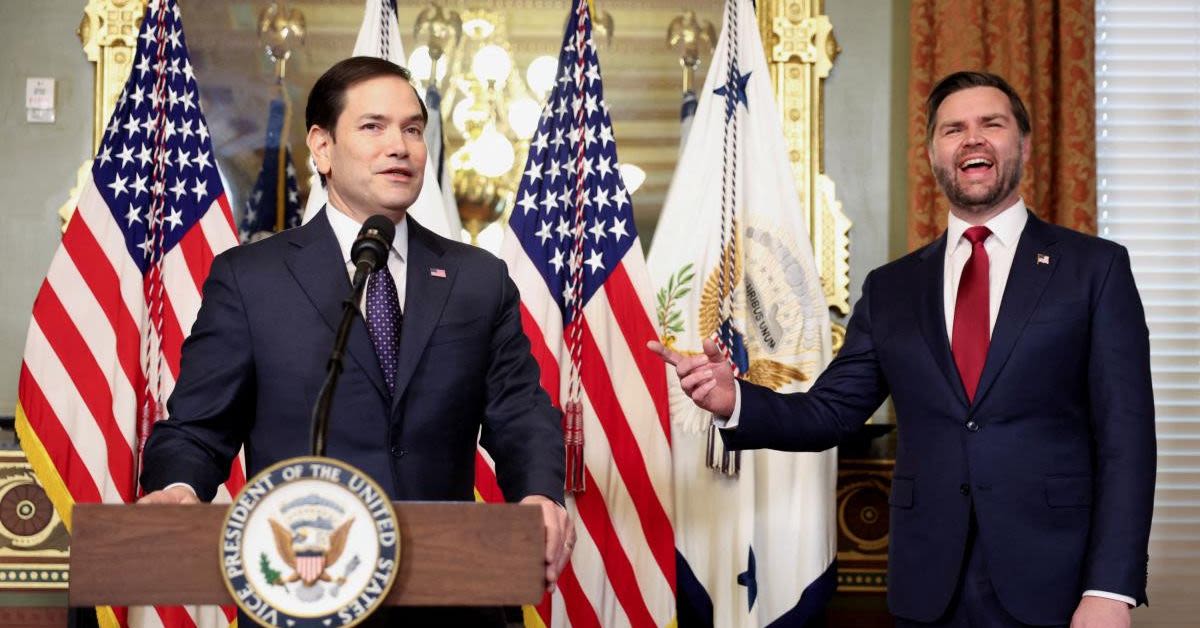
As the 2026 midterm elections draw closer, Republicans are already casting their eyes toward the looming 2028 presidential contest and the emerging fault lines within their own party.
New polling from the University of New Hampshire Survey Center highlights a tightening race in the critical early primary state, according to The Post Millennial. While Vice President JD Vance still leads the prospective GOP field, the survey shows Sen. Marco Rubio rapidly gaining ground and transforming what once looked like a coronation into a genuine contest.
The poll finds that the vice president currently commands 36 percent of the New Hampshire Republican primary vote, with Rubio now just ten points behind at 26 percent. Kentucky Sen. Rand Paul stands at 8 percent, matched by former U.N. Ambassador Nikki Haley, while 6 percent back Florida Gov. Ron DeSantis, 4 percent support former Director of National Intelligence Tulsi Gabbard, and 2 percent favor Louisiana Sen. John Kennedy, with all other candidates registering below 2 percent.
This represents a dramatic shift from the same survey conducted in February, when Vance was commanding more than 50 percent of the state's Republican support compared to Rubio's 7 percent. The erosion of Vances once-dominant lead underscores how quickly the intra-party debate over foreign policy and Americas role abroad is reshaping the Republican landscape.
Rubios surge coincides with his increasingly visible role in the administration, particularly on Iran and broader foreign policy matters. From the White House, Rubio has pressed for a tougher, more assertive posture toward Tehran, aligning himself with the traditional GOP hawkish wing that favors projecting American strength to deter adversaries.
Vance, by contrast, has become the administrations other prominent face on the Iran conflict, taking the lead in negotiating a USIran memorandum of understanding (MOU) intended to halt hostilities. That effort has faltered as bombing has resumed, leaving the agreement in tatters and raising questions among conservatives about the wisdom of diplomatic concessions without ironclad enforcement.
The ideological divide between the two men was laid out by Michael Rubin, a senior fellow at the American Enterprise Institute, who described them as avatars of competing Republican worldviews. At their core, they represent different strains Before taking office last year, Vance frequently criticized foreign wars as a waste of lives and money, Rubin explained, adding, Rubio made a name for himself as a hawk in the Senate, where he pushed for a more confrontational stance toward Iran, Russia, and Cuba. Both men are seen as potential successors to Trump and are the product of powerful, competing constituencies within the Republican Party. On one side are neoconservatives whose adherents are more likely to advocate for foreign intervention. On the other are Republican voters and policy professionals who argue that many recent foreign wars were costly and reckless.
That tension has spilled into conservative media, where Vance has faced mounting criticism over his handling of the MOU. Ben Shapiro, one of the most influential voices on the right, has blasted the agreement as a failure and repeatedly labeled it JDs deal, signaling that responsibility for its shortcomings rests squarely with the vice president.
Yet Vance is not without allies inside the party, particularly among those who favor restraint abroad and negotiated settlements over open-ended conflict. Sen. Rand Paul, long a champion of a more limited foreign policy, backed the MOU as it was being crafted and argued, Im in favor of trying to end the war and I think negotiations is the way it will end. I think its a good idea to get the Strait of Hormuz open as soon as possible. It appears to me the trade has been: We stop blockading them and they stop blockading us. So I think thats a good idea.
Hovering over the entire contest is President Donald Trump, whose endorsement remains the most coveted prize in Republican politics. Trump has so far refused to tip his hand, but he has floated the possibility that the two rivals could ultimately join forces on a unity ticket in 2028, rather than tear the party apart in a bruising primary.
I dont know how you beat them if theyre together, he said of Vance and Rubio in a June interview with Pod Force One, a remark that encapsulates both the strength of the two men within the GOP and the stakes of the foreign-policy debate now unfolding inside the party. As Republicans weigh whether they want a more confrontational or more restrained approach abroad, the evolving VanceRubio rivalry is fast becoming a proxy for the broader struggle over the future direction of conservative leadership.
Login