
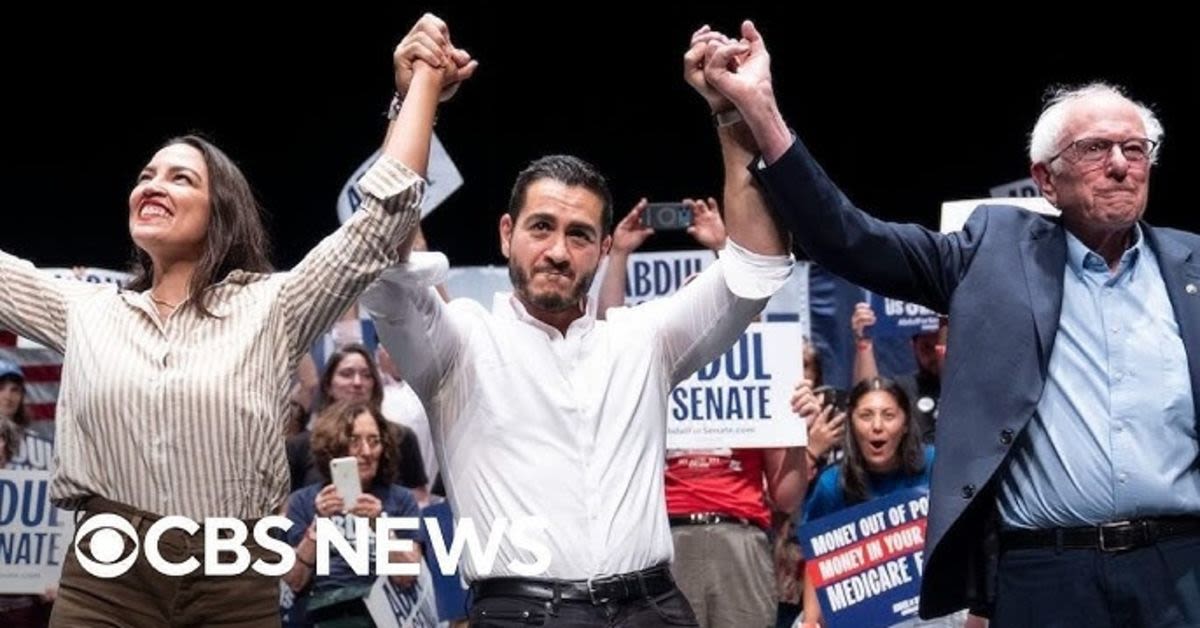
New York Democratic Rep. Alexandria Ocasio-Cortez appears to have gone out of her way to avoid being publicly associated with a far-left Michigan congressional hopeful whose own words have ignited a firestorm on the left.
According to Western Journal, Ocasio-Cortez traveled to Michigan over the weekend for what Politico described as a three-city swing on behalf of Michigan Senate candidate Abdul El-Sayed and controversial Michigan congressional candidate William Lawrence. Yet when she took the stage in Lansing to promote the two men, she conspicuously refused to even mention Lawrence by name, according to David Sivak of the DC Examiner.
The New York lawmaker then reportedly exited the event early, skipping what Politico called a hand-hoisting curtain-call photo-op with Sen. Bernie Sanders, El-Sayed, and Lawrence. For a politician who rarely shies away from the cameras, her absence from the closing tableau raised immediate questions about political calculation and damage control.
Critics and observers on the left and right alike strongly suspect her snubbing of Lawrence was deliberate rather than accidental. Lawrence, himself a progressive, has come under intense fire for past comments attacking older black political leaders, most of whom are Democrats and long considered a core pillar of the partys base.
According to HuffPost, Lawrence made the controversial remarks during a 2024 episode of his podcast, Hegemonicon. The extent to which the older generation of black political leadership are such a pillar, frankly, for establishment, capitalist, imperialist American power through their role as this kind of traditionalist, establishment-ist pillar of the Democratic Party, its a big problem, he said at the time.
He went even further, arguing that these leaders undermine the broader left-wing project. Its a big problem for left politics in this country. And it gets us every single time. It really defangs the white left and puts us in impossible positions, really, he added.
Those remarks recently went mega-viral, triggering outrage from black leftists who are typically aligned with candidates like Ocasio-Cortez and Sanders. Facing a backlash from within his own ideological camp, Lawrence posted on X on July 11 to express regret for his earlier comments, an apology that has done little to quell the controversy.
Observers now suspect Ocasio-Cortezs decision to distance herself from Lawrence is rooted in cold political math rather than ideological disagreement. With 2028 looming as the next open presidential cycle, they argue she is keenly aware that alienating black voters a crucial Democratic voting bloc could cripple any future national ambitions.
This episode unfolds as many on the left are openly encouraging Ocasio-Cortez to seek the White House, or at least to position herself as a leading contender. New York City Assemblyman Zohran Mamdani and other progressives have either directly called for her to run for president or signaled strong support for a potential candidacy, reflecting the lefts desire to push the Democratic Party even further in a socialist direction.
Not everyone in the Democratic establishment shares that enthusiasm, however, and some veterans are blunt about her prospects. Longtime Democratic strategist James Carville, speaking on the Greta Wire podcast and cited by the New York Post, offered a backhanded compliment that underscored the skepticism among party elders.
I think AOC is remarkably talented, let me be very clear about that, Carville said Thursday on the program. Her staff work is pristine. But shes not gonna run for president because shes not gonna have any chance.
For Ocasio-Cortezs critics, Carvilles assessment dovetails with their belief that she is especially not gonna have any chance if she stumbles with black voters before a national campaign even begins. Her apparent effort to sidestep a photo-op with William Lawrence, while still embracing the broader progressive agenda, suggests she understands that the Democratic Partys identity-politics coalition can be unforgiving when its internal hierarchies are challenged, and that even the lefts rising stars are now carefully calibrating their alliances to avoid crossing a base they cannot afford to lose.
Login