
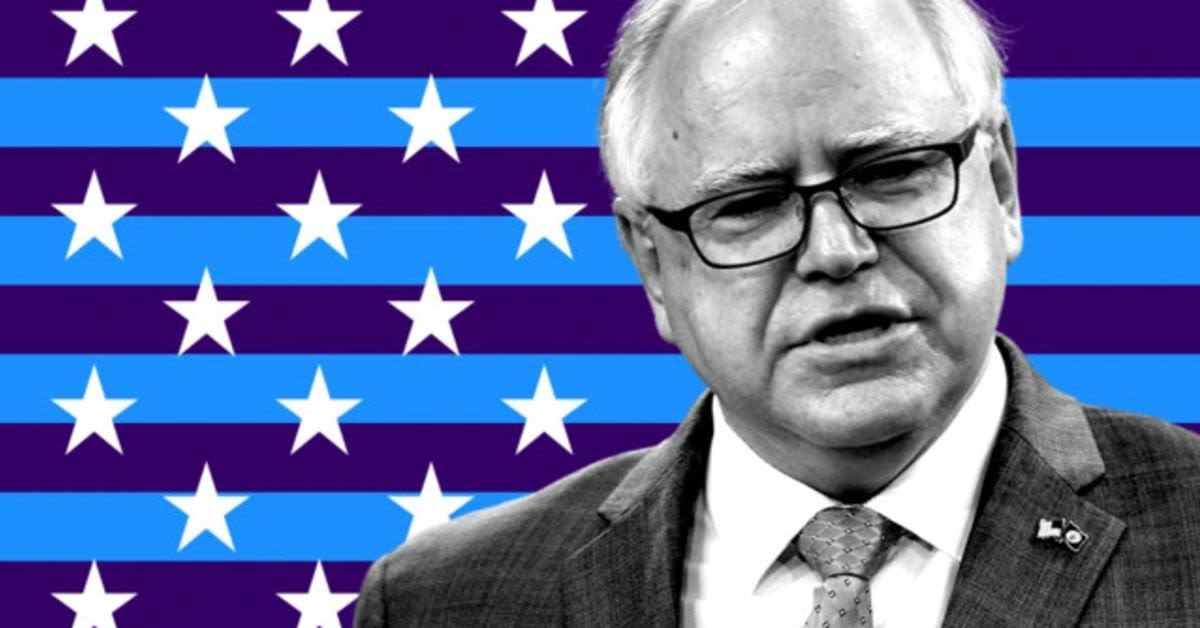
A convicted child rapist whose crimes shocked Minnesota has finally been deported to his native Laos, but only after federal intervention overruled a controversial pardon issued by Democratic Gov. Tim Walz.
According to Western Journal, the case of Tou Lue Vang a man who admitted to repeatedly raping a 10-year-old girl has exposed a disturbing clash between progressive leniency and basic public safety. The states largest newspaper, the Minnesota Star Tribune, has now gone so far as to praise Walz for his role in trying to keep Vang in the United States, even as federal authorities moved to revoke his legal status and remove him from the country.
Vangs crimes were not in dispute.
He told investigators that he raped the child because, in his culture, such conduct was considered normal, reportedly describing the abuse as a mistake, but a minor thing, language that suggested he viewed the repeated rape of a pre-pubescent girl as little more than a trivial misstep.
The fact that a man capable of such depravity remained in the United States for years without being removed is troubling enough.
Yet the real controversy erupted only this year, when a long-delayed removal order finally came into play and Minnesotas Democratic leadership responded not by supporting deportation, but by extending mercy to the offender.
Despite having initially received a 12-year state prison sentence, Vang ultimately served only about eight months in a county facility.
In the years that followed, he remained in the United States, started a family, and built a life that his defenders would later cite as a reason to shield him from the immigration consequences of his crimes.
When his case came before the Minnesota Clemency Review Commission, the panel voted 4-2 to recommend a pardon.
That recommendation was then adopted unanimously by the state Board of Pardons Gov. Walz, Democratic Attorney General Keith Ellison, and state Supreme Court Chief Justice Natalie Hudson, a Walz appointee, all agreed to wipe away the conviction for purposes of state law.
In explaining the decision, the head of the Clemency Review Commission emphasized the support Vang had received from those closest to the case.
The victim supports this pardon. His [Vangs] wife stayed and has forgiven. He also [has] immigration concerns. He has remorse and was discharged from probation, she said in her decision, framing the pardon as an act of compassion grounded in rehabilitation and family stability.
The Trump administration, however, was not persuaded by Minnesotas attempt to recast a convicted child rapist as a sympathetic figure.
Federal authorities moved to terminate Vangs legal status, and he was ultimately deported to Laos after intervention from Secretary of State Marco Rubio.
The White House at the time made clear that, under President Donald Trump, public safety and immigration enforcement would not be subordinated to progressive clemency politics.
Under President Trump, criminal illegal aliens who rape children will be found, arrested, and removed and Democrat politicians will not stand in the way, a White House statement read, underscoring a stark contrast between federal priorities and Minnesotas leadership.
Gov. Walz reacted angrily to Vangs removal, casting the deportation as an act of cruelty rather than justice.
Did that make us any safer? Did that make the children that are left behind any more stable? Walz said at a media briefing, suggesting that the deportation harmed Vangs family without delivering meaningful benefits to the public.
Walz went further, attempting to universalize Vangs situation into a broader moral lesson about human fallibility.
Did it improve the idea that we cant all be judged by our worst day? And I want to be very clear, Walz added, These are horrific crimes. They often are.
The governors rhetorical questions invite a straightforward response.
Yes, the country is safer with one fewer convicted child rapist within its borders, and yes, there is a compelling moral and legal argument that individuals must sometimes be judged by their worst actions, particularly when those actions reveal a capacity for extreme harm and a willingness to prey on the most vulnerable.
Walzs decision to back the pardon, especially in the waning days of his tenure, amounted to a classic lame-duck maneuver that prioritized ideological commitments over public safety.
Yet rather than condemn this indulgence, at least one influential voice in Minnesota media chose to celebrate it, revealing just how deeply progressive sensibilities have penetrated the states journalistic establishment.
In its Cheers and Jeers section on Friday, the Minnesota Star Tribune offered a remarkable defense of Walzs actions.
The item, attributed to reporter Rochelle Olson and presumably vetted by editors, read as follows: Cheers to Gov. Tim Walz: The governor refused to back down from his vote to pardon a Hmong man convicted of felony sexual assault in 2006. Its significant that Tou Lue Vang needed only two of three votes from the state Board of Pardons, but he received unanimous support. In addition to Walz, the board includes Attorney General Keith Ellison and state Supreme Court Chief Justice Natalie Hudson. Before her vote, the chief cited the letter of support for Vang submitted by the assault survivor. Also, Vang had not committed additional crimes in the past two decades. The Pardons Board makes weighty, life-changing decisions after studying the cases and history. In this case, Vangs pardon made him a political punching bag. Secretary of State Marco Rubio deported him to Laos. Vangs actions 20 years ago were awful, but so were the violent protests at the U.S. Capitol on Jan. 6, 2021, and those folks received presidential pardons. Of the deportation, Walz said, And by just picking them up and taking them out with no due process, it just seems unfair. Cheers to Walz for standing behind the pardon.
Each element of that defense reveals a troubling hierarchy of values.
The Star Tribunes framing reduces Vangs conduct to felony sexual assault and actions 20 years ago, glossing over the reality that he repeatedly raped a 10-year-old child conduct that modern criminology consistently identifies as among the most dangerous and recidivist forms of criminal behavior.
The newspaper also treats the unanimity of the Board of Pardons as if it were a mark of broad-based consensus.
In reality, the board consists of two partisan Democratic officeholders and a chief justice appointed by one of them, hardly a cross-section of Minnesotan opinion, and certainly not a neutral body insulated from ideological leanings.
The Star Tribune further notes that Vang had not committed additional crimes in the past two decades, as if the absence of known new offenses somehow mitigates the gravity of his original crimes.
Even if one accepts that he has not reoffended, the more obvious point is that those decades should have been spent in Laos, not in the United States, and certainly not under the protection of a gubernatorial pardon.
Most striking, however, is the attempt to equate Vangs crimes with the events of Jan. 6, 2021.
Vangs actions 20 years ago were awful, but so were the violent protests at the U.S. Capitol on Jan. 6, 2021, and those folks received presidential pardons, the Star Tribune item declared, invoking the Capitol unrest as a kind of moral counterweight to child rape.
This rhetorical move is emblematic of a broader progressive reflex: when confronted with indefensible conduct by someone they wish to shield, they pivot to Jan. 6 as an all-purpose moral cudgel.
Yet the comparison collapses under scrutiny, not least because the Jan. 6 defendants were American citizens, many of whom were arguably overcharged by a politicized Department of Justice for conduct that, in some cases, amounted to little more than chaotic trespass.
By contrast, Vang was an immigrant who had already received what many would regard as a lenient sentence for an extraordinarily serious crime.
He was then granted a politically charged pardon by Democratic officials who appear more committed to the slogan no person is illegal than to the principle that foreign nationals who rape children forfeit any claim to remain in the United States.
The Star Tribunes attempt to cast Vang as a political punching bag ignores the obvious reality that he became a political flashpoint only because state leaders chose to extend extraordinary mercy to a man whose actions placed him beyond the pale in the eyes of most Americans.
It was not his critics, but his defenders, who turned his case into a symbol a symbol of progressive indulgence toward even the most heinous offenders, so long as they fit a preferred narrative.
Walzs complaint that Vang was taken out with no due process is similarly misleading.
Of the deportation, Walz said, And by just picking them up and taking them out with no due process, it just seems unfair, the Star Tribune quoted, as if the governor were unaware that immigration proceedings, removal orders, and federal review constitute precisely the kind of legal process that governs such cases.
What this episode ultimately reveals is a profound divergence between conservative and progressive understandings of justice, responsibility, and the role of the state.
From a conservative perspective, the first duty of government is to protect its citizens especially children from predators, not to bend over backward to preserve the residency of a foreign national who has already demonstrated a willingness to destroy a childs life.
The Trump administrations decision, carried out with the assistance of Secretary of State Marco Rubio, reflects that priority.
By revoking Vangs legal status and deporting him, federal authorities did what Minnesotas leadership refused to do: they placed the safety of American communities above the ideological comfort of progressive politicians and sympathetic editorial boards.
Walz will leave office next January, but the political and cultural forces that produced this scandal are not going anywhere.
Minnesotas Democratic establishment remains firmly entrenched, and the same can be said for the progressive sensibilities that dominate newsrooms such as the Minnesota Star Tribune, where even a convicted child rapist can be recast as a victim of political attack when his long-overdue deportation finally arrives.
Login