
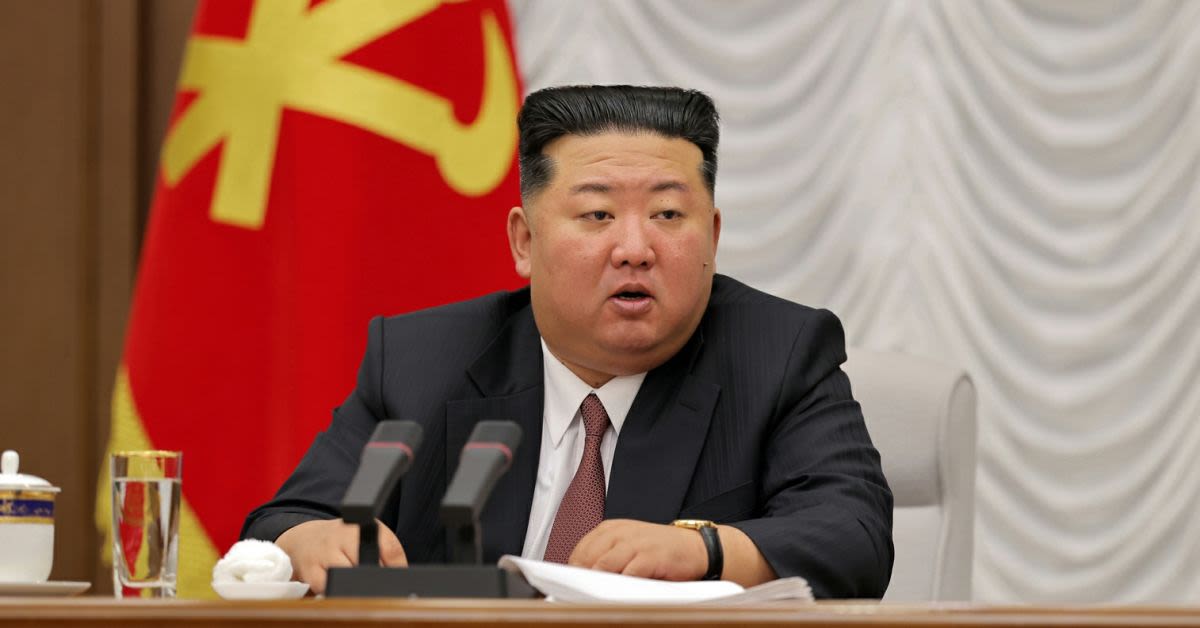
North Korean dictator Kim Jong-un has once again placed his outlaw nuclear weapons program at the center of regime policy, chairing a high-level military commission meeting on Thursday to demand improvements in both the quality and quantity of his arsenal.
According to Breitbart, the gathering of the Central Military Commission of the ruling Workers Party, reported by the state-run Korean Central News Agency (KCNA), allowed Kim to lecture his top commanders on the need for bringing about a qualitative change in strengthening the combat readiness of the army units at all levels. Kim, who has long justified his nuclear buildup as a supposed deterrent against the United States and South Korea, used the session to reinforce his demand for more numerous and more powerful nuclear weapons, despite crippling sanctions and chronic domestic shortages.
American intelligence estimates that the communist regime already holds roughly 50 nuclear warheads and will possess enough fissile material to construct up to 90 additional bombs by 2025. The United Nations International Atomic Energy Agency (IAEA) has repeatedly sounded the alarm over Pyongyangs accelerating nuclear work, stressing that the program is advancing without any international inspections, transparency, or basic safety oversight.
KCNA described the latest meeting as a forum where senior military officials examined how to upgrad[e] the technical infrastructure of combat systems, bolstering up the nuclear force both in quality and quantity, and pushing ahead with the plan for standardizing, specializing, and modernizing military bases in a far-sighted way. The regimes focus on modernizing its bases and systems underscores that, even as ordinary North Koreans struggle with food and energy shortages, the dictatorship continues to prioritize weapons of mass destruction and elite military infrastructure.
Officials at the session also reportedly discussed ways to improve training for rank-and-file soldiers and to enhance the quality of both military camps and educational institutions. Such efforts, framed as professionalization of the armed forces, serve the dual purpose of tightening regime control and ensuring that Kims nuclear threats are backed by a disciplined, loyal military machine.
Saying that the prestige, honour, and destiny of socialist Korea are unthinkable apart from the powerful defence capabilities, KCNA reported, Comrade Kim Jong-Un stated that the security and peace of the country and the people cannot be defended with the will alone and that only when we build the strong army and control all and contain threats with its powerful strength, can we achieve the true peace. In typical fashion, Kim portrayed his nuclear buildup as a defensive necessity, even as he continues to flout international law and destabilize an already volatile region.
The state media dispatch offered no concrete details on how Pyongyang intends to upgrade training, improve performance, or technically expand its nuclear stockpile. That lack of transparency is consistent with the regimes longstanding strategy of secrecy and strategic ambiguity, which it uses to keep adversaries guessing while extracting concessions from a risk-averse international community.
Kim has repeatedly declared that rapidly increasing the volume of nuclear material for military use is a central priority of his rule. At a Workers Party plenary meeting in June, he went further, casting his nuclear ambitions as a response to Western and allied ideologies, insisting that North Koreas nuclear capabilities were needed to confront America first ideology and Zionism.
Today, the world is witnessing rampant ultra-nationalism of modern version such as America First idea, Zionism, Ukrainian Neo-Nazism, and Japanese militarism, Kim told his loyalists, arguing that the global environment required North Korea to thoroughly exercise the position of a nuclear weapons state. By lumping mainstream conservative American policy, support for Israel, and opposition to Russian aggression into a single hostile bloc, Kim signaled that his nuclear program is not merely defensive but ideologically driven and aimed squarely at the West and its allies.
According to state media, Kim used that same June meeting to reiterate that the regime must steadily expand and strengthen the nuclear forces, the core of the military sovereignty of the DPRK [North Korea], and the pivot of implementing the strategy for deterring or fighting a war. His rhetoric leaves little doubt that Pyongyang views nuclear weapons not only as a shield against perceived threats but also as a tool to coerce neighbors and challenge the U.S.-led security architecture in Asia.
Kims relentless push to grow his nuclear arsenal has deeply unsettled international observers, who see a rogue regime with growing capabilities and no meaningful checks. In May, IAEA Director-General Rafael Grossi warned that North Korea had made a very serious increase in the area of nuclear weapons production, which is estimated at a few dozen warheads, a sobering assessment delivered during a visit to South Korea.
Grossi acknowledged that the IAEA lacks direct access to North Korean facilities because Pyongyang has barred U.N. inspectors from the country, but he noted that satellite imagery strongly suggests large-scale production of fissile material. His comments reflect a broader concern that, in the absence of inspections, the world is effectively blind to the full scope and safety of North Koreas nuclear activities.
In April 2025, Grossi had already cautioned that North Koreas nuclear material production was off the charts and should be treated as a pressing global issue. It has spawned exponentially, he observed. The program is no longer, you know, the complex at Yongbyon. Its Kangson. Its other places also in the country. Its a light water reactor. Its a second and perhaps a third enrichment facility being built at the moment. Its a reprocessing campaign, which is ongoing as we speak. And theres, you know, a nuclear arsenal that exists.
I mean, you cannot have a country like this, which is completely off the charts with this nuclear arsenal, he lamented. With such a big program, nuclear program, with all these facilities, without us having any clue of any safety or security measure which is being applied to it. For policymakers who believe in a rules-based order and responsible stewardship of nuclear technology, North Koreas defiance underscores the danger of appeasing dictatorships that reject transparency, human rights, and basic international norms.
Login