
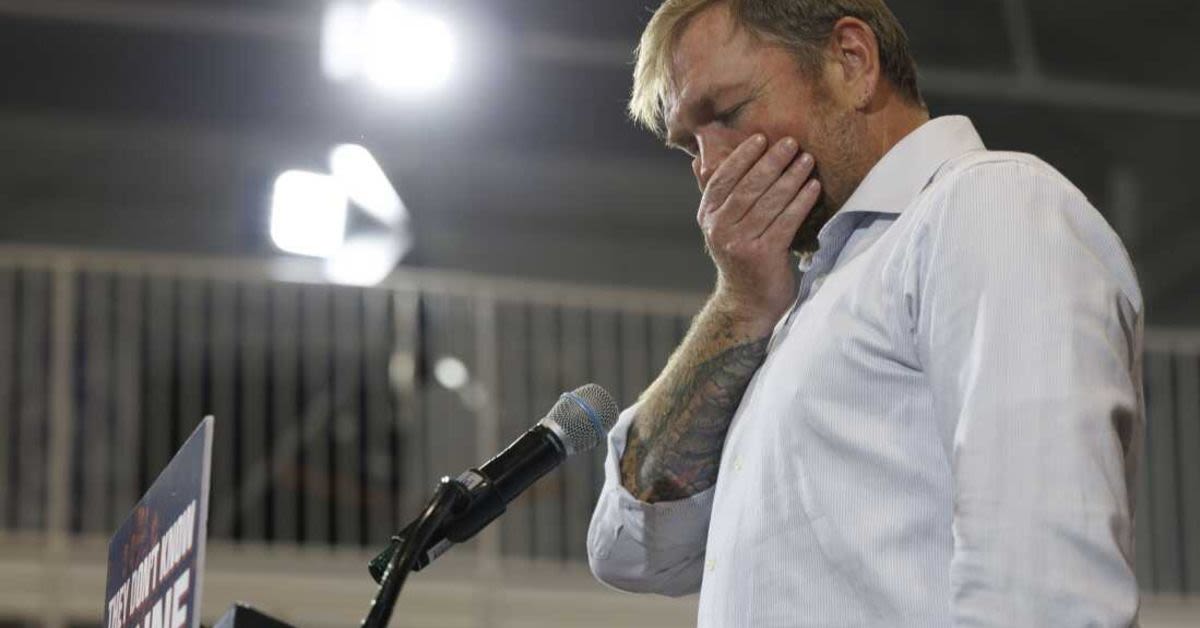
Disgraced Democratic Senate candidate Graham Platner managed to further tarnish both his own reputation and that of his party on Friday afternoon, turning what should have been a swift political exit into a showcase of progressive moral bankruptcy and personal narcissism.
For most casual observers, the Platner saga appeared to have ended days earlier. As reported by Western Journal, the Maine Democrat a self-styled outsider and hobbyist oysterman had already released an 11-minute video on Wednesday night announcing he was suspending his campaign, just 48 hours after being publicly accused of rape by a fellow Democrat, a development that denied his party the usual excuse of blaming right-wing smears.
That video, however, did not remove his name from the November ballot. Under Maine law, a candidate must submit a written request by a specific deadline in this case, Monday to formally withdraw, and Platner conspicuously failed to do so even as his rambling video cast him as the victim of shadowy forces and took no responsibility for anything.
Once journalists noticed that the performative video had not been followed by the legally required paperwork, questions began to mount. Axios reported Thursday that Platner had informed his campaign team he intended to file the withdrawal documents on Monday, a timing that looked suspiciously like either cynical brinkmanship or the last maneuver of a man determined to manipulate the process to the bitter end.
Though Democrats largely appear to think Platner is done with his bid, his last-minute timing is likely to cause a final pang of anxiety within the party, Axios reported. Platner allies have described his comments as parting wishes, not hostage-taking, the outlet added, though the distinction seemed more semantic than substantive given the stakes and the timing.
Whether it was internal party pressure, legal advice, or the same shadowy forces Platner had invoked in his original withdrawal video, something clearly pushed him to accelerate his timetable. Just before the weekly news cycle wound down, at 4:41 p.m. Eastern on Friday, Platner posted what appears to be his formal written withdrawal request on social media, finally triggering the process to remove his name from the ballot.
If this was the cleaned-up, rushed version of his parting wishes, one can only imagine how much more inflammatory the letter might have been had he taken until Monday to polish it. Even in this truncated form, Platner again refused to accept any accountability, failed to mention his would-be opponent, Republican Sen. Susan Collins, and instead used his exit to deliver a vulgar shot at Immigration and Customs Enforcement, a slogan for free Palestine, and an obscure cheer for a local soccer club.
The letter also featured a familiar theme: Platners own self-regard. On June 9th, 156,084 Mainers voted for a new kind of politics. One that is representative of people down here in the real world not billionaires, oligarchs, or the political establishment. Mainers voted for Medicare for All; to ban billionaires from buying elections; and for an end to taxpayer-funded genocide and forever wars. They voted for time and dignity; for strong unions and jobs they can raise families on; for the hope of buying a home; for the chance to retire with grace.
Platners rhetoric, steeped in the usual progressive talking points, conveniently omits the uncomfortable reality that those same voters also backed a man now bearing a Nazi tattoo, facing credible accusations of partner abuse, boasting a history of blackout drinking, and leaving behind a toxic social media trail and a record of misrepresentations too extensive to catalog. The movement he praises so lavishly is the same movement that either failed to vet him or chose to ignore glaring red flags in the name of ideological purity.
His formal notice of withdrawal, like his earlier video, still managed to center himself as the heroic vessel of the peoples will. My name may have been on the ballot, but that ballot line belongs to the people of Maine. As such, please consider this notice as my official withdrawal from consideration for this office, he said, framing his exit not as a necessary consequence of his own alleged behavior but as a noble act of deference to the electorate.
Then came the coda that revealed more about his character and his politics than any of his lofty rhetoric. But that wasnt the end: F*ck ICE. Free Palestine. Up the Hearts. In three short phrases, Platner managed to insult federal law enforcement, align himself with the radical anti-Israel left, and toss in a niche cultural reference that underscored how unserious he remains even as his public life collapses.
The last phrase, Up the Hearts, is a nod to a documentary series about Maines professional soccer team, the Portland Hearts of Pine. It is the sort of inside-baseball reference that might amuse a small circle of local fans but sits jarringly alongside a resignation letter prompted by a credible rape allegation, making the entire message feel more like a social media stunt than a sober acknowledgment of gravity.
The flippancy is striking when contrasted with how a responsible adult might handle such a moment. Most people, faced with the need to resign from a public role under the cloud of a serious accusation, would at least attempt to express remorse, acknowledge harm, or apologize for poor judgment, rather than using the occasion to shout out a favorite team as if signing off from a podcast with Go New York, Go New York, Go!
His Free Palestine line, coming from a man in his position, does the pro-Israel cause an unintended favor. And of course, Free Palestine. Coming from a man as disgraced as Platner, thats the biggest piece of pro-Israel advertising I can remember, the original commentary observed, and it is difficult to argue with that assessment when the slogan is attached to someone whose credibility has imploded so spectacularly.
The attack on Immigration and Customs Enforcement is equally revealing. And F*** ICE? Again, aside from great advertising for immigration enforcement, I cant better the point made about the asterisking made by Jeff Blehar of National Review about the ridiculousness of this, the piece noted, underscoring how Platners attempt at edgy radicalism collapses into self-parody when paired with his own scandal.
As Blehar pointed out, the coy use of an asterisk in F*ck ICE is almost comical given the gravity of the allegations against Platner. To be fair: Allegedly wholeheartedly drunkenly raping a woman. But otherwise, the point stands. If youre already going out of the race being known as an accused rapist, putting an asterisk in there will not help your reputation in posterity. Sorry.
What is most striking about Platners letter is not what he says, but what he leaves out. There is no expression of remorse toward the woman who has accused him, no apology to supporters he misled, no acknowledgment of the damage he has done to his party, and no sense of responsibility toward the voters of Maine whom he claims to revere.
Equally absent is any serious focus on the ostensible political mission that justified his candidacy in the first place. There is no call to defeat Sen. Susan Collins, no rallying cry to ensure that his seat goes to another Democrat, and no substantive argument about policy or governance; if anything, the tone suggests he would not be particularly troubled to see Collins return to Washington, a rare point of agreement between Platner and many conservatives.
Instead, the letter is a monument to Platners self-image and to the progressive movements tendency to elevate personality over principle. It is all about how great his campaign supposedly was, how the movement will endure beyond him, and how he is magnanimously surrendering a ballot line that belongs to the people of Maine, while reminding everyone that those people had already chosen him once.
Even in the act of finally doing what he should have done days earlier formally withdrawing from a race he had already publicly abandoned Platner managed to expose the hollowness at the core of the progressive project that embraced him. When the left has the opportunity to vet its own candidates, it too often looks the other way, provided the rhetoric is sufficiently radical and the target is the establishment.
Party officials and activists cannot credibly claim they were blindsided by the nature of this candidate. They had to have known, at some point, that this man was a sociopathic narcissist who would tell them anything to get his name on the Democratic Party line in November. And they were cool with that. This last parting salvo is exactly who they knew Graham Platner was which is the lesson that ought to stick with us, not any Up the Hearts nonsense.
Platners exit, far from closing the book on an embarrassing episode, raises deeper questions about the priorities and judgment of a political movement that preaches moral superiority while tolerating, and even celebrating, deeply flawed standard-bearers. Voters in Maine and across the country would do well to remember that the same ideological machine that now scrambles to distance itself from Graham Platner once held him up as the embodiment of its values, and that his final, vulgar sign-off is not an aberration but a revealing snapshot of what lies beneath the slogans.
Login