
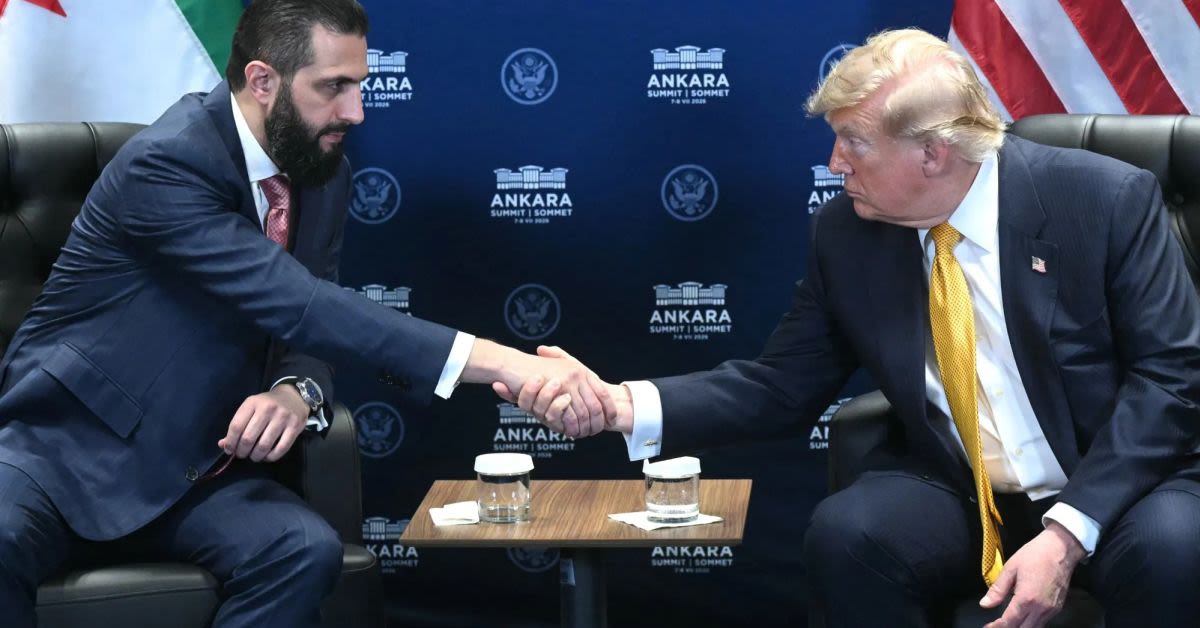
President Donald Trump used a high-profile NATO summit in Ankara, Turkey, to signal a dramatic shift in U.S. policy toward Syria, announcing that he is prepared to remove the war-torn nation from Washingtons list of state sponsors of terrorism.
The development came after Trump held a bilateral meeting with Syrian President Ahmed al-Sharaa, who assumed the transitional presidency following the collapse of the Assad regime in December 2024. As reported by RedState, al-Sharaa previously led Hay'at Tahrir al-Sham, the rebel faction that ultimately toppled Bashar al-Assad, and has since positioned himself as the face of a post-Assad Syria seeking international legitimacy.
Trump, who has long favored bold, disruptive moves in foreign policy, made his intentions clear when pressed by reporters at the summit. When asked, Are you going to remove Syria from the state-sponsor of terrorism list? the president responded without hesitation: I think I will, yeah... Why wouldn't I? He's done a great job.
Shortly after the meeting, the administration moved from rhetoric to action. U.S. President Donald Trump has notified Congress of his decision to rescind Syrias designation as a State Sponsor of Terrorism, a senior U.S. administration official said on Wednesday.
Under U.S. law, the decision cannot take effect immediately, and Congress now has a 45-day window to review and potentially challenge the move. The step follows Trumps earlier decision in June 2025 to terminate the most severe sanctions against Syria, a clear indication that the White House has been laying the groundwork for a broader realignment.
Trump framed the policy shift in cultural and historical terms, casting Syria as a once-great civilization that deserves a chance to recover from decades of dictatorship and war. Syria had one of the great cultures the professors and lawyers and doctors it had one of the great cultures of any country, not just the Middle East, and then it went through this terrible period of time.... They're proud of the job he's done, Trump said during his meeting with al-Sharaa.
The presidents remarks underscored a familiar conservative theme: that nations should be judged not only by their past failures but also by their willingness to reform and align with Western interests. At the same time, the administration is not blind to the lingering dangers in the region, acknowledging that the evil threat of ISIS still remains despite the fall of Assad and the territorial defeat of the so-called caliphate.
Why, then, extend such a significant diplomatic olive branch to a country long associated with instability and terror networks? According to the U.S. Embassy in Syria, the move is part of a broader strategy to stabilize the Middle East while advancing American interests and maintaining a hard line against terrorism.
GIVING SYRIA A CHANCE TO SUCCEED: President Trump is committed to supporting a Syria that is stable, unified, and at peace with itself and its neighbors. The embassy further emphasized that President Trump wants Syria to succeedbut not at the expense of U.S. interests.
The administration laid out specific benchmarks that will guide this cautious reengagement. While seeking to reengage constructively, this Administration will continue to guard against all threats and monitor progress on key priorities: taking concrete steps toward normalizing ties with Israel, addressing foreign terrorists, deporting Palestinian terrorists and banning Palestinian terrorist groups, helping the United States prevent a resurgence of ISIS, and assuming responsibility for ISIS detention centers in northeast Syria.
In a statement highlighting the potential upside of this policy shift, the administration cast the move as both historic and conditional. Today @POTUS informed Congress of his intent to rescind Syrias designation as a State Sponsor of Terrorism. This historic step opens new possibilities for economic opportunity and recovery, giving the Syrian people a chance at greatness.
For conservatives who favor a strong America that uses leverage rather than endless military entanglements, the approach reflects a blend of realism and opportunity. A stable, pro-Western Syria that normalizes relations with Israel, cracks down on jihadist elements, and distances itself from Iranian influence would mark a significant strategic win after decades of mismanagement and failed interventions.
The contrast with the Assad dynasty could not be starker. From Hafez al-Assads iron-fisted rule beginning in 1971 through Bashar al?Assads brutal tenure from 2000 until his ouster in 2024, Syria was synonymous with repression, a catastrophic civil war from 2011 to 2024, and persistent allegations of support for terrorism.
Whether Congress will ultimately endorse Trumps decision remains to be seen, and whether al-Sharaa can truly transform Syria into a responsible regional actor is an open question. Yet for the first time in years, a country long viewed as a permanent fixture in the Middle East quagmire appears, at least for now, to be edging onto a more hopeful path.
Login