
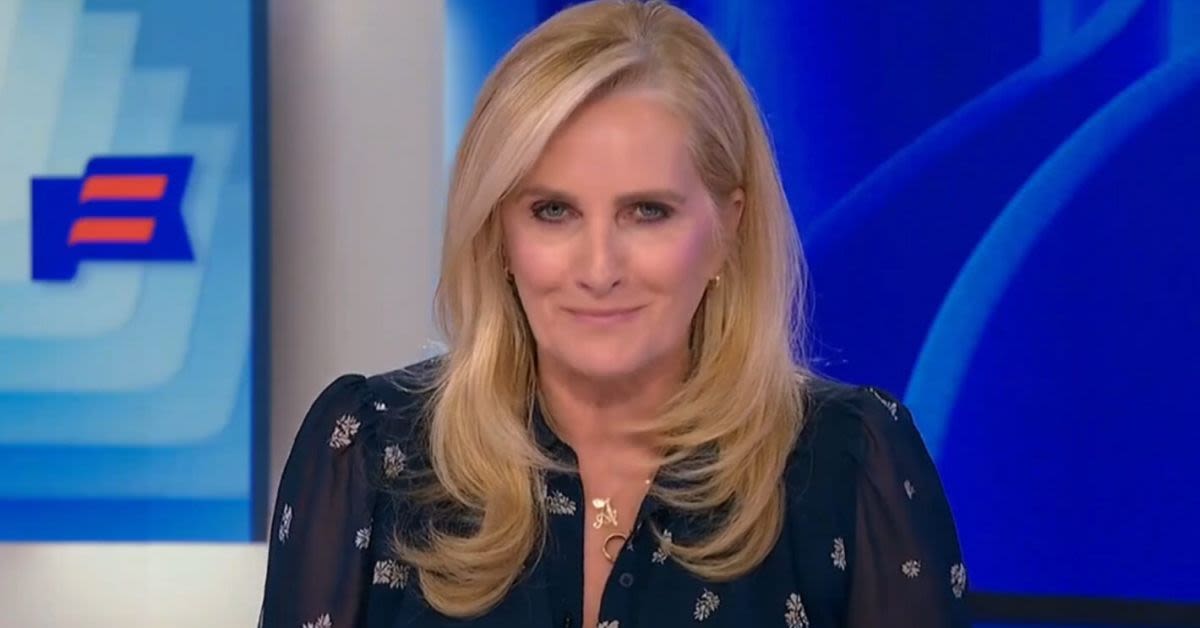
MS NOWs decision to jettison one of its last remaining legacy anchors in favor of taped podcasts is less a bold experiment in innovation than a public confession of decline.
According to Western Journal, the cable outlet now severed from the NBC News corporate structure that once subsidized its ambitions is confronting the harsh economics of a fragmented media landscape and the consequences of its own ideological branding. Once able to rely on a deep-pocketed corporate sugar daddy for both funding and a steady pipeline of news content, the network now finds itself tightening its belt to the point where it is openly signaling that it no longer has Alex Witt money to spend and may resort to airing podcasts on weekend evenings. That is not the posture of a confident news organization; it is the posture of a channel trying to disguise retrenchment as strategy.
According to Variety, MS NOW will part ways with its longest-serving host, Alex Witt, who has been with the network since 1999, when it still operated under the MSNBC banner as a joint venture between Microsoft and NBC. Witt, who has anchored weekend programming since 2011, is being pushed out as the network will move away from featuring live, hosted hours after 6 p.m. on weekends and instead fill its schedule largely with taped video podcasts, expanding its use of a popular Saturday-night program from Crooked Media as well as podcasts hosted by MS NOW mainstays Nicolle Wallace and Chris Hayes. In other words, one of the last vestiges of the channels original news identity is being sacrificed so management can plug in cheaper, pre-recorded content that aligns with the progressive infotainment model it has embraced for years.
Witts exit is being described, predictably, as a mutual decision, though such characterizations in television news are almost always a polite fiction designed to spare both sides embarrassment. Her current program, The Weekend: Primetime, will be canceled, and while the network insists it will maintain live coverage from 1 p.m. to 4 p.m. in her former slot with another MS NOW personality, Antonia Hylton, the broader trend is unmistakable: live, reported weekend news is being hollowed out and replaced with podcast simulcasts. One can only hope, as the original piece wryly noted, that Hylton has some experience in podcasting, because that appears to be the only growth area MS NOWs leadership truly believes in.
Varietys reporting underscores how symbolic Witts departure is for the networks identity and its dwindling connection to its own history. When Witt departs, she will take with her one of MS NOWs last ties to its early history, when it was known as MSNBC and was a joint venture of NBC News and Microsoft. Witts long tenure on weekends, according to one person familiar with the network, comes from a simple achievement: Nothing else MSNBC or MS NOW put on the schedule drew bigger or more reliable numbers than her. After her departure, only Chris Jansing, the veteran anchor who continues to work for MS NOW as a correspondent, will offer similar connections to the past. That is a remarkable admission: the anchor who consistently delivered the most stable weekend ratings is being shown the door just as the network abandons the very format in which she excelled.
MS NOW president Rebecca Kutler tried to frame the move in the familiar corporate language of appreciation and transition, emphasizing Witts long service and the networks supposed gratitude. Witt has been a continued, trusted, and steady presence for our audiences, Kutler said in her memo, citing Witts coverage of the 2003 Space Shuttle Columbia disaster and her reporting from Ground Zero after the Sept. 11 terrorist attacks, among other major events. We thank Alex for her endless contributions to the network and will have more opportunities to celebrate her in the coming months. The words are polished, but they cannot disguise the reality that a trusted, and steady presence is being replaced by taped content and outsourced audio shows.
The tone of Kutlers memo, with its carefully crafted praise and vague promises of future opportunities to celebrate, calls to mind the kind of euphemistic send-off that has become standard in corporate media. The Western Journal piece draws a pointed comparison to the late Anglo-American writer Christopher Hitchens, who once recalled that he left his first media job when his editor said something to me that made it impossible to go on working for him. The full story, Hitchens noted in a footnote, was rather less delicate: Youre fired were the exact words, as I remember them. In the world of MS NOW, that blunt honesty is replaced by a memo about endless contributions and celebrations to come a public-relations gloss on what is, at bottom, a cost-cutting dismissal.
Had Hitchens been dispatched from a weekend desk at MS NOW, the send-off would likely have sounded very much like Kutlers memo, only with a sardonic twist. As the Western Journal writer quipped, those words would doubtless have been, We thank Christopher for his endless contributions to the network and will have more opportunities to celebrate him in the coming months just as soon as he sleeps off this hangover. The joke lands because it exposes the gap between the reality of a firing and the sanitized language used to describe it, a gap that has become especially wide in a media culture obsessed with optics and narrative control.
Mocking MS NOWs troubles might seem like shooting fish in a barrel, given the networks long record of partisan excess and its habit of turning every political story into a morality play with conservatives cast as villains. Yet the networks current predicament is not merely a punchline; it is the logical outcome of a two-decade experiment in ideological branding masquerading as journalism. As the Western Journal notes, MS NOW then MSNBC reinvented itself as the official network of the progressive left years ago, abandoning any serious pretense of ideological balance in favor of a stable of hosts whose primary function was to flatter liberal viewers and demonize Republicans.
Two decades back, the channel went all in on personalities such as Keith Olbermann and Rachel Maddow, who specialized in reducing complex political debates to a juvenile binary in which Republicans and mere liberal Democrats were all a bunch of stupidheads and haha, what a bunch of losers, arent we so much smarter? That posture may have been cathartic for a certain slice of the left, but it was never a recipe for broad-based credibility. It was, instead, a televised echo chamber, one that encouraged viewers to see their political opponents not as fellow citizens with different ideas, but as objects of ridicule.
Olbermann is long gone from the network, but not because his shtick failed to resonate with its audience. As the Western Journal acidly observes, his departures from various outlets have had less to do with ratings than with personality issues that beg for some mental health professional to finally make differential diagnosis from the wide swath of the DSM-5 that could potentially cover the former SportsCenter anchors employment and/or other personal issues. Maddow, by contrast, remains a central figure at MS NOW, still trying to milk the lulz from the same old formula of partisan mockery and conspiratorial framing. The faces have changed over the years, but the underlying model has not.
What MS NOW has effectively built is a televised version of The Daily Show a blend of commentary, snark, and selective outrage but presented under the banner of a news channel rather than a comedy program. For a time, that hybrid model worked well enough, especially during the Bush and Trump years, when progressive audiences were eager for nightly doses of outrage and affirmation. Yet as the Western Journal points out, it worked, until it didnt, and the unraveling of that model is one reason the channel now finds itself operating as an independent entity, stripped of the institutional backing that once insulated it from market realities.
The deeper problem is that the demographic most susceptible to confusing this kind of partisan infotainment with straight journalism no longer consumes media in the traditional cable format. Younger viewers, in particular, have migrated to on-demand platforms, podcasts, and social media, where they can curate their own ideological feeds without sitting through linear programming schedules. Variety, citing data from the Pew Research Center, notes that Younger audiences, in particular, find podcast hosts and digital influencers to be more authentic than traditional TV personnel, and help them understand issues with more depth, according to data from Pew Research. The organization found in 2025 that about 21% of U.S. adults get news from news influencers on social media, with 38% of those between the ages of 18 to 29 doing so regularly compared with just 8% of adults 65 or older. Licensing podcasts from a third party or making use of podcasts already being created by current staff can also serve to keep costs down.
The networks leadership appears to have drawn a simplistic conclusion from this data: if younger audiences trust podcasters and influencers more than traditional anchors, then the solution is to put more podcasts on television. As the Western Journal distills it, the takeaway seems to be, Hey, the kids arent buying this junk anymore. They like Joe Rogan and the Crooked Media pod bros instead. Why dont we just put podcasts on air instead of real news? That logic ignores the central appeal of podcasts: they are on-demand, intimate, and often long-form, consumed when and how the listener chooses, not slotted into a rigid weekend schedule on a struggling cable channel.
Attempting to graft that format onto linear television raises obvious questions about audience behavior and content value. Thatll work great, the Western Journal remarks with heavy irony. What could possibly go wrong taking a format where part of the attraction is the fact that its an on-demand product and putting it on air at a fixed time? The answer, from a conservative perspective, is that very little about this strategy addresses the underlying issues: a credibility deficit, a shrinking cable audience, and a programming philosophy that prioritizes ideological comfort over rigorous reporting.
The decision to replace live weekend news with taped podcasts is, at bottom, a cost-saving maneuver dressed up as a response to changing viewer habits. The network cant afford the extravagances it once could, and losing its corporate patron has exposed just how fragile its business model has become. The people who cant afford Alex Witt money anymore certainly think this is a great idea, and clearly theyve got it all under control, the Western Journal notes with a sardonic edge, before adding a final jab: Say, I hear Keith Olbermann hosts one of them there podcasts, too! Lose one connection to the past, get one back in return? I wouldnt count on it not because of those employability issues, but because even ol Keith knows watching MS NOW is like watching a cancer patient who knows hes not going to make it.
For conservatives who have long viewed MS NOW/MSNBC as a partisan megaphone rather than a serious news outlet, the networks current predicament is less a tragedy than a cautionary tale. A channel that chose to become the official network of the progressive left is now discovering that ideological fervor is no substitute for sustainable economics or genuine journalistic trust. As it sheds veteran anchors, leans on taped podcasts, and clings to a shrinking audience, MS NOW looks less like a robust news organization and more like a brand in hospice care, sustained by habit and inertia rather than vitality or relevance.
Login