
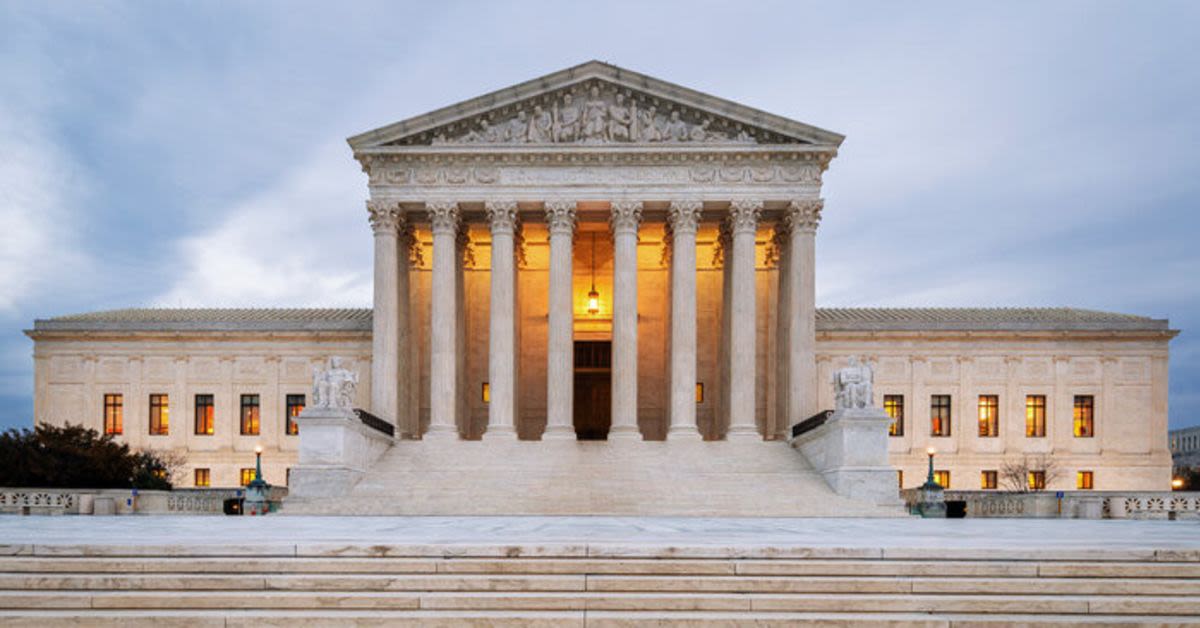
The U.S. Supreme Court has once again rebuked efforts by blue-state lawmakers to sidestep the Constitution, striking down Hawaiis latest attempt to nullify the right to bear arms in public.
In a 6-3 decision, the court on Thursday invalidated Hawaiis 2023 statute that barred carrying firearms onto private property open to the public unless the owner gave explicit verbal or written consent. According to The Blaze, the law, quickly dubbed a vampire law, effectively turned the Second Amendment on its head by presuming that citizens could not carry for self-defense in most everyday locations unless they first secured permission.
The ruling builds on the courts landmark decision four years ago, which held that the Second and 14th Amendments protect Americans right to carry handguns outside the home for self-defense. Hawaiis Democrat-controlled legislature responded to that precedent not by respecting it, but by crafting a workaround that threatened violators with up to a year in prison for carrying on most private property without prior consent.
This sweeping restriction prompted a challenge from three Maui County residents with concealed-carry permits, joined by the Hawaii Firearms Coalition. They relied in part on the argument articulated last year by Solicitor General D. John Sauer, who warned that, "Because most property owners do not post signs either allowing or forbidding guns, Hawaiis default rule functions as a near-complete ban on public carry."
The Supreme Court agreed, reversing a 2024 decision from the San Francisco-based 9th Circuit Court of Appeals that had upheld the law. The majority emphasized that law-abiding permit holders "not only must ... take care to avoid all the territory where the possession of a gun is prohibited outright, but they may also be barred from entering many places that people routinely visit in the course of their daily routines, such as gas stations, restaurants, and stores."
While the justices acknowledged that businesses open to the public retain the right "to admit or exclude persons who are carrying guns for self-defense under either the common-law rule or Hawaiis law," they underscored that the state had inverted the traditional legal presumption. The court noted that the vampire law "flips the default rule at common law, under which anyone has an implied license to enter property held open to the public unless the property owner withdraws consent."
Writing for the majority, Justice Samuel Alito condemned the states approach as fundamentally incompatible with the Constitutions guarantee of armed self-defense. He stressed that the "regime" established in Hawaii "hobbles what the Second Amendment protects: the right of Americans to carry arms for self-defense as they go about their daily lives."
The decision marks another defeat for progressive jurists who have sought to narrow the scope of the Second Amendment through creative legal theories and expansive regulatory schemes. Liberal Justice Ketanji Brown Jackson, joined by Justice Sonia Sotomayor, filed a lengthy dissent that recast Hawaiis restrictions as a benign effort to balance competing interests. At the outset of her opinion, Jackson claimed the state was merely trying "to protect the rights of its residents both those who wish to carry guns and those who prefer that guns are not carried on their private property without their express permission."
Jackson insisted that the law did not meaningfully burden the right to bear arms, asserting flatly, "Hawaii's law does not restrict the right to carry a gun at all." She went further, arguing that the statute "does not implicate the Second Amendment," despite the fact that it required citizens to seek consent virtually everywhere before exercising what the Constitution describes as a right that "shall not be infringed."
Throughout her 32-page dissent, Jackson reiterated her opposition to the courts modern Second Amendment jurisprudence, which she derided as a "grave mistake." She accused the majority of abandoning neutral legal principles, charging that "the court's objective is protecting guns, not consistently preserving any principle of law."
Jackson also suggested that state practice and local custom should carry greater weight than federal constitutional guarantees when it comes to firearms. She emphasized that "recognizing state autonomy in this respect is especially appropriate here, since Hawaii has never had a custom of armed carry," effectively arguing that a lack of historical gun culture in one state can justify curtailing a fundamental right.
Her dissent closed with a pointed attack on her colleagues methodology in evaluating historical analogues for gun regulations. Jackson wrote, "While purporting to constrain judges, the majority has unmasked the discretionary choices that lie beneath the courts decisions regarding which analogues are 'vastly different' ... and whose historical experiences are worthy of inclusion."
Justice Elena Kagan penned a separate dissent, aligning herself with the courts liberal bloc in favor of broader regulatory authority over firearms. Their position, however, failed to persuade the majority, which reaffirmed that constitutional rights cannot be erased by clever legislative drafting or by redefining long-standing legal defaults.
The implications of the ruling extend well beyond the islands, reaching into several Democrat-led states that have adopted similar schemes to chill lawful carry. This decision will reportedly impact a handful of blue states, including New York, Maryland, and California, which took a similar approach to Hawaii by presuming that citizens are disarmed unless explicitly told otherwise.
Gun-rights advocates hailed the outcome as a vital check on states that have treated the Second Amendment as a second-class right. John Commerford, executive director of the National Rifle Association's Institute for Legislative Action, welcomed the ruling, stating, "Law-abiding gun owners will no longer be forced to beg for special permission simply to exercise their constitutional right to bear arms in public places."
Login