
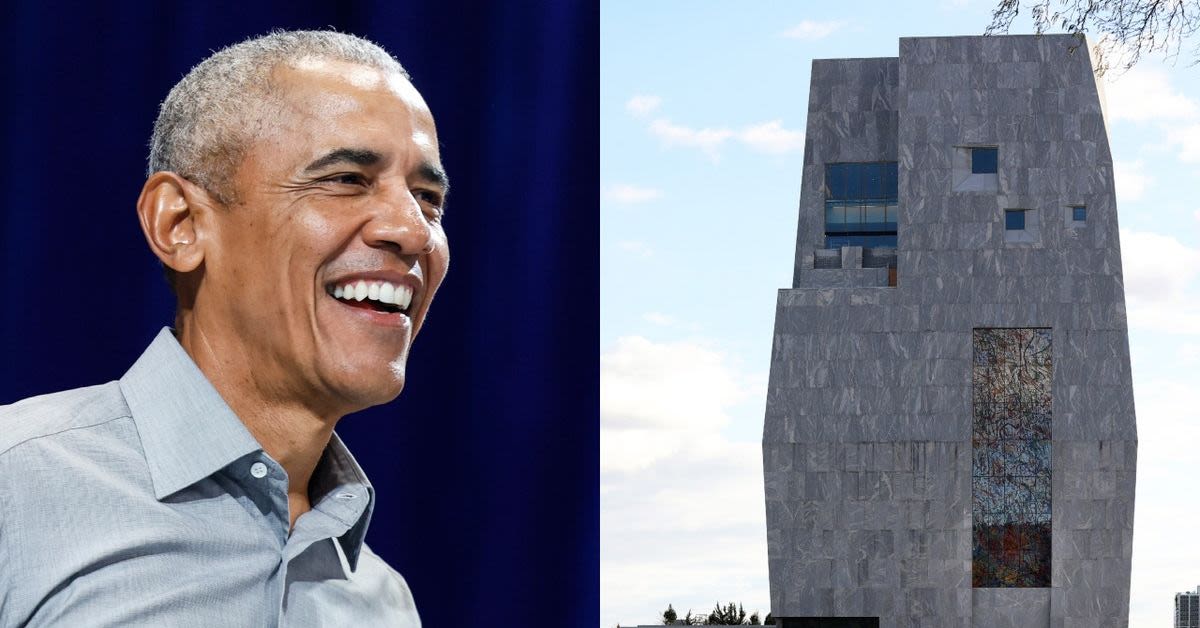
The Obama Presidential Library, a monument to the 44th president and his political legacy, has adopted an entrance policy that undercuts one of the Democratic Partys most strident talking points: opposition to photo identification requirements.
The $850 million complex, which opened last Friday in Chicago, Illinois, has drawn attention not only for its imposing gray design which critics say resembles a massive trash receptacle more than a traditional library but also for its admission rules, according to Western Journal. Visitors who arrive at the site or check the museums website are met with a clear directive that would be denounced as discriminatory if applied to the ballot box: You must show a valid photo ID to enter.
The official policy is explicit: Must be able to provide proof of residency. Be prepared to show proof of residency at the Museum with a valid photo ID, Illinois drivers license, state ID, or city-issued ID. Guardians must be able to provide proof of residency for accompanying children. For a political movement that has spent years branding voter ID laws as racist and exclusionary, the requirement at the Obama Library raises an obvious question about double standards.
For more than a decade, Democrats have insisted that asking for identification at the polls would disenfranchise minorities and the poor, particularly black Americans whom progressive activists routinely portray as unable to obtain basic documentation. Yet when it comes to accessing a taxpayer-supported presidential monument in a deep-blue city, those same supposed barriers suddenly vanish, and photo ID becomes a perfectly reasonable expectation.
This contradiction exposes the hollowness of the lefts rhetoric on election integrity and suggests that the real objection is not to IDs themselves, but to any safeguard that might limit opportunities for fraud or abuse. If an ID is acceptable to walk into a museum honoring Barack Obama, why is it supposedly oppressive to require one to choose the nations leaders?
Polling data show that the American public has already answered that question, and they overwhelmingly reject the Democratic Partys narrative. Referencing research from the Pew Research Center, CNN data analyst Harry Enten highlighted just how far out of step progressive elites are with ordinary voters on this issue.
Entens segment was prompted by a blunt social media post from singer and songwriter Nicki Minaj, who asked on X in February, What sensible forward thinking cutting edge leading nation is having a DEBATE on whether or not there should be VOTER ID?!?!!!! Like?!?!? Theyre actually fighting NOT to have ppl present ID while voting for your leaders!!!!! Her incredulity captured what many Americans instinctively feel: that identification at the polls is common sense.
The American people are with Nicki Minaj, Enten said, summarizing the data. He noted that polling going back to 2018 shows at least 75 percent support for voter ID, and after citing an 83 percent approval figure for 2025, he broke down the numbers by party affiliation.
Normally you might expect, Hey, thered be a big divide by party, with Republicans really for it and Democrats really against it. But not really. On screen, Democrats registered 71 percent approval for voter ID, while Republicans came in at a near-unanimous 95 percent.
Enten then presented figures that further dismantle the claim that voter ID is racially discriminatory, a claim largely confined to left-wing activists and party insiders. By race, support is broad and consistent 85 percent among whites, 82 percent among Latinos, and 72 percent among blacks.
So the bottom line is this voter ID is not controversial in this country. A photo ID to vote is not controversial in this country, Enten said. It is not controversial by party, and it is not controversial by race.
Despite this, Democratic leaders continue to lean on what can only be described as the soft bigotry of low expectations, assuming that minorities are less capable of meeting the same civic standards as everyone else. In the worldview of leftist elites, these Americans require perpetual special treatment and lowered thresholds, even as real-world behavior from museum visits to everyday transactions proves otherwise.
For a party that has long adopted a patronizing posture toward the very communities it claims to champion, the Obama Librarys ID policy is more than a bureaucratic detail; it is a revealing symbol. When it comes to protecting the integrity of elections, Democrats insist that identification is an intolerable burden, yet when guarding access to a presidential shrine, they quietly demand the very same standard they denounce at the ballot box.
Login