
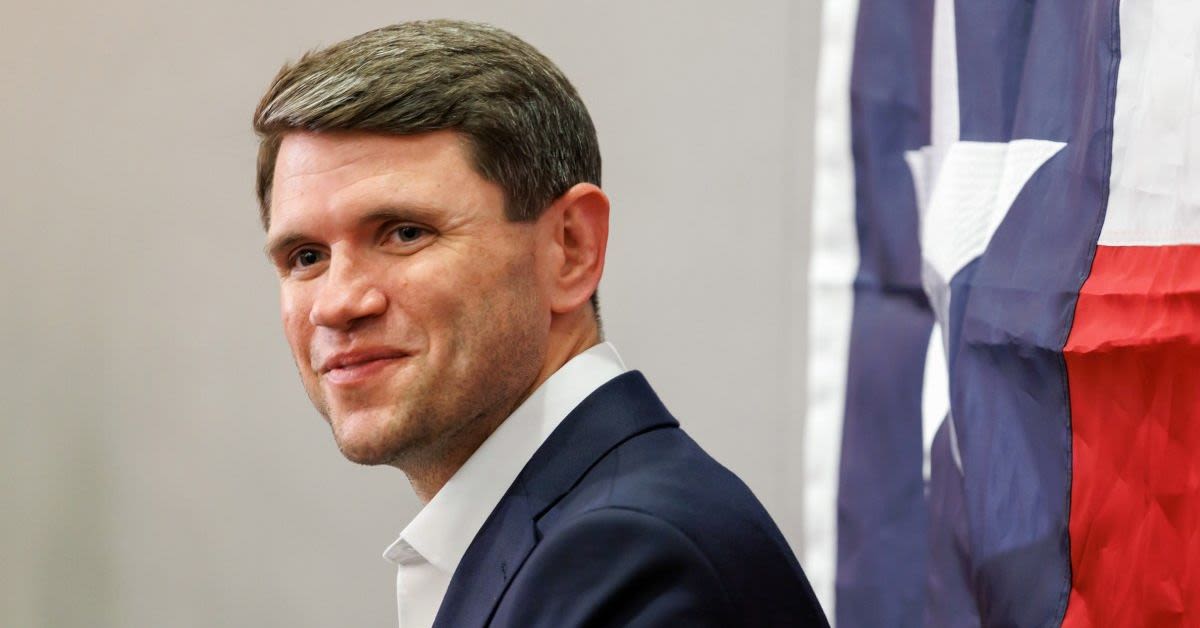
Left-wing Texas Senate hopeful James Talarico is working hard to brand himself as a friend of law enforcement, even as his own past rhetoric calls for a future in which police and prisons all but disappear.
According to the Washington Free Beacon, the Democratic state representative now insists he opposes defunding the police and touts a "proven track record" of backing law enforcement, yet video from 2022 shows him urging that police and prison budgets be slashed and redirected to social programs to "make prisons obsolete." The remarks came in a speech to Texas inmates completing a high school diploma program, where Talarico openly aligned himself with radical prison abolitionist thought and sketched out what he called a "world without prisons."
In that address, Talarico approvingly cited Ruth Wilson Gilmore, whom he described as an "anti-prison activist" who said "prisons are a catchall solution to our social problems," before expanding on his own vision. "Prisons allow us to ignore the consequences of systemic racism and global capitalism," Talarico told the graduates, arguing that "If we took just half of what we spent on wars, prisons, and policing and spent it on education, health care, and jobs, we could make prisons obsolete."
He pressed the point further, acknowledging that his ideas would strike many as fanciful but insisting they should nonetheless guide public policy. "It's hard to imagine a world without prisons," he continued. "But it was also hard to imagine a world without telegrams and cassette tapes. Just because it was hard to imagine doesn't mean you shouldn't. We won't build it overnight, but dreaming is the first step."
Those comments place Talarico squarely in the camp of "Defund the Police" activists who, at the height of the Black Lives Matter movement, demanded that police budgets be gutted in favor of expansive welfare and social spending. They also sit uneasily beside his current claims that he does not support defunding law enforcement, a position that appears tailored to a statewide electorate far more conservative than his Austin base.
When Republicans highlighted his past criticism of police officers on school campuses and argued that he backed defunding, Talaricos campaign scrambled to reassure voters. It told Fox News that Talarico "opposes defunding the police and has a proven track record voting to send billions of dollars to support law enforcement," pointing to his votes for large spending bills in the GOP-controlled Texas House that included additional police funding.
Those votes, however, occurred in a legislative environment where Republicans set the agenda and wrote the budgets, leaving Talarico little choice but to accept law-enforcement funding as part of broader packages. His own rhetoric suggests that, given the power to shape policy, he would prioritize dismantling traditional policing and incarceration in favor of expansive social programs and experimental justice models.
"If violence is systemic then love must be systemic," Talarico declared in his 2022 speech, pivoting from criticism of current institutions to a utopian alternative. "What would a nonviolent government look like? Instead of criminalizing, policing, and imprisoning communities, a nonviolent government would refuse to repay evil with evil and instead respond to evil with good."
He argued that such a government would embrace "restorative justice" practices modeled on certain Native American traditions, invoking a "Native peacemaking process" that "involves bringing together victims, offenders and their supporters to get to the bottom of a problem," as described by the International Institute for Restorative Practices. That approach, he said, would "disrupt the spiral of violence," replacing punishment with reconciliation and social intervention.
"Restorative justice takes its inspiration from indigenous communities in which the goal of a justice system is to disrupt the spiral of violence, not contribute to it," Talarico said, contrasting that ideal with the current criminal justice system. "In a restorative justice model, the question is how to right a wrong, not how to punish a wrong. Restorative justice is not easy. Throwing people in cages is much easier. But it's the only way to achieve true public safety. It's the only way to achieve love in public."
Talaricos campaign declined to respond to questions about the speech and his past statements, leaving voters to reconcile his abolitionist rhetoric with his present claims of support for police. The silence is notable given that his 2022 remarks were not off-the-cuff but carefully framed within a broader ideological tradition that explicitly seeks to dismantle prisons and policing as we know them.
The quote he used from Gilmore comes from her 2007 book Golden Gulag: Prisons, Surplus, Crisis, and Opposition in Globalizing California, a work of "scholar activism" that contends Californias prison boom in the 1980s and 1990s was driven less by crime than by a desire to suppress "militant anticapitalism" and "antiracist" movements. Gilmore has since become a leading intellectual force behind the defund-the-police movement that surged after the death of George Floyd, providing the theoretical backbone for activists who view law enforcement as an instrument of systemic oppression.
Gilmore has been explicit that the goal is not fiscal prudence but a wholesale reordering of societys priorities. "No abolitionist who is a true abolitionist wants to save money," she told the Intercept in June 2020. "What, therefore, we're talking about is divest from police, prisons, courts, and so forth and put those money and human resources into schools, social work, a Green New Deal or Red Green New Deal, economic activitythings that communities, municipalities, states can do."
Beyond his rhetoric, Talaricos financial ties also suggest sympathy with the defund agenda. In June 2020, his state representative campaign contributed $2,500 to the Austin Justice Coalition, a left-wing nonprofit that pushed to cut the Austin Police Departments budget to the "minimum possible" level, according to the New York Post, while MAYA Consulting, the progressive firm where Talarico worked as an "equitable education" consultant, gave the group another $5,000 around the same time, as the Washington Free Beacon reported.
Since 2018, Talarico has represented a deep-blue Austin district, where he has drawn attention for culture-war provocations and progressive legislation that play well with the activist left but poorly with more traditional voters. He has proclaimed that "God is non-binary" and introduced a 2021 bill requiring every large public school district in Texas to hire a "diversity, equity, and inclusion officer," embedding the DEI bureaucracy that many conservatives see as ideological enforcement rather than education.
Now, as he seeks a Senate seat in a state that backed President Donald Trump by 14 points, Talarico is attempting a political makeover, softening or erasing some of his most radical positions. Around the launch of his Senate bid, he quietly edited his campaign website, removing language that championed "trans kids" and "bold, progressive ideas" and denounced "Republican extremism," the Free Beacon reported, replacing it with populist messaging that claims he is fighting "billionaire mega-donors" and insists the "biggest divide in this country is not left vs. right" but "top vs. bottom."
For conservatives, the pattern is familiar: a progressive politician who governs and speaks like an activist in a safe liberal enclave, then pivots to moderation when higher office beckons. Talaricos own words about making "prisons obsolete," diverting funds from "wars, prisons, and policing," and replacing punishment with "love in public" offer a clearer window into his governing philosophy than any carefully crafted campaign talking point, and Texas voters will have to decide whether they are comfortable entrusting public safety to a candidate who once urged them to imagine a world without prisons at all.
Login