
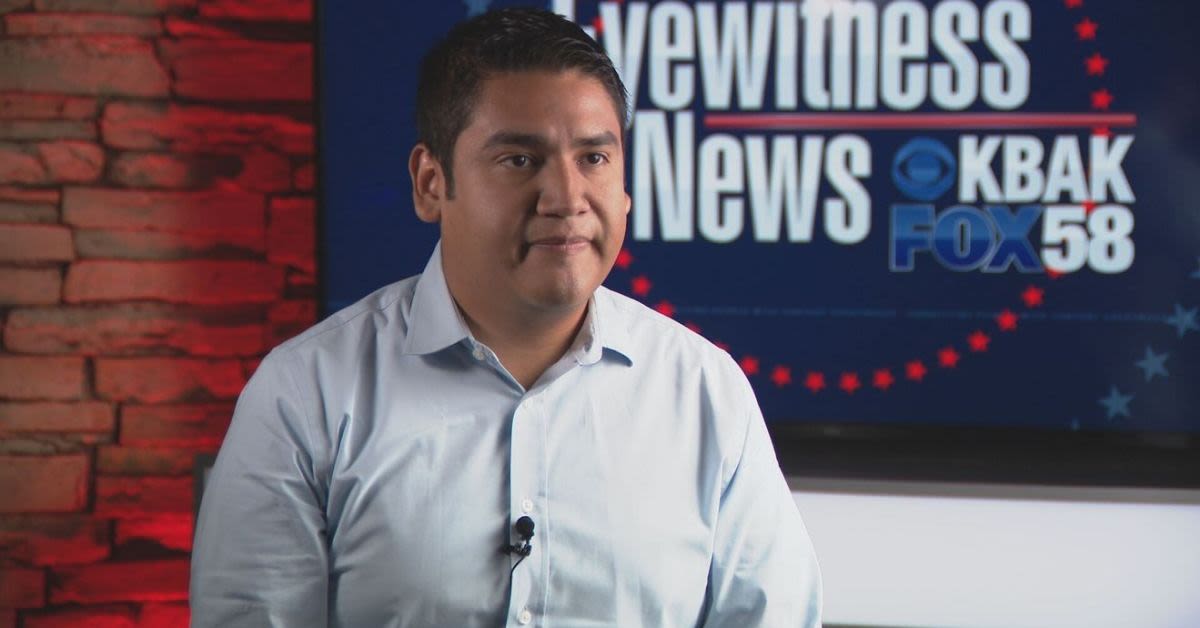
Randy Villegas, the left-wing Democratic nominee in Californias 22nd Congressional District, once co-authored an academic paper portraying conservative residents of the states Central Valleythe very voters he now seeks to representas fostering a climate of fear in some Latinx immigrant communities through their opposition to illegal immigration.
According to The Washington Free Beacon, Villegas, a political science professor at the College of the Sequoias, produced the paper in 2020 while completing his doctorate at the University of California, Santa Cruz. The article, titled The political socialization of Latinx youth in a conservative political context and published in the Journal of Applied Developmental Psychology, scrutinizes poor Whites and older White residents in the valley who, by resisting mass migration across the southern border, allegedly generate fear in some Latinx immigrant communities.
The region is characterized by a populist conservatism that can be traced to the Dust Bowl influx of poor Whites from the Midwest, Villegas and his coauthors wrote, casting the areas longstanding conservative culture as a problem rather than a perspective. Today, older White residents, who dominate the active electorate, tend to lean to the right and overwhelmingly supported Trump in the 2016 election.
The paper contends that these voters and the political elites who represent them have been particularly outspoken in their open opposition to immigration from south of the border, and that this stance has created a climate of fear in some Latinx immigrant communities and contributed to contentious classroom environments. In Villegass telling, the Central Valleys political atmosphere is defined by racial tensions and anti-immigrant sentiments, language that effectively brands mainstream conservative views on border security as bigotry.
In a region where Confederate and Dont Tread on Me flags associated with the Tea Party movement fly freely on trucks and in the front yards of some White residents homes, youth commonly reported hearing anti-immigrant and anti-Mexican rhetoric in the media (including social media) and in public, sometimes voiced by elected officials. Villegas further cited an anecdote in which a social studies teacher made negative comments about immigrants by referring to them as illegals, a term widely used in legal and policy debates but treated in his research as inherently suspect.
Even as he recounted these stories, Villegas conceded that he could not affirm whether such anecdotes reflect a more general experience, undercutting the sweeping nature of his claims. Nonetheless, the papers framing leaves little doubt that he views conservative cultural symbols, traditional patriotism, and opposition to illegal immigration as sources of intimidation rather than legitimate political expression.
Six years after publishing that critique, Villegas is asking many of the same voters he implied were racist to send him to Congress. Californias 22nd District, currently represented by two-term Republican David Valadao, covers a heavily agricultural, majority-Latino stretch of the southern Central Valley where working-class families tend to value public safety, border enforcement, and economic stability over academic identity politics.
Villegass paper argued that President Donald Trumps immigration policies frightened Latino voters in the region, yet Trump carried the district by six points in 2024, suggesting that many Hispanic residents do not share the lefts hostility toward strong borders. The district has become somewhat less Republican after Californias redistricting, but the GOP still holds a slight edge under the new lines, giving Valadao a realistic path to reelection despite the states overall Democratic tilt.
Villegass campaign did not respond to a request for comment, leaving unanswered whether he stands by his characterization of local conservatives as contributors to a climate of fear. His silence also avoids the question of how he intends to represent constituents whose values he has previously described in academic literature as a source of racial tension.
The Democratic primary that elevated Villegas was itself a proxy fight between the partys activist left and its institutional leadership. Villegas, running as the more progressive option, embraced policies such as Medicare for All and secured endorsements from Sen. Bernie Sanders (I., Vt.), Reps. Pramila Jayapal (D., Wa.), Ro Khanna (D., Calif.), and Alexandria Ocasio-Cortez (D., N.Y.), aligning himself with the partys democratic socialist wing.
His opponent, state lawmaker Jasmeet Bains, was backed by the Democratic Congressional Campaign Committee (DCCC) and 11 members of Californias Democratic delegation, who viewed her as a more moderate and electable choice in a swing district. While the DCCC poured $135,000 into an ad boosting Bains, Villegas defeated her by 5 points, a result that infuriated several House Democrats who believed the committee had squandered resources and misread the district.
That money definitely could be used for something else and it was weird to me that the DCCC jumped in when so many caucuses had made a different decision, one House Democrat told Axios, underscoring the internal rift between Washington strategists and the partys left flank. The episode highlighted how national Democrats, even when attempting to steer the party toward pragmatism, often find themselves outmaneuvered by progressive activists more in tune with the demands of the ideological base than with swing-district realities.
On the Republican side, Valadao faced no primary challenger, allowing him to conserve resources and build a formidable war chest for the general election. He has raised $4.2 million to Villegass $1.7 million and holds $2.9 million cash on hand compared with Villegass $340,000, a significant financial advantage in a district where retail politics and costly media markets both matter.
For Central Valley voters who fly Dont Tread on Me flags, support border enforcement, and backed Trump, the choice in November will be stark. They can return a Republican incumbent who has not labeled them a source of racial tensions and anti-immigrant sentiments, or they can send to Washington a progressive academic who has already framed their deeply held convictions as a threat to Latinx immigrant communities and to the classroom itself.
Login