
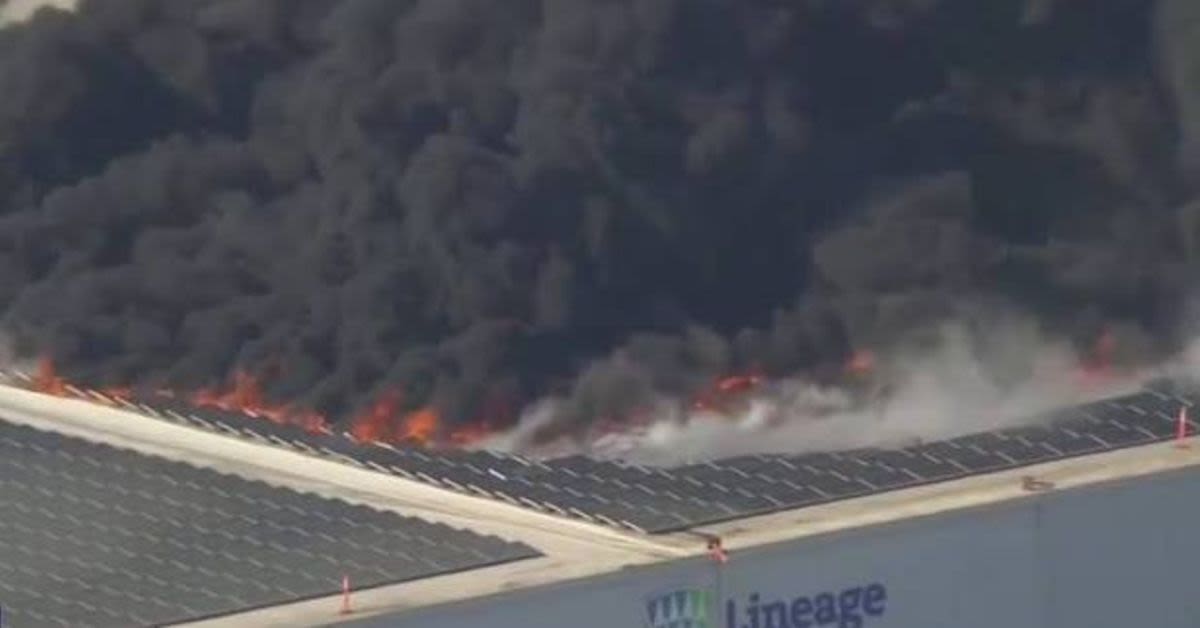
A stubborn industrial inferno in Los Angeles Boyle Heights neighborhood has laid bare not only the dangers of green-energy infrastructure gone wrong, but also the chronic failures of Californias Democratic leadership to respond swiftly and responsibly when working-class communities are put at risk.
According to RedState, the fire erupted last Wednesday on the roof of a Lineage cold food storage warehouse on South Los Palos Street, just east of Downtown Los Angeles, and quickly spread through the facilitys solar panel system. The blaze, which initially appeared to be confined to the rooftop and photovoltaic array, has continued to smolder for days, sending thick, toxic smoke over large swaths of the city and frustrating the efforts of the Los Angeles Fire Department (LAFD) to fully extinguish it.
Officials reported that the fire compromised an ammonia line inside the facility, a serious hazard in any industrial setting, though the leak was later contained by LAFD crews. A shelter-in-place order was issued for residents in a broad areafrom south of the 101 Freeway to Washington Boulevard, and from Soto Street to Indiana Streetbefore being lifted around 8:45 p.m. on the first night of the incident.
Roughly 70 residents on two nearby streets were evacuated as a precaution, according to the Los Angeles Police Department. The LAPD also declared a citywide tactical alert, a move that increases the number of officers available to respond to emergencies and maintain order as the situation unfolded.
Compounding the concern is the fact that this is not the first time the same building has burned because of its solar infrastructure. In August 2024, firefighters were dispatched to a rooftop solar panel fire at the very same facility, a warning sign that should have prompted aggressive follow-up inspections and enforcement.
Take note of that last point, the original report emphasized, underscoring that LAFD had already mitigated a fire at this building before, which was caused by the same issue. Yet, as the piece noted, thanks to the cuts that both Gov. Gavin Newsom and L.A. Mayor Karen Bass have enacted to the fire budget which would have shored up prevention and mitigation, one wonders if any follow-up or inspection had been done to prevent this from occurring again.
The result is a textbook case of Too little, too late, as the article put it, with toxic materials continuing to burn and smoke blanketing surrounding neighborhoods. Residents have been forced to breathe in noxious fumes for days, while officials scramble to catch up to a crisis that should have been anticipated and prevented.
Local outlet ABC7 highlighted the scale of the disaster four days after the fire began, noting that an estimated 85 million pounds of foodincluding meat, poultry and bread productsare now spoiling inside the cold storage facility. An estimated 85 million pounds of food, including meat, poultry and bread products, are beginning to spoil inside the cold storage facility at the center of the massive structure fire in Boyle Heights, complicating response efforts, the station reported in a segment shared on social media.
The warehouse, described by LAFD Chief Jamie Moore as like a giant cooler, spans roughly 500,000 square feet and is constructed with corrugated steel walls packed with dense insulating foam. That foam, Moore explained, is burning slowly and off-gassing despite continuous water drops from firefighting helicopters, turning the building into a long-term source of hazardous emissions.
The impact has been visible far beyond Boyle Heights. One observer posted video from Elysian Park, home to Dodger Stadium, showing the ballpark shrouded in a sickly haze. The smoke from the nearby Boyle Heights warehouse fire has enshrouded Dodger Stadium in an acrid, nasty haze, the post read. Not sure Id want to sit here and watch as a fan, much less play the game, unless conditions improve.
Even as the immediate hazardous-materials threat from the ammonia leak was brought under control, Chief Moore warned that the public health risks were far from over. He cautioned residents with respiratory issues or smoke sensitivity to avoid outdoor activities, noting that crews were now focused on the biohazard portion of the incident caused by millions of pounds of decomposing food.
Although the formal shelter-in-place order was lifted on Friday, residents across a wide regionfrom the San Gabriel Valley and Northeast Los Angeles to Glendale, Burbank, and downtownreported persistent smoke, strong odors, and degraded air quality. Some Angelenos said the conditions were as bad as, or worse than, the Eaton Fire that burned in Altadena in January 2025.
Despite the obvious severity of the situation, Governor Gavin Newsom did not declare a state of emergency until four days after the fire began. However, it took four days before Governor Gavin Newsom declared a state of emergency, the report noted, raising the obvious question: Why did it take days to declare the emergency?
The governors office eventually announced, Governor Newsom proclaims State of Emergency in Los Angeles for the Boyle Heights fire response, but the delay has fueled criticism that the administration is more focused on national political theater than on the basic responsibilities of governance. While Eastside families were breathing toxic smoke, Newsom was reportedly in Chicago, socializing with former President Barack Obama at the Obama Presidential Center.
Apparently Newsom was too busy hobnobbing in Chicago with former President Barack Obama at Obama's new presidential library, the piece observed acidly. It went on to note that Newsom has also been taking every opportunity to piss and moan about being targeted by President Donald Trump and the Department of Justice because of his First Partner's corrupt non-profits, suggesting that the governor sees the real state of emergency as the legal scrutiny facing his inner circle, not the literal burning of Los Angeles.
State of emergency? To him the only emergency is they're coming after him and therefore democracy is in peril, the commentary continued. Los Angeles burning? Ain't nothing but a thing.
City Hall has not escaped scrutiny either. Los Angeles Mayor Karen Bass has issued a series of official updates about the fire and the response efforts, but critics question whether she was even in the city as the crisis unfolded. Since June 17, there have been X posts about the fire and the efforts to combat it issued from the Mayor of L.A. account, the report noted, adding that an intern could be sending those out, and it can be done from anywhere on the planet.
The question is: was Bass in the city running point on this? the piece asked, echoing a concern that has become familiar during her tenure: the perception that the mayor is frequently absent when disaster strikes.
Mayoral candidate Spencer Pratt, who has built his campaign around public safety and accountability, alleges that she was not present. Karen was sipping cocktails in Chicago when the Boyle Heights Fire erupted, just as she was sipping cocktails in Ghana when our Palisades Fire erupted, Pratt charged in a social media post. I warned you all...what happened to us will happen to all of LA. That smoke choking out LA is full of lead. Don't breathe it!
Republican lieutenant governor candidate Gloria Romero echoed that criticism, suggesting a pattern of neglect. So once again, she was out partying and failed to act quickly when east LA caught fire? Romero asked pointedly, amplifying the perception that Bass is more interested in travel and political networking than in hands-on crisis management.
Its quite amazing: Karen Bass manages to be out of town or the country when disaster strikes the city, the original article remarked. At this rate, she's going to ensure there is no Los Angeles left by the end of her second term.
The political finger-pointing has not been confined to City Hall and the Governors Mansion. Former Assemblywoman and current State Senate candidate Wendy Carrillo, a Democrat, has directed her ire at Los Angeles County Supervisor Hilda Solis, whose District 1 includes Boyle Heights and neighboring East Los Angeles.
Carrillo accused Solis of neglecting Latino communities and framed the response as a matter of racial injustice. ?? @HildaSolis - DO YOUR JOB. The Boyle Heights fire is one block / across the street from East Los Angeles and it is a disgrace that you have not done more to help East LA families who are inhaling toxic smoke. Its day 4 and people are getting sick. You have done NOTHING, Carrillo wrote in one post.
She continued in another message, repeating, ?? @HildaSolis - DO YOUR JOB. Carrillo went on: The Boyle Heights fire is one block / across the street from East Los Angeles and it is a disgrace that you have not done more to help East LA families who are inhaling toxic smoke. Its day 4 and people are getting sick.
You have done NOTHING since the 25,000 gallons of oil spilled onto East LA a couple of weeks ago and now this, she added. SHAMEFUL response and clear environmental racism.
The charge of environmental racism is a familiar talking point on the left, but it sidesteps a more basic question: why, in a city and county run entirely by Democrats, are minority neighborhoods still bearing the brunt of mismanagement, slow responses, and decaying infrastructure. As the commentary dryly interjected after Carrillos accusation, Mmmkay.
For conservatives, the Boyle Heights fire encapsulates a broader pattern: progressive leaders who talk endlessly about equity and climate justice, yet preside over repeated environmental and public safety failures in the very communities they claim to champion. This is exactly what Spencer Pratt warned about during his campaign, the article noted, lamenting that it's a shame people failed to take him seriously.
The political alternatives facing Los Angeles voters only deepen the sense of frustration. Thanks to the shenanigans in the L.A. mayor's race, the citizens now have the choice between Bass and Nithyha Raman, a Democrat socialist who thinks she can solve fire problems by banning grilling on red flag days, the piece observed, highlighting how the citys political class seems more interested in symbolic gestures and lifestyle regulations than in competent governance, robust fire prevention, or serious infrastructure oversight.
Its clown world in California, from the top to the bottom, the report concluded starkly. It would be funny if it didn't involve the tragic loss of lives and property.
As the warehouse continues to smolder days after the first flames were spotted, residents are left to cope with foul air, spoiled food supplies, and lingering uncertainty about long-term health impacts. The unanswered questions are not merely technicalhow best to extinguish a foam-insulated, solar-topped industrial freezerbut political and moral: why a state that boasts of its environmental leadership cannot prevent repeat fires at the same facility, why its leaders delay emergency declarations while communities choke, and why the people of Los Angeles are asked, again and again, to accept the consequences of policies and priorities they never truly endorsed.
Login