
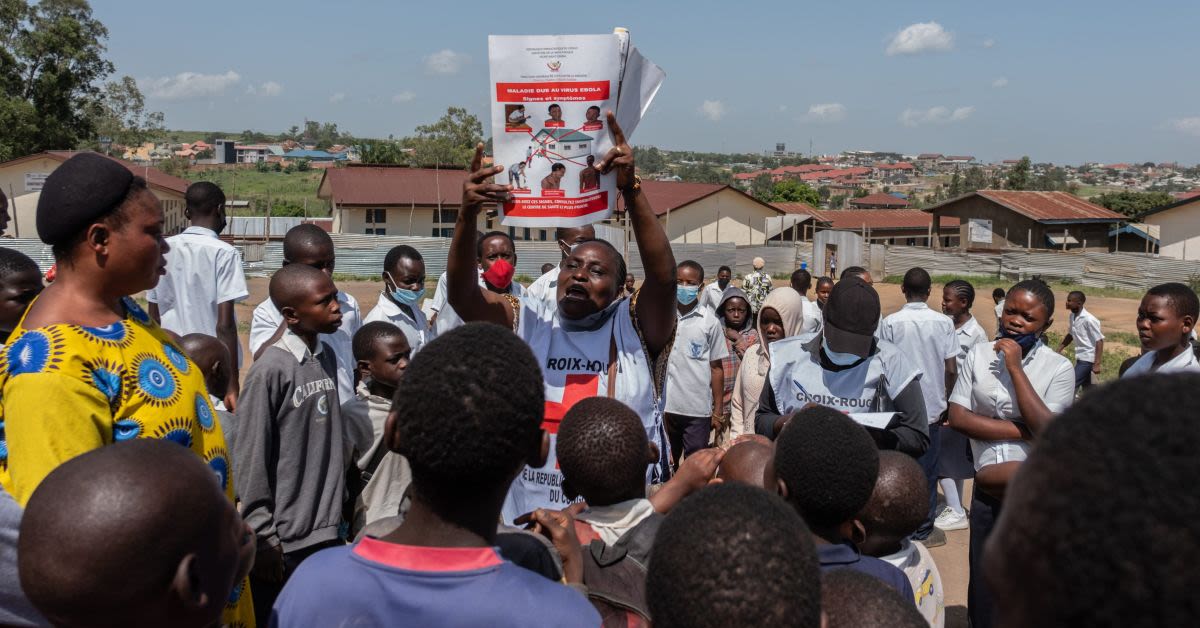
At least 30 people have died since the beginning of May in a single camp for displaced civilians in northeastern Congo, an unprecedented spike that local officials fear signals a rapid and largely unchecked spread of Ebola among some of the countrys most vulnerable people.
According to Reuters, the deaths have occurred in the Kigonze camp on the outskirts of Bunia, the current epicenter of the Ebola outbreak in the Democratic Republic of Congo, where more than 15,000 people uprooted by conflict are crammed into makeshift shelters. For weeks, it was impossible for health workers to confirm the cause of most of the fatalities because patients and their relatives refused to allow testing, a stance that aid organization Caritas and camp representatives say only began to soften on Thursday.
Those who died reportedly suffered from headaches, fever and vomitingclassic symptoms associated with Ebolaaccording to a camp spokesperson, a grieving father, three humanitarian sources and a local civil society leader who spoke to Reuters. People didn't just die like this before, camp spokesperson Desire Grodya Bapi told Reuters, underscoring how dramatically the situation has deteriorated in a matter of weeks.
The sudden rise in deaths at Kigonze has intensified fears that Ebola may be circulating undetected among eastern Congos more than 5 million displaced people, many of whom live in similarly overcrowded and unsanitary camps. Resistance to testing, driven by fear, mistrust and misinformation, is compounding the threat posed by a near-total absence of adequate sanitation and hygiene infrastructure in these communities.
Camp President Dz'djo Ndrutsi Etienne reported that 10 people were buried in Kigonze in the past week alone, a staggering figure for a settlement that previously saw only a handful of deaths each month. Grodya said the camp typically recorded between one and three deaths per month, a baseline that makes the current toll of at least 30 since early May all the more alarming.
Justin Zanamuzi, director of the Catholic aid organization Caritas, which provides assistance to Kigonzes residents, said his team on Wednesday saw several bodies covered in sheets, including a pregnant woman and children. Footage from Thursday, shared by a civil society leader and verified by Reuters, showed health workers in full protective gear disinfecting additional bodies and preparing tiny coffins beside a crucifix as mourners wailed in the background.
Our team tried to persuade people to accept doctors to inspect the bodies. They completely refused, Zanamuzi said, describing a climate of suspicion that has hampered efforts to contain the disease. That reluctance to cooperate with medical teams has allowed the virus to move in the shadows, with officials only now beginning to piece together the true scale of the outbreak inside the camp.
The national Ebola outbreak was formally declared by Congolese authorities on May 15, but officials acknowledge that the wave of deaths in Kigonze began earlier in the month. Grodya, the camp spokesperson, said health workers have since managed to take samples from five victims, and some of those tests have already come back positive for Ebola.
Three separate aid sources confirmed on Saturday that laboratory analysis of samples from some of this weeks victims also returned positive results for Ebola, though they did not specify the exact number of confirmed cases. The patchy testing and delayed reporting mean that the official figures almost certainly understate the true extent of the viruss spread within the camp and possibly beyond it.
For residents like 47-year-old Kato Lonu, the crisis is not an abstraction but a personal tragedy. Kato lost two children, including a 6?month?old baby, in recent days and described the conditions in Kigonze in stark terms: "These are conditions that no human being should have to live in. If you look around, people are dying one after another," he said.
Humanitarian workers say the surge in deaths is a grim illustration of how communities have become more exposed to deadly diseases such as Ebola as international donors have scaled back funding for basic water, sanitation and hygieneknown in the aid world as WASH. Four aid workers told Reuters that cuts by major donors, including the United States under President Donald Trump, have sharply reduced support for toilets, clean water and handwashing facilities, all of which are essential to stopping a virus that spreads through contact with bodily fluids, including human waste.
Data compiled by the United Nations show that funding for toilets and handwashing stations in Congo more than halved between 2024 and 2025, dropping to around $38 million. This years $80 million appeal for WASH services is only 21 percent funded, leaving millions of displaced people in squalid conditions that virtually invite outbreaks of Ebola, cholera and other preventable diseases.
Congo now has hundreds of camps sheltering civilians who have fled war and militia violence, with some sites housing as many as 100,000 people. Ebola deaths have already been recorded in another camp in Ituri province, the same region where Bunia is located, and Ituri alone accounts for over 90 percent of nearly 900 confirmed cases in the current outbreak.
In Kigonze, the physical layout of the camp makes infection control almost impossible. Large families are squeezed into flimsy plastic tents set less than a meter apart, while children wander barefoot through narrow dirt alleyways that double as drainage channels when it rains.
Some of the few visible signs of past international engagement are toilets marked with the logo of USAID, Washingtons main foreign aid agency, which critics on the left have long targeted and which the Trump administration has sought to streamline and refocus. An aid source said USAID helped fund the construction of these facilities, but both Grodya and the same source acknowledged that the number of toilets is woefully inadequate and that they frequently overflow.
The latrines, they fill up very quickly, and people have to empty them themselves, with their bare hands," Grodya said, describing a practice that not only strips people of dignity but also dramatically increases the risk of disease transmission. In such an environment, where human waste is handled without protection and clean water is scarce, the idea of containing a virus like Ebola through public health messaging alone is little more than wishful thinking.
Washington has historically been the leading supporter of WASH services in Congo, providing over $60 million in 2024 to reduce the spread of waterborne and hygiene-related diseases, according to a summary shared by a former USAID official. The Trump administration has defended its subsequent aid reductions, arguing that it wants to focus on hyper-prioritized life-saving humanitarian assistance rather than diffuse, open-ended development spending that often lacks accountability.
At the same time, the United States has committed more than $375 million in direct Ebola funding, reflecting a strategic choice to concentrate resources on targeted disease control rather than broad-based infrastructure projects. There was no immediate comment from the U.S. State Department on the specific situation in Kigonze or on current levels of support for that camp.
Reuters could not determine exactly how much, if any, U.S. funding is still reaching Kigonzes WASH programs, but aid agencies on the ground say the impact of the cuts is unmistakable. Four major organizationsMercy Corps, the Danish Refugee Council, CARE International and Oxfamreported that their U.S.-funded WASH projects for displaced people in the three Ebola-affected provinces have been scaled back or terminated since last years reductions.
Mercy Corps, for example, built 82 water taps and more than 400 public toilets serving over 125,000 displaced people in 2024, a network that significantly improved hygiene and reduced disease risk. This year, the group says funding cuts have forced it to operate just six taps with no public toilets, reaching fewer than 19,000 people and leaving the rest to fend for themselves in conditions that are deteriorating by the day.
For conservatives who believe in targeted, results-driven foreign aid, the unfolding tragedy in Kigonze raises difficult but necessary questions about how best to balance fiscal restraint with moral responsibility. On one hand, the Trump administrations emphasis on hyper-prioritized life-saving humanitarian assistance reflects a legitimate concern that American taxpayers should not be writing blank checks for sprawling international bureaucracies that often fail to deliver measurable outcomes.
On the other hand, the experience in northeastern Congo suggests that cutting support for basic sanitation and clean water can undermine precisely the kind of life-saving interventions that conservatives and liberals alike claim to support. When latrines overflow, when families are forced to handle human waste with their bare hands, and when children grow up in camps without access to safe water, the cost is not only counted in dollars saved but in lives lost to preventable disease.
The crisis in Kigonze also highlights the importance of local responsibility and community cooperation, principles long championed by conservatives who argue that culture and governance matter as much as money. Health workers cannot fight Ebola effectively if residents refuse testing, reject medical inspections of the dead or succumb to rumors that fuel distrust of doctors and aid agencies.
As Ebola continues to claim lives in Kigonze and other camps across Ituri, the central challenge is not simply how much the West spends, but how wisely those funds are deployed and how firmly local authorities and communities commit to basic standards of hygiene, transparency and cooperation. Without that combination of targeted international support and local accountability, the world will continue to see the same tragic pattern repeat itself: emergency declarations, hurried funding pledges, and then, once the headlines fade, a slow retreat that leaves vulnerable families once again exposed to the next inevitable outbreak.
Login