
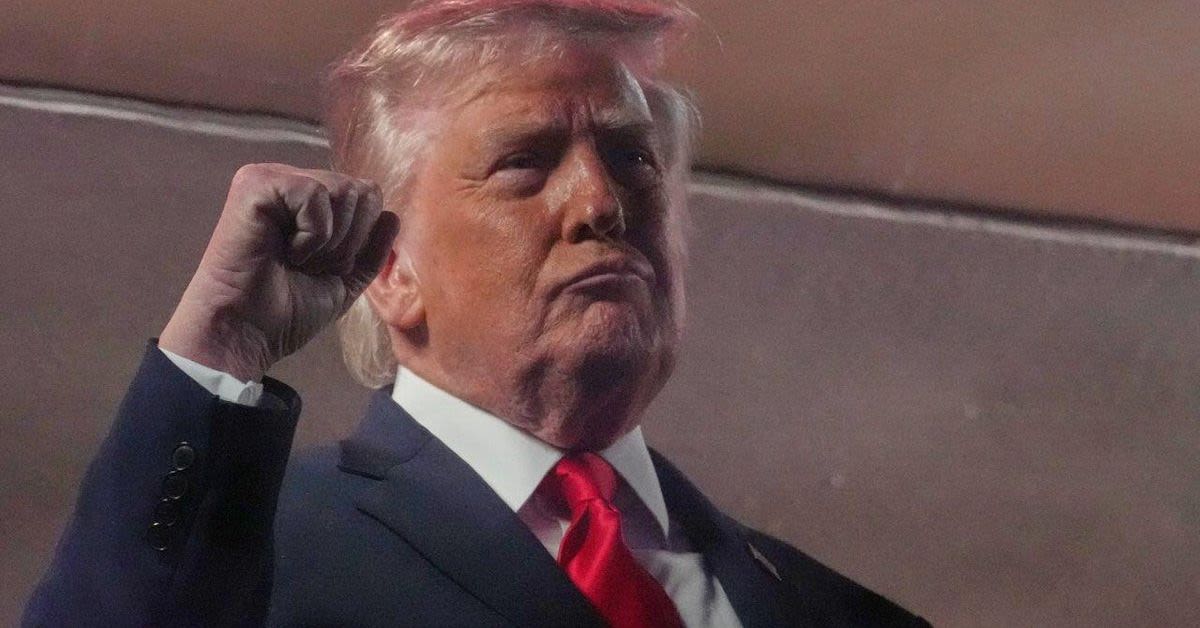
NBA Commissioner Adam Silver used the national spotlight before Game 3 of the NBA Finals at Madison Square Garden on Monday night to rebut a partisan swipe from House Minority Leader Hakeem Jeffries (NY-08), who had mocked President Donald Trumps appearance at the game and questioned his loyalty to the New York Knicks.
According to RedState, Silver did not mention Jeffries by name, but his remarks left little doubt that he was responding to the left-wing talking point that Trump, a native New Yorker, had no legitimate reason to be courtside. The commissioner, who has hardly been a conservative darling in recent years, nonetheless felt compelled to correct the record on the presidents long-standing ties to the franchise.
"He was a fixture at Madison Square Garden," Silver told the ESPN broadcast crew from the floor, addressing a panel that included NBA legends Shaquille O'Neal and Charles Barkley. "You guys remember all of you when you played here back in the old days, he had courtside seats. He was here all the time. He was at drafts, so he's a genuine Knicks fan."
Silvers comments, delivered as cameras panned a packed arena, directly undercut the narrative that Trump was merely injecting himself into the event for political gain. The commissioner went further, praising the turnout despite heightened security and emphasizing the unifying role sports should play in public life.
"The arena is packed. People got through extra security...we should be using sports to create MORE community, not less!" Silver said, in a pointed contrast to those who insist on dragging partisan politics into every cultural space. His remarks implicitly challenged the idea that a presidents attendance at a basketball game should be treated as a political provocation rather than a normal civic moment.
The left, predictably, did not welcome that message, preferring to keep Trumps every move framed as a controversy. As RedState's Sister Toldjah reported earlier Monday, Jeffries had used a Capitol Hill press conference to belittle Trumps presence at Game 3 and to cast doubt on his authenticity as a Knicks supporter.
During that congressional presser, Jeffries, wearing a pale pink Knicks cap and a seersucker suit, tried to turn sports fandom into a partisan litmus test. He questioned whether Trump, who has been associated with New York sports and culture for decades, even knew enough about the team to qualify as a real fan.
Hakeem Jeffries declared, "It also is not clear to me that Donald Trump is a big Knicks fan. I mean does this guy even know the difference between Karl Rove and Karl-Anthony Towns?!? I don't think so. He's just injecting himself into the NBA Finals because he always has to bring the MAGA circus into town and that's unfortunate."
The optics were hard to ignore: a career politician in a fashionably ironic pink cap lecturing a lifelong New Yorker about who is allowed to cheer for the citys team. For many viewers, the spectacle underscored how deeply Democrats have politicized even the most ordinary aspects of American life, from childrens classrooms to professional sports arenas.
Jeffries attempt at a punchlinedragging Karl Rove into a comparison with Karl-Anthony Townslanded more as a sneer at Trumps supporters than as a serious critique. It also betrayed a deeper impulse on the left to gatekeep cultural spaces and to ostracize anyone associated with the populist right, even in a setting that should be about competition, entertainment, and civic pride.
Silvers broader message stood in stark contrast to that divisive posture. The commissioner, who has often aligned with progressive causes, nonetheless reminded the country that, "I think we should be using sports to create more of a sense of community with people, not less."
At a moment when Democrats seem determined to turn every arena into another front in the culture war, Silvers defense of Trumps fandom and his call for unity offered a rare acknowledgment from a major sports figure that not everything must be filtered through partisan resentment.
Login