
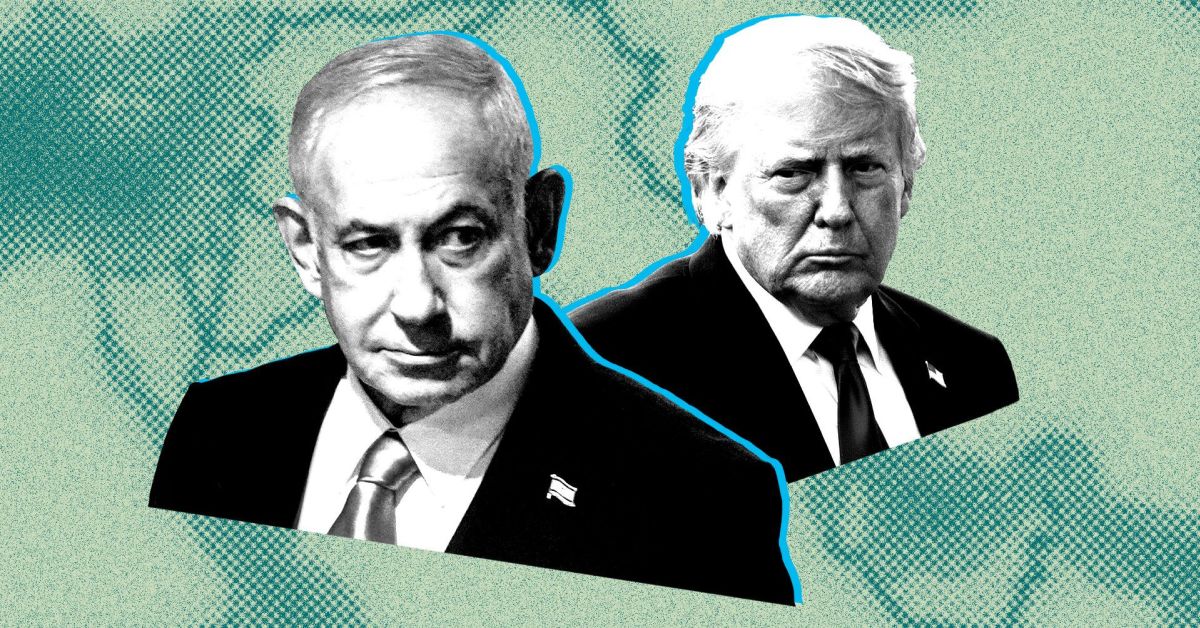
President Donald Trump is downplaying reports of a profane clash with Israeli Prime Minister Benjamin Bibi Netanyahu, framing the episode instead as a momentary flare-up between close allies operating under wartime pressure.
According to The Western Journal, the president brushed aside Beltway chatter about a supposed blowup, emphasizing that the U.S.-Israel partnership remains strong despite occasional friction over military tactics. Weve worked very well together, I like Bibi a lot, Trump said. And Ive worked very well with him. The remarks came during an appearance on New York Post columnist Miranda Devines podcast, Pod Force One, where Trump addressed a widely circulated Axios report describing a tense phone call with Netanyahu.
Axios had claimed that Trump, frustrated with Israels operations in Lebanon, had repeatedly used the f-word while scolding the Israeli leader over the course of the conversation. Devine pressed the president on that account, which portrayed him as sharply critical of Netanyahus handling of the conflict. Trump did not deny his irritation, but he framed it as the natural byproduct of serious leaders grappling with grave decisions in a volatile region.
Speaking to Devine, Trump acknowledged, I was a little bit perturbed at his constantly fighting with Lebanon. He added that, At some point, I said, Bibi, we gotta stop this, followed by, We gotta stop it. The presidents comments came as Iran, seizing on Israels actions, announced it was suspending further participation in talks aimed at ending fighting between U.S. and Iranian forces. That move underscored how every Israeli military decision reverberates across the broader Middle East and directly affects American troops and interests.
Still, Trump made a point of stressing that any disagreement with Netanyahu remains tactical, not strategic, and certainly not personal. Im a wartime president, hes a wartime prime minister, very important part of the world, Trump said. And I think weve done very well. Weve gotten along well together. His framing reflects a longstanding conservative view that Israel is a critical democratic ally in a hostile region and that robust debate behind closed doors is compatible with unwavering public support.
For his part, Netanyahu has echoed that theme of unity amid occasional disputes, particularly on the shared threat posed by Tehran. CNBC reported that the Israeli leader conceded he and Trump had tactical disagreements, but stressed that both remain firmly aligned in viewing Iran as an adversary that must never be permitted to obtain a nuclear weapon. We can disagree in the morning, and by the afternoon we have common action, he said, underscoring the practical cooperation that continues despite any harsh words exchanged in private.
Netanyahu went further, expressing confidence that the Iranian regime itself is ultimately unsustainable, even if its collapse cannot be scheduled on a calendar. You cant quite predict when a regime like that goes under, Netanyahu said, CNBC reported. You didnt predict it in a number of cases: Not in Romania, and not in the fall of the Berlin Wall, and nobody predicted it, but it happened. Why? Because the cracks were propagating underneath.
In fact, you have enormous cracks right now in Iran, and you cant predict when itll happen, he said. For conservatives who see Iran as the chief state sponsor of terror and a mortal threat to both Israel and the West, the Trump-Netanyahu dynamicfrank, occasionally heated, but fundamentally alignedsignals that, despite media attempts to magnify every disagreement, the core strategic partnership and the shared resolve to confront Tehran remain firmly intact.
Login