
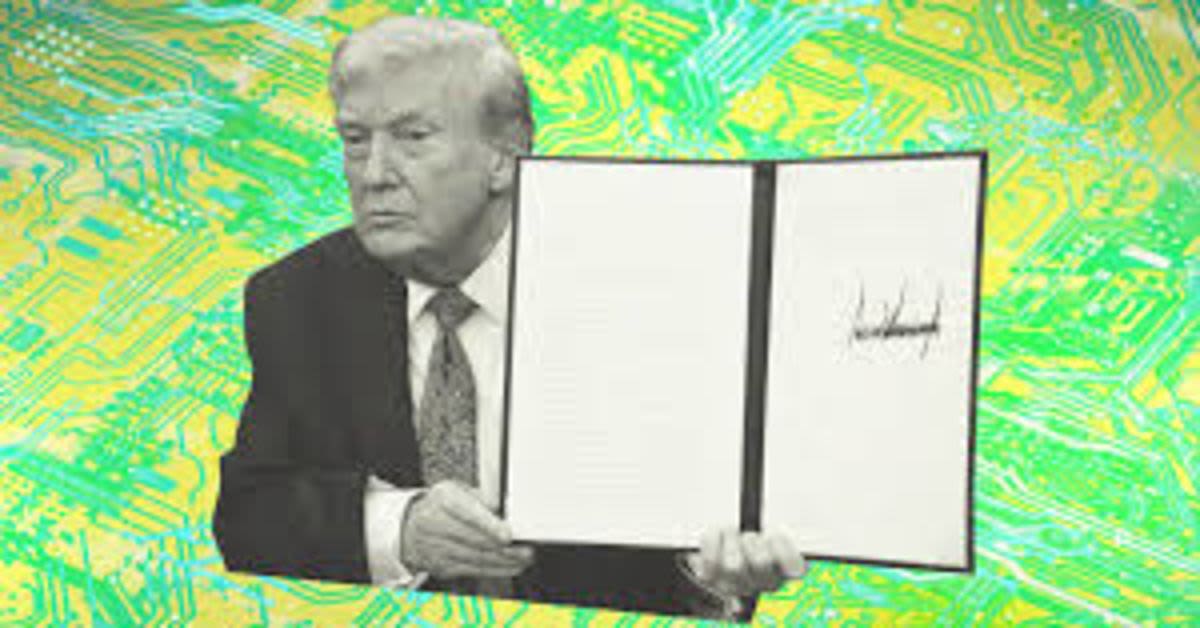
President Donald Trump has quietly signed a revised executive order on artificial intelligence, scaling back earlier draft provisions that had alarmed both industry leaders and advocates of American technological dominance over China.
According to Western Journal, the order was executed behind closed doors rather than in the typical public signing ceremony, a decision first reported by Politico, which cited two White House officials familiar with the matter granted anonymity to discuss it. Those officials indicated that the final document replaced a more restrictive draft that had been scuttled at the behest of AI companies, reflecting the administrations willingness to listen to industry concerns while still asserting a federal role in safeguarding national security.
At the heart of the order is a new, voluntary process under which certain AI developers would submit new models or products for federal review up to 30 days before public release. A previous draft, pulled at the last minute on May 21, had proposed a 90?day advance review period, while industry representatives had pushed for a far shorter 14?day window, underscoring the tension between innovation and oversight.
Trump had already signaled his reservations about the original, more stringent proposal, warning that it risked undermining Americas edge in a critical technology race. He told NBC News there was concern that the initial draft negatively impacted the competitive position of Americas AI companies, and he emphasized, Were leading China, were leading everybody, and I dont want to do anything thats going to get in the way of that lead.
The order explicitly frames the United States AI leadership as a product of free?market dynamism rather than heavy?handed regulation. The United States continues to lead the world in Artificial Intelligence (AI) because of the enormous talent and innovation of our AI industry, and because we refuse to stifle this innovation with overly burdensome regulation, the document states, drawing a sharp contrast with the regulatory instincts of the prior administration and of many progressive policymakers.
Trump credits his administrations deregulatory agenda with unleashing a wave of private?sector investment and technological progress. My Administration has unleashed tremendous technological growth and economic investment in AI by slashing the bureaucratic constraints that the prior administration placed on Americas AI developers and researchers, and by instead encouraging AI innovation and accelerating responsible AI adoption across government and industry, he wrote, underscoring a core conservative belief that limited government and reduced red tape fuel economic strength and strategic advantage.
At the same time, the order acknowledges that rapid advances in AI carry serious security implications that Washington cannot ignore. It notes that AI developments introduce new national security considerations that require coordinated action across executive departments and agencies (agencies), and components, signaling that the federal government intends to monitor emerging risks without seizing control of the sector.
The administration pledges to work in partnership with private firms rather than imposing top?down dictates. As these capabilities evolve, my Administration will continue to work closely with industry to ensure that the best and most secure technology is deployed rapidly to confront any and all threats to our country, the order said, reflecting a preference for collaboration over coercion in dealing with cutting?edge technologies.
To that end, the order calls for a voluntary framework with AI developers that would allow companies to share information about new models with federal authorities before those tools are widely deployed. Under this arrangement, firms could provide details subject to appropriate confidentiality, cybersecurity, insider-risk, and intellectual-property protection, use, and nondisclosure requirements, for a period of up to 30 days before they plan to release such models to other trusted partners, giving the government a limited preview without granting it veto power.
The stated aim of this cooperation is to bolster both innovation and security, rather than to slow progress. The order says the collaboration is intended to promote secure innovation and strengthen the cybersecurity of critical infrastructure, a priority that resonates with conservatives who see national defense and protection of key systems as legitimate federal responsibilities, distinct from broader economic micromanagement.
Crucially, the document draws a bright line against any move toward a licensing regime that could be used to control speech, research, or entrepreneurial activity. Nothing in this section shall be construed to authorize the creation of a mandatory governmental licensing, preclearance, or permitting requirement for the development, publication, release, or distribution of new AI models, the order said, a reassurance likely to be welcomed by those wary of bureaucrats using safety as a pretext for censorship or industrial policy.
By pairing a voluntary review mechanism with explicit protections against mandatory preclearance, the Trump administration is attempting to thread a needle that many on the left have shown little interest in threading: addressing genuine national security threats without strangling a vital industry in red tape. The revised order reflects a broader conservative approach that trusts markets and innovators first, uses government power sparingly and strategically, and keeps a wary eye on any regulatory scheme that might erode Americas technological leador the individual freedoms that underpin it.
Login