
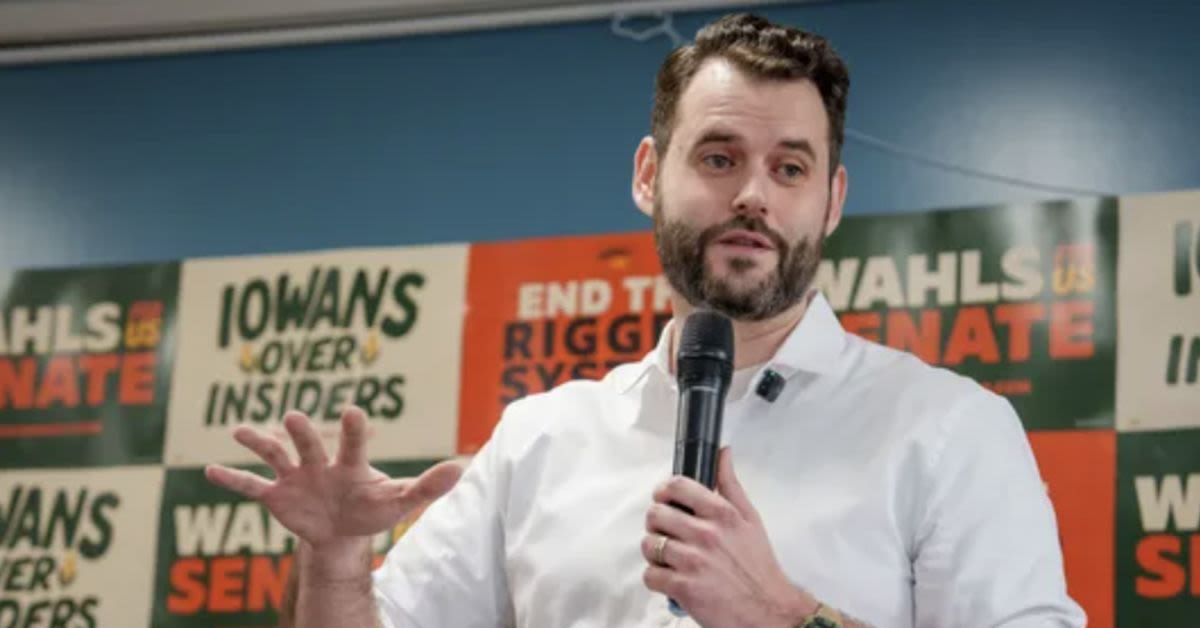
Iowa Democratic Senate hopeful Zach Wahls is facing renewed scrutiny for his role in promoting a radical bail fund that helped spring dozens of Black Lives Matter rioters from jail, including offenders who attacked police, terrorized local businesses, and tried to set fire to a county courthouse.
According to the Washington Free Beacon, Wahlsnow seeking the Democratic nomination for the U.S. Senate seat being vacated by Sen. Joni Ernst (R.)used his platform in the immediate aftermath of George Floyds death to champion a bail fund that would go on to underwrite the release of violent agitators and hardened criminals. The episode underscores a broader divide between progressive activists who sought to reimagine public safety in 2020 and voters in states like Iowa, where support for Black Lives Matter and defund the police rhetoric has remained tepid at best.
On May 29, 2020, as unrest spread nationwide, Wahls, a Democratic state senator, dismissed concerns about lawlessness and property destruction. He wrote that there was "a lot of hand-waving going on about protests, riots, looting, etc.," and insisted that "disorder co-occurs with injustice."
He went further, framing the issue in explicitly racial terms and assigning blame to white Americans rather than to those committing the violence. Wahls declared that the "key problem that has to be solved here is a white one," a formulation that aligned him with the most ideological elements of the lefts racial politics rather than with voters worried about safety in their own communities.
Within hours of Wahlss comments, downtown Des Moines descended into chaos. Rioters smashed windows, vandalized businesses, and clashed with law enforcement, and the unrest continued into the following night as police struggled to restore order.
After two nights of destruction and a wave of arrests, Wahls did not call for calm or for respect for the rule of law. Instead, he urged his followers on X to help free those detained in connection with the violence, effectively siding with the protesters and rioters over the police officers and business owners under siege.
"@eicommunitybond has set up a fund to help Iowa #BlackLivesMatter protestors make bail. I'm donating, and I hope you will, too," Wahls wrote, directing supporters to the Eastern Iowa Community Bond Project, which would later rebrand as the Prairielands Freedom Fund (PFF). The fundraisers own language made clear its ideological bent, seeking donations "to free protesters of police violence" and casting those in custody as victims rather than suspects.
An archived version of the appeal left no doubt about its priorities or its hostility toward law enforcement. "We stand with everyone demanding justice for George Floyd, Breonna Taylor, and the countless other victims of police violence. All funds raised here will go directly to pay bail for protesters to bring them home safe," the fundraiser stated, signaling that the groups sympathies lay firmly with those confronting police, not with the officers themselves.
The money poured in. By the end of that week, donations to PFF had more than quadrupled, surging from $40,000 to roughly $175,000, a war chest that allowed the fund to free more than 60 protesters in short order. As the summer wore on and riots continued across the country, PFF kept posting bail for increasingly violent offenders, including individuals who assaulted police and at least two career criminalsone of whom was ultimately convicted of attempting to burn down the Polk County courthouse.
Wahlss enthusiastic support for a bail fund that freed violent rioters and repeat offenders places him sharply at odds with the law-and-order instincts of many Iowa voters. He now faces a June 2 Democratic primary against state Rep. Josh Turek, even as he and Turek compete for the chance to replace Ernst in a state where skepticism of Black Lives Matter and soft-on-crime policies runs deep.
Even at the height of the movements national prominence, Black Lives Matter never commanded majority support in Iowa. An Iowa Policy and Opinion Lab poll from early January 2021 found that only 45 percent of Iowans backed the movement, suggesting that Wahlss alignment with its most radical elements could be a serious political liability.
The controversy also echoes the national backlash that engulfed Democrats in 2020 when prominent figures embraced similar bail funds. Thenvice president Kamala Harris, who went on to lose Iowa to President Donald Trump by more than 13 points, was repeatedly criticized for promoting the Minnesota Freedom Fund, which helped free murderers, rapists, and other violent criminals from jail under the guise of social justice.
Wahlss campaign has not addressed the matter publicly. His team did not respond to a request for comment, leaving unanswered why a would-be U.S. senator believed it prudent to champion a fund that repeatedly put dangerous individuals back on the streets.
The radical network surrounding PFF came into sharper focus almost immediately after Wahlss endorsement. Less than two hours after his post, the Central Iowa chapter of the Democratic Socialists of America (DSA) issued its own endorsement of the bail effort, and that same day the group launched the Des Moines Mutual Aid Bail Fund, which promptly partnered with PFF through pooled donations and a shared fundraising page.
This alliance between left-wing activists and the Wahls-backed bail fund proved highly lucrative. By October 2020, the combined effort had raised more than half a million dollars, which the groups used to secure the release of offenders with little regard for the nature of their alleged crimes.
PFF boasted that it had "paid bail for every protester who requested our assistance regardless of the cost of bail or charges," a blanket policy that effectively erased any distinction between peaceful demonstrators and those accused of serious violence. That approach reflected a broader ideological commitment to abolitionist criminal justice theories rather than to public safety or accountability.
Among the most alarming beneficiaries was Lonnie Williams, arrested in August 2020 on a first-degree arson charge after he allegedly launched a lit firework through a window of the Polk County courthouse during a protest the night before Wahlss post. His detention was brief: DSA activist Ronnie Free, who describes himself as an "abolitionist" and "class (war) clown," posted $25,000 to free Williams the same day, according to court records reviewed by the Washington Free Beacon.
Williams was no first-time offender. His criminal history stretches back to 2011, with convictions for felony drug possession, shoplifting, and theft, and in April 2021 he pleaded guilty to attempted arson and received a two-year probation sentence, underscoring the real-world consequences of the bail funds decisions.
The joint PFFDSA operation also secured the release of Khatija Janette Mills, another career criminal. Mills was arrested and charged with second-degree criminal mischief following a May 31 Sioux City protest that left five police officers injured, and she walked free two weeks later when DSA official Molly Free, Ronnie Frees wife, posted her $3,000 bond.
Mills quickly reoffended. Later that same month, she was arrested again and charged with assault causing bodily injury; she ultimately received two years probation for her first arrest and a $315 fine for the second after pleading guilty, illustrating how the bail funds interventions repeatedly placed dangerous individuals back into Iowa communities.
Millss record is extensive and troubling. Since 2018, she has faced charges including aggravated assault, DUIs, marijuana possession, and multiple retail and motor fuel thefts, and she has since been arrested again for criminal mischief and theft.
She is now serving a five-year prison sentence after pleading guilty to a bodily injury charge in October 2024, a trajectory that highlights the folly of reflexively treating repeat offenders as mere protesters deserving automatic release.
The bail funds also intervened on behalf of Indira Sheumaker on at least two occasions. First, Molly Free posted Sheumakers $10,000 bail after she was charged with felony criminal mischief for allegedly vandalizing a police vehicle during a June 20 protest, a case that was later dismissed when the district attorney declined to prosecute.
Sheumaker was then accused of putting a Des Moines police officer in a chokehold during a July 1, 2020, protest outside the Iowa state capitol and was charged with felony assault on a police officer; once again, Free stepped in to pay her $300 bond. Sheumaker ultimately pleaded down to an aggravated misdemeanor assault charge and in May 2021 was sentenced to two years of probation, only to be elected to the Des Moines City Council six months latera stark illustration of how radical activism has migrated from the streets into local government.
Wahlss embrace of PFF also links him to a broader constellation of far-left causes that go well beyond anything he has publicly emphasized on the campaign trail. PFF has been repeatedly promoted by the Community Justice Exchange, a project of the George Soros-funded Tides Center, and shortly after Wahlss promotion the group began openly advocating to defund the police and abolish Immigration and Customs Enforcement.
Today, PFFs primary mission is paying immigration bonds for illegal aliens while continuing to push for the abolition of ICE, positions that sit uneasily with Iowas more conservative electorate and its concerns about border security and the rule of law. As Wahls seeks higher office, his record of backing a bail fund that freed violent rioters and aligned with anti-police, anti-ICE activism raises fundamental questions about his judgment, his priorities, and whether his values match those of the Iowans he now asks to send him to the United States Senate.
Login