
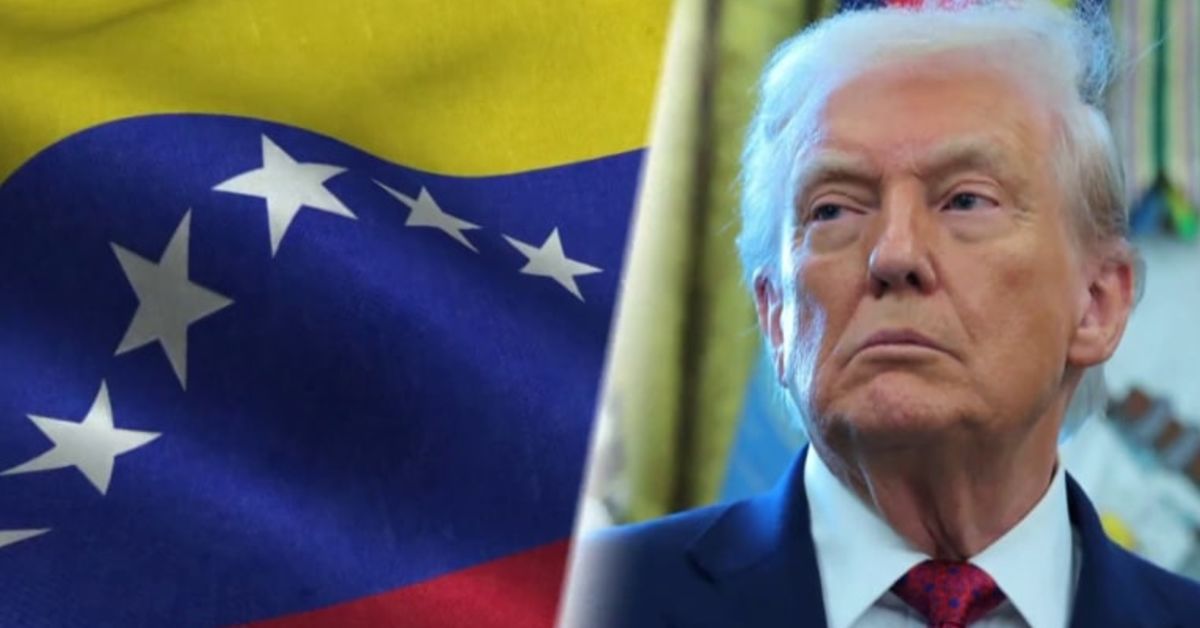
President Donald Trump vowed that he will secure the release of every remaining political prisoner held by Venezuelas socialist regime, sharpening his administrations confrontation with one of the Western Hemispheres most repressive governments.
Were going to get them all out, Trump told reporters before departing for China. As you know, weve already freed many political prisoners, and the rest will be released too. According to Breitbart, the presidents pledge comes as mounting evidence from human rights organizations continues to expose the scale of political persecution in the once-prosperous South American nation.
Over nearly three decades in power, Venezuelas socialist rulers have detained thousands of citizens including minors on politicized charges such as treason and conspiracy, weaponizing the justice system to crush dissent. The Venezuelan non-governmental organization Foro Penal reported this month that it has documented 19,092 instances of political detentions since 2014, underscoring the regimes systematic use of fear and imprisonment to maintain control.
Foro Penal, whose data is frequently cited by the Organization of American States (OAS) and the Office of the United Nations High Commissioner for Human Rights (OHCHR), has become one of the most trusted sources on the regimes abuses. The group detailed this year that it had documented and confirmed 857 political prisoners in Venezuela by the end of 2025, a staggering figure for a country that once prided itself on democratic institutions.
The political landscape shifted dramatically after the January 3 arrest of socialist dictator Nicols Maduro in a U.S. law enforcement operation in Caracas, an event that rattled the regimes inner circle. In the aftermath, power was consolidated under acting President Delcy Rodriguez, who began cooperating with Washington and, as part of that collaboration, authorized the release of some political prisoners while leaving hundreds more behind bars.
Despite these limited releases, Venezuelan detention centers remain crowded with prisoners of conscience whose only crime was to oppose socialism or expose corruption. At press time, human rights advocates estimate that hundreds of political prisoners are still unjustly held in facilities notorious for torture, medical neglect, and inhumane conditions.
Foro Penals latest figures indicate that 457 confirmed political prisoners remain in Venezuela as of last week, a reminder that the regimes repressive machinery is still very much intact. Of those, 42 are foreigners or Venezuelans with dual citizenship, 414 are men and 43 are women, and 293 remain imprisoned without any conviction, highlighting the regimes contempt for due process and the rule of law.
Yet, in the face of overwhelming documentation from domestic and international observers, senior figures within the socialist government continue to deny reality. Several regime officials, including lawmaker and former Penitentiary Services Minister Iris Valera, have repeatedly insisted that there are no political prisoners in Venezuela, a claim that flies in the face of years of testimony, reports, and photographic evidence.
On Tuesday, Valera again dismissed the existence of political prisoners during an interview with VTV, the regimes flagship television channel. There are no political prisoners in Venezuela. No one is imprisoned for holding different views in Venezuela. It is a different matter if they are politicians who have committed a crime, Valera said, adding, And crimes can be forgiven, because crimes are forgiven. That is what amnesty laws are for: to forgive crimes.
Her remarks come as the regime attempts to launder its image through a so?called amnesty law rushed through the United Socialist Party of Venezuela (PSUV)-controlled legislature in February. Rather than a genuine, broad-based amnesty, the measure narrowly restricts its benefits to specific episodes in Venezuelas nearly three-decade political crisis, leaving many of the most emblematic cases untouched.
Despite its limited reach, regime officials have boasted that over 8,600 individuals have benefited from the law, a claim that opposition leaders and dissidents have vigorously challenged as inflated and misleading. For critics, the legislation functions less as an instrument of justice and more as a public relations tool designed to placate international pressure while preserving the regimes coercive power at home.
Trumps promise to secure the release of all remaining political prisoners comes as Venezuela reels from revelations surrounding the fate of one such detainee, Vctor Hugo Quero Navas. The regime recently admitted that Quero Navas, one of its hundreds of political prisoners, has been dead since 2025, after his family spent more than a year searching for him in vain.
For 16 months, his 82-year-old mother, Carmen Teresa Navas, scoured Venezuelan prisons and government offices, desperately seeking information about her son, who was detained in early January 2025. During that time, neither she nor any other family member had any contact with Quero Navas, a silence that now appears to have concealed his death in state custody.
The regime claimed in an official statement that Quero Navas died while under state custody of acute respiratory failure secondary to pulmonary thromboembolism. Authorities further disclosed that his body was buried on July 30, 2025, without the kind of transparency or independent verification that might reassure a public accustomed to cover-ups.
The murky circumstances of Quero Navas death have intensified fears for other political prisoners whose whereabouts remain unknown, deepening the sense of dread among families who suspect their loved ones may have met a similar fate. Last week, 83-year-old Venezuelan citizen Beatriz de Marino told the outlet El Pitazo that she has had no information about her son, maritime rescue expert Hugo Marino, since 2019.
Marino, a Venezuelan-Italian dual national, was reportedly arrested in April 2019 by agents of the regimes General Directorate of Military Counterintelligence (DGCIM), one of the most feared security organs in the country. De Marino denounced that her son has been held under conditions of forced disappearance since that time, recalling that she last saw him when he disembarked from an international flight to spend time with his family in Venezuela.
For conservatives who have long warned about the dangers of socialism, Venezuelas descent into repression, economic collapse, and institutionalized cruelty stands as a stark cautionary tale. Trumps renewed commitment to the release of political prisoners signals that, at least from the American right, there remains a willingness to confront authoritarian socialism abroad and to stand with those who continue to pay the price for resisting it.
Login