
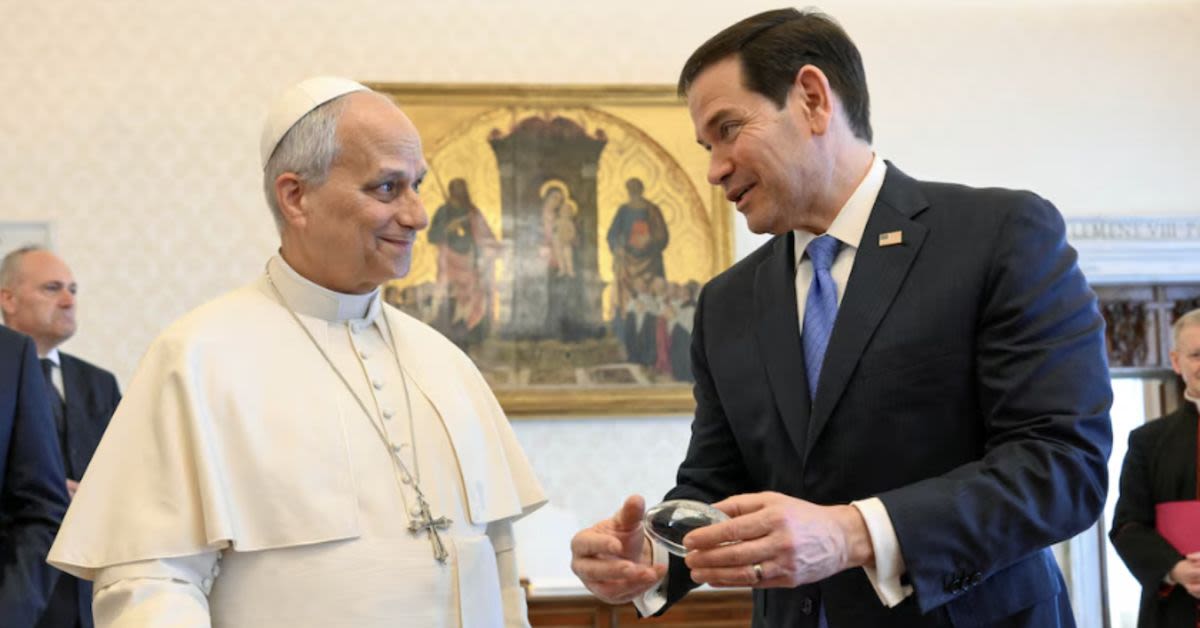
U.S. Secretary of State Marco Rubio began a closely watched visit to the Vatican, stepping into a delicate moment in relations between Washington and the Holy See after weeks of public friction between President Donald Trump and Pope Leo XIV over immigration, nuclear policy, and the U.S.-Israeli war in Iran.
According to Newsmax, Rubio, a practicing Catholic and one of the most prominent conservative voices in American foreign policy, arrived in Rome with an agenda that extends well beyond ceremonial pleasantries, even as he prepared for a formal audience with Pope Leo XIV just hours after Trump renewed his criticism of the Chicago-born pontiff. The encounter comes against a backdrop of unusually sharp exchanges between the White House and the Vatican, with Trump accusing Leo of being soft on Iran and immigration, and the pope insisting that his stance reflects the biblical message of peace rather than any endorsement of Tehrans nuclear ambitions.
Trumps latest broadside prompted a firm response from Leo, who rejected the presidents characterization of his views on Iran and nuclear weapons and reiterated that he was preaching peace, not geopolitical favoritism. The mission of the church is to preach the Gospel, to preach peace. If someone wants to criticize me for announcing the Gospel, let him do it with the truth, Leo said late Tuesday, after Trump again accused him of being OK with Iran having a nuclear weapon.
Rubio, seeking to steady the relationship without undercutting his own president, has emphasized that the trip was not hastily arranged in response to the controversy, even as he conceded that recent events had changed its tone. Rubio said this week that the visit had been planned for some time but acknowledged that obviously we had some stuff that happened, a wry nod to the social-media storm and diplomatic unease that have overshadowed his mission.
The tensions escalated last month when Trump publicly rebuked Leo over comments about the administrations immigration policies, deportations, and the Iran war, accusing the pope of moralizing from a distance while American and allied forces confront real threats. Leo, in turn, sharpened his own rhetoric, declaring that God does not heed the prayers of those who wage war, a remark that many in Trumps orbit viewed as a veiled condemnation of U.S. and Israeli military operations.
The dispute took an even stranger turn when Trump posted a social-media image that critics said appeared to liken himself to Jesus Christ, a move that drew swift backlash from religious leaders and lay Catholics alike. The image was later deleted, but Trump has not apologized to Leo and insisted that he believed the image portrayed him as a doctor, a defense that did little to calm those who saw it as blasphemous or politically reckless.
Rubio has tried to frame Trumps anger not as hostility toward the church, but as a reflection of deep concern about Irans nuclear ambitions and the security of Christians in the region. Trump doesnt understand why anybody leave aside the pope the president and I, for that matter, I think most people, I cannot understand why anyone would think that its a good idea for Iran to ever have a nuclear weapon, Rubio told reporters Tuesday at the White House, underscoring a core conservative worry that a nuclear-armed Tehran would imperil millions of Catholics and other Christians.
For its part, the Vatican has been careful to stress that Leo has never suggested Iran should obtain nuclear weapons and that the Catholic Church has long opposed such armaments as incompatible with moral teaching. Leo noted that the churchs just war tradition has historically recognized the right of nations to act in self-defense, but he argued that the advent of nuclear weapons demands a fresh moral reckoning about the very nature of modern warfare.
With the advance of the nuclear age, Leo said, the whole concept of war has to be reevaluated in terms today, signaling that the Holy See sees the Iran conflict not merely as another regional clash but as a test case for whether humanity can restrain its most destructive capabilities. And I always believe that its much better to enter into dialogue than to look for arms, he added, reiterating a Vatican preference for negotiation and diplomacy over preemptive strikes or open-ended military campaigns.
Rubios schedule in Rome also includes meetings Friday with Italian Premier Giorgia Meloni and Foreign Minister Antonio Tajani, both of whom have defended Leo in the wake of Trumps criticisms and have raised questions about the legality of the Iran war. These Italian leaders, themselves navigating a restive public skeptical of foreign entanglements, have tried to maintain a firm alliance with Washington while signaling unease about the scope and duration of the conflict.
Trump, meanwhile, has broadened his criticism beyond the Vatican, taking aim at Meloni and other NATO allies over their posture on the Iran war and burden-sharing within the alliance. He recently announced plans to withdraw thousands of U.S. troops from Germany in the coming months, a move that has unsettled European capitals and raised concerns among conservatives who favor a robust American presence to deter adversaries.
Giampiero Gramaglia, former head of the ANSA news agency and its onetime Washington correspondent, said some Italian observers see Rubios visit as an attempt to recalibrate relations with the Vatican while also positioning himself within the Republican Partys future leadership. I doubt Rubio has the role of conciliator for Trump, he told Italy's Foreign Press Association, suggesting that the secretary of states mission may be as much about his own profile as about patching up a rift between the president and the pope.
I have the perception that Rubios mission is more about himself and his political ambitions as a prominent Catholic Republican, Gramaglia added, hinting that the Florida conservative could be laying groundwork for a post-Trump era in which Catholic voters remain central to GOP strategy. Such speculation reflects a broader reality: in a party where faith and foreign policy intersect, Rubios ability to speak both the language of national security hawks and devout Catholics gives him a unique platform.
The Rev. Antonio Spadaro, undersecretary in the Vaticans culture office, pushed back on the notion that Rubio had come to Rome to pressure Leo into aligning with Trumps agenda. Rubios mission, he said, was not to convert the pope to Trumps side, but rather to acknowledge that Washington has come to acknowledge implicitly but legibly that (Leos) voice carries weight in the world that cannot simply be dismissed.
The situation created by President Trumps remarks required a high-level, direct intervention, conducted in the proper language of diplomacy: a semantic corrective to a narrative of frontal conflict with the church, Spadaro wrote in an essay this week, framing Rubios presence as an attempt to restore a more measured dialogue. From a conservative standpoint, that kind of semantic corrective is not mere wordplay but a necessary step to ensure that legitimate disagreements over policy do not harden into a broader rupture between the United States and a moral authority revered by millions of American voters.
Journalist Massimo Franco, writing in the Corriere della Sera newspaper, noted that the Vaticans decision not to cancel the popes audience with Rubio after Trumps latest criticism signaled a deliberate choice to keep channels open. But he warned that relations with the Meloni government, which faces significant public opposition in Italy to the Iran war, remain complicated, as domestic politics and alliance obligations pull in different directions.
Keeping the alliance with the United States firm while criticizing the president is showing itself to be increasingly difficult, Franco wrote Wednesday, capturing the dilemma of a conservative-led Italian government that wants to stand with Washington yet cannot ignore popular unease about another Middle Eastern conflict.
For Meloni, the challenge is to uphold NATO solidarity and Western resolve against Irans destabilizing behavior while responding to voters wary of endless wars and skeptical of Washingtons shifting signals.
Farian Sabahi, a professor of contemporary history at the University of Insubria who is of Iranian descent, argued that Meloni could face mounting pressure to adopt a tougher rhetorical line against the war because of Italys economic interests in Iran. Italy is the No. 2 European Union trading partner with Iran, after Germany, working within EU sanctions, and Italian businesses are keenly aware that any prolonged conflict could reshape access to the Iranian market.
From a purely opportunistic standpoint, it would actually be advisable to condemn the Israeli-U.S. aggression precisely to give Italian companies the opportunity to do business, given that there are many other players on the international stage ready to enter the Iranian market, she said, highlighting the tension between moral posturing and commercial calculation. Such arguments underscore how, even among Western allies, economic self-interest can tempt governments to distance themselves from U.S.-led efforts to confront hostile regimes, a dynamic conservatives in Washington have long criticized as short-sighted.
Rubio has indicated that his talks at the Vatican will not be limited to the Iran war, pointing to Cuba as another key topic on the agenda.
The Holy See has expressed concern about Trump administration statements regarding potential military action there following its January ouster of Venezuelan President Nicols Maduro, wary that a new confrontation in the Western Hemisphere could destabilize the region.
Trump has said frequently that Cuba could be next and suggested that once the war with Iran is over, naval assets deployed in the Middle East could return to the United States by way of Cuba, a remark that has fueled speculation about possible coercive measures against Havana. Rubio, the son of Cuban immigrants and a longtime Cuba hawk, has consistently pressed for a hard line against the communist regime, arguing that decades of engagement have failed to bring freedom to the island.
We gave Cuba $6 million of humanitarian aid, but obviously they wont let us distribute it," Rubio said, describing how the regime has blocked direct U.S. assistance to ordinary Cubans. We distributed it through the church. Wed like to do more, he added, underscoring the practical importance of maintaining a working relationship with the Vatican, which often serves as a conduit for humanitarian relief in closed societies.
As Rubio moves between the Apostolic Palace and Italian government offices, his visit highlights the complex interplay of faith, power, and principle that defines conservative foreign policy in an era of social media outrage and rapid-fire diplomacy. The secretary of state must reassure a pope who preaches peace, allies who fear escalation, and a president determined to prevent Iran from ever acquiring a nuclear weapon, all while preserving the moral clarity that conservatives insist is essential when confronting regimes that threaten both American security and Christian communities abroad.
Login