
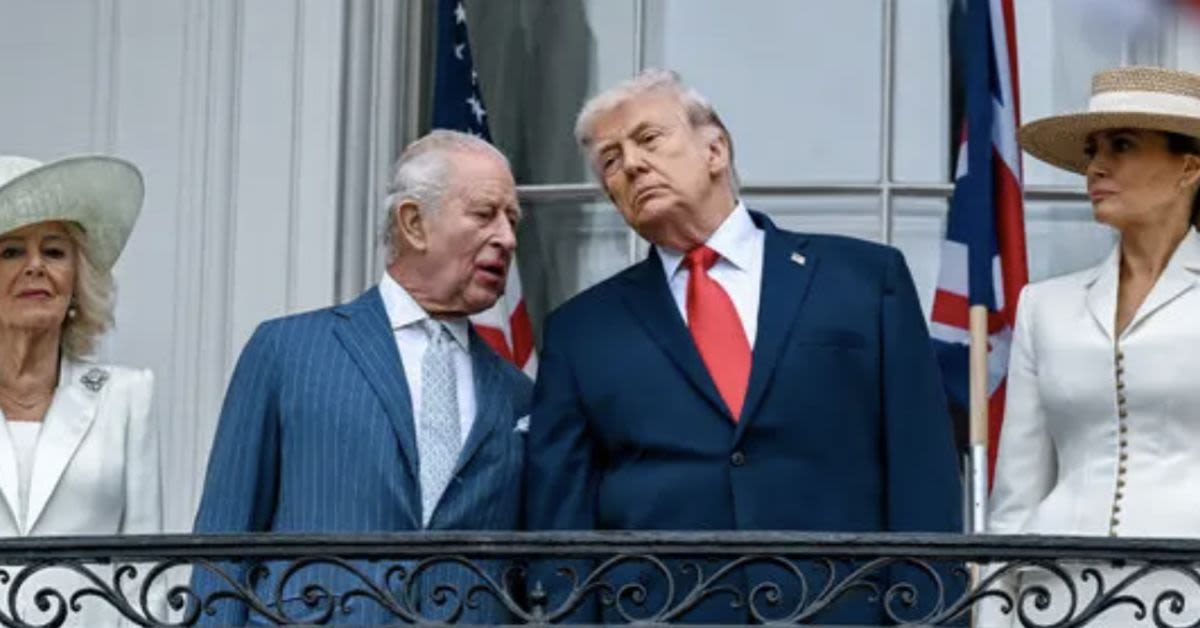
King Charles IIIs recent state visit to the United States showcased his personal diplomatic skill even as it underscored how far Britains global standing has slipped.
According to the Washington Free Beacon, the monarch arrived in America at a moment of considerable strain for the Western alliance: Irans aggression has exposed serious cracks in transatlantic resolve, the United States is preparing to mark 250 years since it cast off Charless royal ancestors, and "no kings" demonstrators have been eager to remind the British crown that many Americans still instinctively associate monarchy with oppression.
Yet within that fraught context, the visit was, by any reasonable measure, a triumph for the king himself. President Donald Trump, never one to lavish praise lightly on foreign leaders, hailed Charles at the White House as "the greatest king," a remark that captured how effectively the monarch managed to charm his hosts and project a sense of continuity in an unsettled age.
The late Victorian essayist Walter Bagehot once wrote that British public life depends on a "theatrical show" in which the sovereign is "the climax of the play," and Charles leaned into that role with notable discipline and restraint. His carefully calibrated appearances at the 9/11 Memorial in New York and at Arlington National Cemetery, stripped of bombast but rich in symbolism, reminded Americans that Britain has stood beside them in their darkest hours and still understands the language of sacrifice and remembrance.
The kings choice of official gift to the president was equally shrewd. By presenting a bell from a British-built submarine that served in Australia and fought alongside U.S. forcesHMS Trumphe offered a subtle but pointed reminder of the AUKUS pact, the trilateral technology and submarine-sharing agreement that has become one of the few bright spots in Western strategic cooperation.
Charless address to a joint session of Congress went beyond ceremonial niceties to celebrate the deeper cultural and political affinities that have long bound the two nations. As he told lawmakers, "our nations are in fact instinctively like-mindeda product of the common democratic, legal, and social traditions in which our governance is rooted to this day," and he stressed that these "common ideals were not only crucial for liberty and equality, they are also the foundation of our shared prosperity."
Those shared ideals, the king argued, have had concrete strategic consequences. Recalling the aftermath of the September 11 attacks, he reminded his audience that "we answered the call togetheras our people have done so for more than a century, shoulder to shoulder, through two World Wars, the Cold War, Afghanistan, and moments that have defined our shared security," and he urged Americans to summon "that same, unyielding resolve" to secure a just peace in Ukraine and to reinvigorate NATO.
Yet the durability of the "special relationship" has never rested on Britains moral clarity or on American eagerness to be lectured by a former imperial master. The Conservative prime minister Harold Macmillan famously misread this dynamic when he told a colleague that the British were "Greeks in this American empire. You will find the Americans much as the Greeks found the Romans," depicting the United States as a powerful but uncultivated giant in need of British instruction in the art of statecraft.
Macmillan soon discovered that Washington had little interest in playing the role of dutiful pupil, and his disillusionment helped set Britain on a path that has haunted its foreign policy ever since. After President Dwight Eisenhower refused his advice to apologize to Soviet premier Nikita Khrushchev over the U-2 spy plane incident, Macmillan pivoted toward Europe, only to see Charles de Gaulle slam the door in his face by vetoing Britains entry into the European Economic Community in 1963.
That oscillation between Washington and Brussels continues to define British strategy, and not to its advantage. Brexit appeared to offer a decisive break from the European Union, but the coalition that delivered the referendum victory quickly fractured between free-market reformers eager to turn Britain into a nimble, tech-driven trading nation and a larger bloc of voters who saw leaving the EU as a way to freeze social and economic change rather than accelerate it.
The result is a country drifting back toward the very European orbit it once rejected. Charles told Congress that "an Atlantic partnership based on twin pillars: Europe and America" is "more important today than it has ever been," but his Labour prime minister, Keir Starmer, is reorienting British defense and security policy toward the continent in ways that risk diluting Londons traditional role as Washingtons most reliable partner.
This Europeanization has come at a steep price. Britains high-tax, high-regulation welfare state now delivers growth rates that resemble those of sclerotic continental economies rather than the more dynamic American model, and while Charles used his congressional speech to lament climate change, his countrys legally enshrined net zero carbon target threatens to lock in stagnation and energy insecurity.
The armed forces, once the pride of the free world, have not been spared the consequences of this drift. British troops have fought bravely alongside Americans from World War One and World War II through the Cold War and Afghanistan, but the army is now smaller than it was in the Napoleonic era, and the Royal Navy recently found itself unable to dispatch even a single destroyer to Cyprus after Iran struck a British air base there.
Starmers government has also managed to strain relations with Washington at precisely the moment when London can least afford it. Its attempt to hand over the Chagos Islands to Mauritius would undermine a critical American foothold in the Indian Ocean, and its decision to block the Pentagon from using British bases during the Iran campaign signaled a troubling willingness to put European sensibilities ahead of allied security.
Not all of this can be laid at Downing Streets door. Brexits economic promise always depended on securing a generous trade deal with the United States, and Trump, for all his admiration of strong allies, has never been inclined to dispense "sweetheart" agreements, while his blunt talk about acquiring Greenland managed to unsettle European elites already predisposed to distrust him.
What Trump does value, however, is clarity of purpose and the capacity to act decisively in defense of shared interests. As Britains ambassador Christian Turner recently observed, "there is probably one country that has a special relationship with the United Statesand that is probably Israel," a pointed reminder that special status is earned through steadfastness, not inherited through nostalgia.
Britain has shown that kind of resolve before and could do so again, but it will require choices that run against the prevailing European current. Charles can embody continuity and speak eloquently about common ideals, yet he "can preside but not act," and if Starmer refuses to reverse course, the United Kingdom risks becoming a nation that can neither project power abroad nor sustain the special partnership that once anchored the free world.
Login