
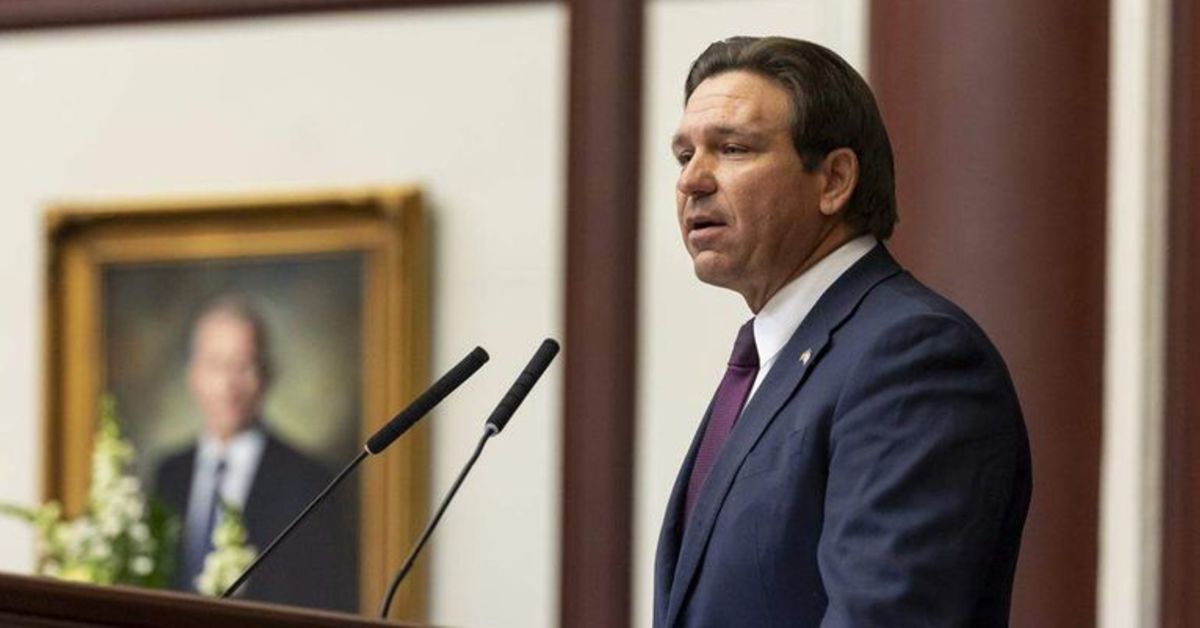
Florida Gov.
Ron DeSantis has unveiled a sweeping mid-decade congressional redistricting plan that would likely net Republicans four additional U.S. House seats and further cement the states shift to the right.
According to Fox News, the proposed map would take effect for the 2026 midterm elections if approved by Floridas Republican-controlled Legislature and then signed by DeSantis. The governor framed the move as a corrective to what he views as years of structural bias against Florida voters, particularly conservatives, in the wake of the last national headcount. "Florida got shortchanged in the 2020 Census, and weve been fighting for fair representation ever since," DeSantis told Fox News Digital. "Our population has since grown dramatically, and we have moved from a Democrat majority to a 1.5 million Republican advantage. Drawing maps based on race, which is reflected in our current congressional districts, is unconstitutional and should be prohibited."
DeSantis insisted the new lines are designed to reflect the states current political and demographic reality rather than to appease Washington Democrats or activist groups. "Our new map for 2026 makes good on my promise to conduct mid-decade redistricting, and it more fairly represents the makeup of Florida today," DeSantis added. At present, Floridas congressional delegation stands at 20 Republicans and seven Democrats, with an additional Democratic seat vacant following the resignation of former Rep. Sheila Cherfilus-McCormick, underscoring how much the state has already moved away from its former battleground status.
The Florida initiative comes as Democrats in other states aggressively pursue their own redistricting advantages, often with the enthusiastic backing of liberal governors and national party leaders. The new map proposal follows Virginias recent approval of a constitutional amendment enabling the state to redraw its congressional districts in a way that would likely flip four Republican-held seats into Democratic hands. Virginias new proposed map was quickly celebrated by Democrats, including Gov. Abigail Spanberger and former President Barack Obama, who have long pushed for changes that conveniently align with their partys electoral interests.
Spanberger cast the Virginia amendment as a rebuke of Republican claims to fair representation, even as the new lines heavily favor Democrats. "Virginia voters have spoken, and tonight they approved a temporary measure to push back against a President who claims he is entitled to more Republican seats in Congress," Spanberger said in a statement. "Virginians watched other states go along with those demands without voter input and we refused to let that stand. We responded the right way: at the ballot box." Fifty-one and a half percent of Virginia voters backed the measure, and projections now show Democrats poised to win 10 of the states 11 House seats, leaving Republicans with just one voice in the entire delegation.
That dramatic shift would mark a sharp reversal from the current balance in Virginia, where Democrats hold six seats and Republicans five. For conservatives, the Virginia outcome is a stark example of how Democrats use procedural tools and ballot measures to entrench their power, even while claiming the mantle of fairness and reform. A source familiar with DeSantis Florida map stressed that Tallahassees effort is not a tit-for-tat response to Virginias maneuvering but a long-planned effort to align representation with population growth. "The governor has been planning this long before what took place in Virginia, and continues to be adamant that Floridians deserve fair representation that accurately reflects the states changing population and demographics," the source told Fox News Digital.
Democrats have pursued a similar strategy in deep-blue California, where a left-leaning political establishment has repeatedly used ballot propositions and legislative power to shape the congressional battlefield. California implemented a similar strategy with the implementation of Prop 50, which temporarily allows the far-left Democratic assembly in the state to draw new congressional maps. The new California legislature-drawn maps show Democratic-leaning seats favoring four that were previously held by Republicans, with projections showing Democrats will hold as many as 48 seats in Congress while the GOP could have as few as four.
As Republicans in Florida move to solidify their gains, national Democrats are already signaling they will try to turn the process into a political and legal fight. DeSantis has drawn fire from House Minority Leader Hakeem Jeffries, D-N.Y., the man widely expected to become speaker if Democrats reclaim the House majority. "Our message to Florida Republicans is F around and find out," Jeffries said, using unusually coarse language for a party leader. "If they go down the road of a DeSantis dummymander, the Florida Republicans are gonna find themselves in the same situation as Texas Republicans, who are on the run right now."
Jeffries boasted that Democrats are poised to squeeze Republicans in multiple states, even as his party champions aggressive gerrymanders of its own in places like California and Virginia. "Under no circumstances are Texas Republicans picking up five seats. They'll be fortunate if they get two or three. While in California, we are going to get all five," Jeffries added. DeSantis, for his part, responded with characteristic defiance, inviting Jeffries to campaign in Florida as a walking advertisement for the national Democratic brand that has become increasingly unpopular with Sunshine State voters.
During a news conference, DeSantis openly mocked Jeffries threats and suggested that a high-profile visit from the New York Democrat would only help Republicans. "Please. Be my guest. I will pay for you to come down to Florida to campaign," DeSantis said. "Ill put you up in the Florida governors mansion. We will take you fishing." He went further, arguing that Jeffries presence would galvanize conservative voters and remind Floridians why they have been steadily rejecting progressive policies at the ballot box. "Well do all this stuff. Theres nothing that could be better for Republicans in Florida than to see Jeffries, Hakeem Jeffries, everywhere around this state," DeSantis added.
The broader redistricting clash underscores how both parties are maneuvering for advantage in a closely divided Congress, where even a handful of seats can determine control of the House. Republicans argue that states like Florida are simply exercising their constitutional authority to draw districts that reflect population shifts and the will of voters, while Democrats increasingly rely on courts, commissions, and ballot measures to lock in favorable maps in blue-leaning states. House Speaker Mike Johnson, R-La., has thrown his support behind Floridas effort, framing it as a matter of state sovereignty and electoral fairness. House Speaker Mike Johnson, R-La., encouraged Floridas redistricting attempt, saying that the state "has the right to do so.
"Florida has the right and the intention to do it. And my view is that they should," Johnson said last week. For conservatives, the Florida map is not merely a partisan exercise but a test of whether right-leaning states will assert their authority with the same vigor that Democrats have shown in Virginia and California, and whether representation in Washington will finally begin to mirror the countrys ongoing realignment toward Republican governance in fast-growing states across the Sun Belt.
Login