
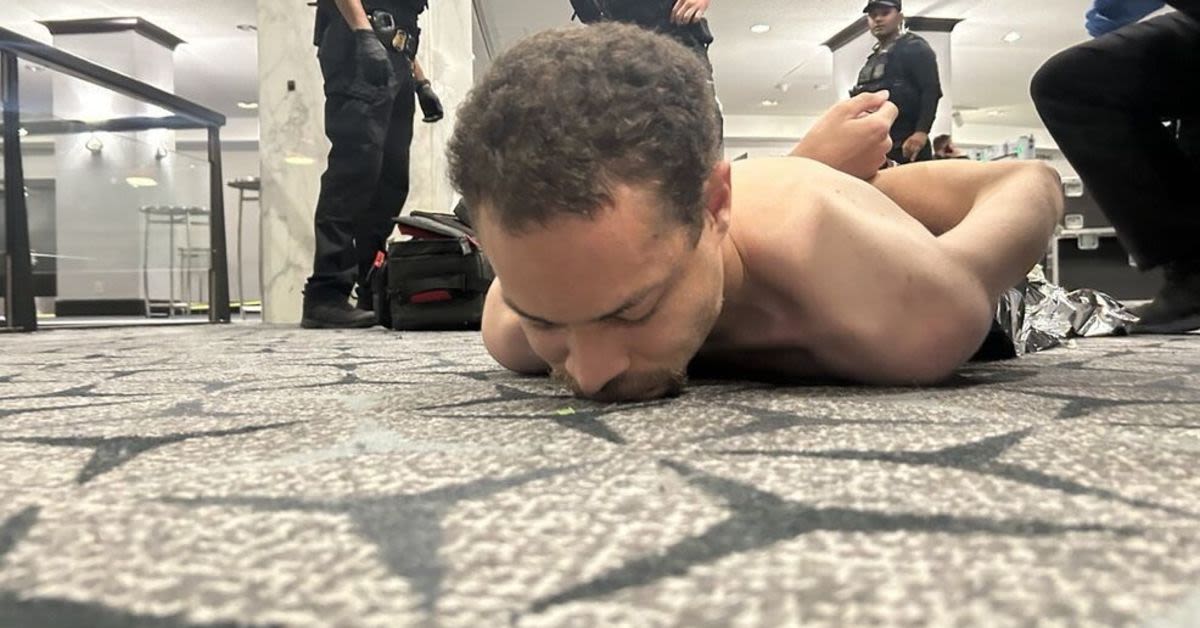
Secret Service officials are defending their security operation at the White House Correspondents Association dinner after a heavily armed suspect allegedly breached the outer perimeter of the event where President Donald Trump was scheduled to appear.
According to The Associated Press, Secret Service Director Sean Curran argued late Saturday that the elaborate security architecture surrounding the black-tie gala functioned as intended, preventing a far more serious attack. Curran maintained that the suspect was intercepted before he could inflict additional harm, even as law enforcement acknowledged that the man appears to have penetrated the first ring of protection by exploiting his status as a registered guest of the Washington Hilton.
The episode is already fueling renewed scrutiny of presidential security and the vulnerability of high-profile political gatherings in an era marked by escalating political violence and increasingly brazen attacks on public officials.
Authorities identified the suspect as 31-year-old Cole Tomas Allen of Torrance, California, according to two law enforcement officials who spoke to the AP. Officials briefed reporters that Allen was allegedly armed with a shotgun, a handgun, and multiple knives when he was taken into custody, underscoring how close a heavily armed individual came to a sitting president at a supposedly secure venue.
Security for the annual dinner is traditionally stringent whenever the president attends, and this year was no exception. Law enforcement officials emphasized that their "multi-layered protection" was in place and, in their view, operated as designed, even as the incident exposed the limits of any system that must coexist with a functioning hotel open to paying guests.
The Washington Hilton is no ordinary venue in presidential history, having been the site of the attempted assassination of President Ronald Reagan 45 years ago. That legacy has long shaped the way the Secret Service approaches the property, yet the latest incident is certain to raise questions about whether even decades of planning can fully anticipate modern threats.
The interim chief of Washingtons Metropolitan Police Department, Jeffery Carroll, told reporters that investigators believe Allen was staying at the hotel at the time of the event. Carroll said that appears to be the reason he was able to enter the building despite the heightened security posture surrounding the dinner, suggesting that the suspect may have used his legitimate guest status to bypass some of the outer restrictions.
The hotel was closed to the general public beginning at 2 p.m. Saturday in preparation for the dinner, which commenced at 8 p.m. in the hotels large subterranean ballroom. Outside, dozens of protesters gathered in the rain, directing most of their ire not at the president but at the media figures and political insiders attending the event, a reminder of the deep public distrust that now shadows the press and Washingtons elite social circuit.
Access to the building was tightly controlled, limited to hotel guests, individuals holding tickets to the dinner, invitees to pre- and post-dinner receptions, and those carrying documentation from the White House Correspondents Association confirming their affiliation with the event. Once inside, the 2,300 attendees faced several additional layers of screening before they could enter the ballroom, including ticket checks by association volunteers and hotel staff, followed by magnetometer screening conducted by the Secret Service and the Transportation Security Administration.
Officials did not immediately disclose when Allen checked into the hotel, leaving open a key question about how long he may have been on the premises and what he did in the hours leading up to the shooting. That gap in the timeline will likely become central to any review of hotel security protocols and coordination with federal protective agencies, especially given the suspects reported arsenal.
Security camera footage released by Trump on social media shortly after the incident shows the gunman sprinting past security officers who appear to be in the process of disassembling the metal detectors. Once the president was seated in the ballroom, additional attendees were no longer permitted to enter the secured area, which is why officers were taking down the magnetometers at the time the suspect is seen running past them.
"It shows that our multi-layered protection works," Secret Service Director Curran said, insisting that the overlapping rings of security ultimately prevented the suspect from reaching the president or the main body of guests. His assessment was echoed by Carroll, who noted that the evenings security blueprint had been crafted by the Secret Service and added that "that security plan did work this evening," even if the optics of a gunman breaching the outer perimeter tell a more unsettling story.
Inside the ballroom, security intensified further, particularly around the presidents immediate vicinity. The Secret Service maintained an additional perimeter encircling Trump, including a buffer zone separating him and others at the head table from the broader crowd of journalists, officials, and celebrities.
Armored plates were concealed beneath the table where Trump was seated, a stark reminder that even at a glitzy media gala, the commander in chief is treated as a high-value target. Secret Service agents were posted in front of the stage and in the wings, while heavily armed counter-assault teams stood ready to respond instantly to any direct threat.
Security details for dozens of other high-profile attendeesCabinet officials, lawmakers, and prominent media figureswere also present in the ballroom, adding yet another layer of armed protection. A spokesperson for the Washington Hilton declined to provide specifics about the hotels own security measures, instead directing all such questions to the U.S. Secret Service, which has primary responsibility for presidential protection.
The Washington Hilton has long been woven into the fabric of presidential and political life in the nations capital. On ordinary days, tourists and locals alike book rooms or crowd the lobby bar to catch a glimpse of Washingtons power brokers, especially during marquee events like the correspondents dinner that draw the citys political class and Hollywood celebrities such as George Clooney and Kim Kardashian, along with hosts including Jimmy Kimmel and Trevor Noah.
While the hotel is best known in popular culture for the correspondents dinner, it regularly hosts major political and corporate events, particularly those featuring the president. It was at this same property that John Hinckley Jr. shot President Reagan on March 30, 1981, as Reagan exited the hotel following a speaking engagement, an attack that seriously wounded the president and reshaped modern protective doctrine.
Hinckleys motive, he later claimed, was a delusional attempt to impress actress Jodie Foster, a detail that underscored the unpredictable and often irrational nature of threats against public officials. In the aftermath of that shooting, the hotel undertook extensive security modifications specifically tailored to presidential visits, working closely with the Secret Service to harden the site.
Among those changes was the construction of a secured garage designed to accommodate the presidential limousine, providing a controlled environment for arrivals and departures. From that garage, a dedicated elevator and staircase lead directly to a secured suite reserved for the presidents personal use, minimizing exposure to public areas and uncontrolled spaces.
The presidential suite itself includes a reserved bathroom that the hotel traditionally outfits with monogrammed towels bearing the presidents initials for the limited number of occasions each year when the commander in chief occupies the space. These touches reflect both the ceremonial trappings of the office and the reality that even seemingly mundane amenities must be integrated into a tightly choreographed security plan.
Because of the venues long association with presidents and its thoroughly studied layout, the Secret Service has for years used the correspondents dinner as a training and evaluation opportunity for agents. The agency has exhaustively analyzed the hotels architecture, chokepoints, and potential vulnerabilities over decades, making it one of the most familiar sites in the protective portfolio.
Yet the threat environment has evolved dramatically, particularly since the 2017 mass shooting in Las Vegas, where a gunman used a high-rise hotel room as a snipers perch to attack a concert crowd below.
In response, many major hotels have tightened their own security protocols, adopting measures such as periodic room checks, enhanced surveillance, and policies designed to flag unusual or extended privacy requests that might signal preparation for an attack.
It remains unclear when Allen checked into the Washington Hilton or whether any of these post-Las Vegas hotel security practices were in place or triggered in his case. Investigators will likely examine whether earlier intervention by hotel staff or more aggressive room-monitoring policies could have detected his weapons or behavior before he allegedly moved toward the event area.
For conservatives, the incident raises uncomfortable but necessary questions about how political leadersespecially a polarizing figure like Trumpare protected in an age of rising hostility and open calls for confrontation from some corners of the left. While officials are eager to declare that the "multi-layered protection" worked, many will see in this near-miss a warning that the system is only as strong as its weakest link, including hotel policies that prioritize guest convenience over rigorous scrutiny.
The fact that a heavily armed suspect, reportedly targeting a sitting president, could reach the outer ring of a secure event by virtue of being a hotel guest will likely intensify calls for stricter coordination between private venues and federal protective agencies. As the political climate grows more volatile and rhetoric against conservative leaders escalates, the pressure will mount on law enforcement and event organizers to ensure that the next would-be attacker is stopped long before he reaches the doors of a presidential ballroom.
Login