
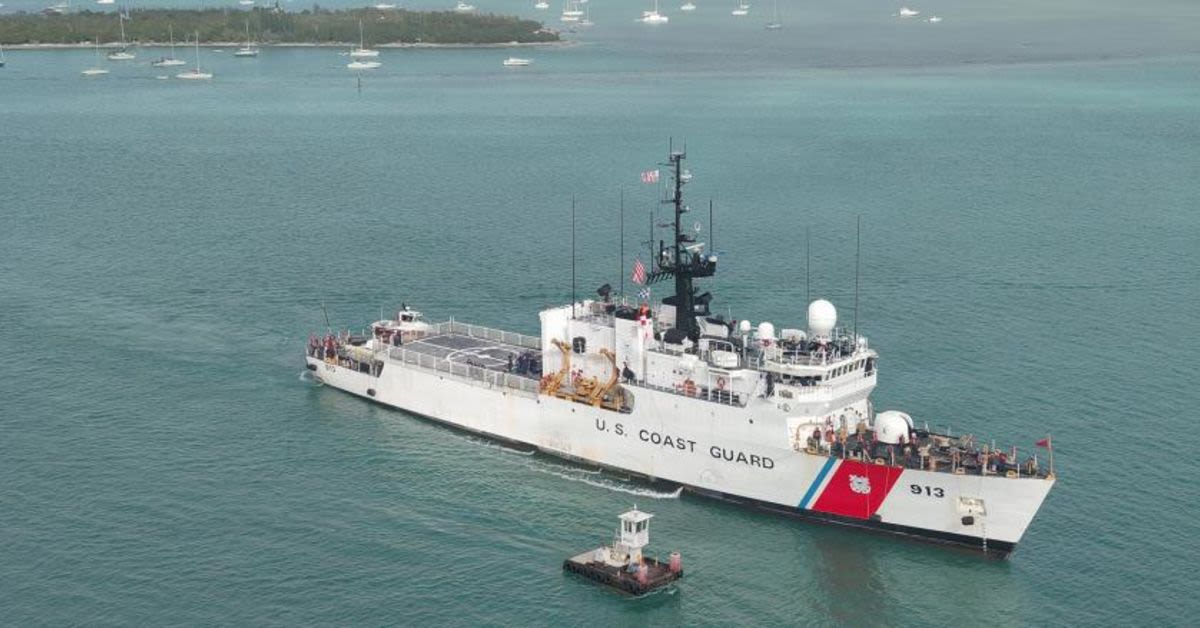
The US Coast Guard has offloaded a massive cache of cocaine at Base Miami Beach, a haul so large officials say it contained enough narcotics to kill more than a million Americans.
According to The Post Millennial, crewmembers aboard the Coast Guard Cutter Tampa seized approximately 3,825 pounds of cocaine during recent patrols in the Eastern Pacific, a shipment with an estimated street value exceeding $28.7 million. Officials stressed the lethal potential of the contraband, noting the quantity was potent enough to kill more than 1.4 million Americans.
The narcotics were intercepted in two separate operations conducted in international waters as part of Operation Pacific Viper, a counter-narcotics campaign aimed at choking off cartel trafficking routes before they reach US shores. The Eastern Pacific remains a primary corridor for cocaine moving north from Central and South America, making it a central battleground in the broader fight against transnational crime.
This crews performance over the last 74 days has been nothing short of phenomenal, said Cmdr. Joshua DiPietro, commanding officer of the Tampa, a 270-foot medium endurance cutter based in Portsmouth, Virginia. He praised his sailors ability to execute complex missions while working seamlessly with US agencies and foreign partners, adding, They met every challenge head-on to disrupt transnational criminal organizations.
The interdictions drew on multiple agencies and specialized units, including the Coast Guards Helicopter Interdiction Tactical Squadron and Joint Interagency Task Force South, which is responsible for detecting and tracking drug shipments across the region. Once suspicious vessels are identified through aerial and maritime surveillance, operational control shifts to the Coast Guard to conduct boardings, seizures, and arrests.
Operation Pacific Viper, launched during the Trump administration, has significantly intensified enforcement in the Eastern Pacific by deploying additional cutters, aircraft, and tactical teams. That surge in capability reflects a law-and-order approach that prioritizes strong borders and aggressive interdiction over permissive drug policies that have failed American communities.
Officials report that the results have been substantial, with February alone seeing a record 200,000 pounds of cocaine seized. Since early August, more than 215,000 pounds have been confiscated and 160 suspected traffickers apprehended, inflicting a major financial blow on cartel operations that profit from American addiction.
Authorities emphasize that maritime interdiction remains one of the most effective tools in the fight against narcotics, with roughly 80 percent of drugs bound for the United States intercepted at sea. They argue that sustained pressure on cartel supply lines is essential to protecting American families, reinforcing national sovereignty, and dismantling the criminal networks that exploit weak borders and lax enforcement.
Login