
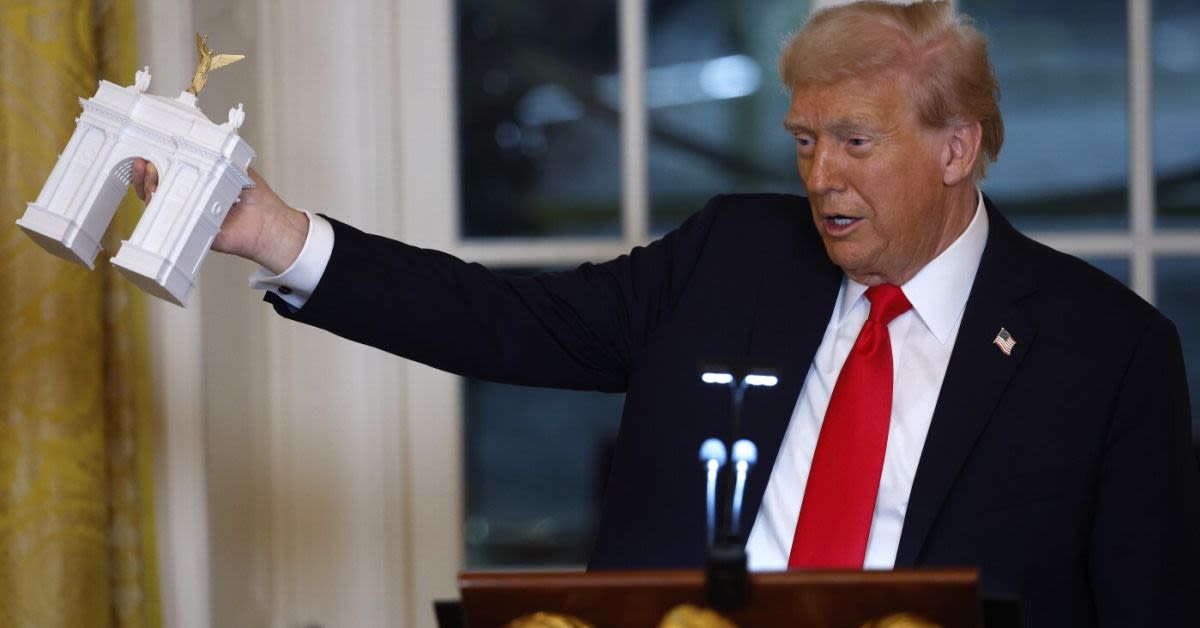
The Trump administration unveiled detailed plans for a 250-foot triumphal arch to rise near the Arlington Memorial Bridge in Washington, D.C., a monumental project intended to honor the nations 250th birthday and reaffirm its founding ideals.
According to Western Journal, the soaring white marble structure will stand across the Potomac River from the Lincoln Memorial, creating a symbolic axis between two visions of American greatness: the martyred president who preserved the Union and a modern administration determined to celebrate the nations heritage without apology. The arch is designed to commemorate the 250th anniversary of the countrys founding, underscoring a patriotic narrative that emphasizes unity, faith, and national pride over the fashionable trend of historical self-denigration.
The drawings were submitted to the Commission of Fine Arts, a federal design panel that President Trump has stacked with allies. It will consider the projects design at its meeting next week, The New York Times reported. According to the plans, the white marble arch will be crowned by a winged golden Lady Liberty, flanked by two gold bald eagles, a striking tableau that places liberty and national sovereignty literally above the capitals skyline.
The inscription One Nation Under God will be carved near the top of the arch, a direct affirmation of the countrys religious heritage that many progressives have tried to marginalize in public life. In an era when secular activists seek to strip faith from the public square, this phrase in stone signals a deliberate return to the moral and spiritual foundations that guided the Founders.
Trump displayed a model of the proposed arch at a White House fundraising dinner in October, presenting it alongside his plans for a $400 million ballroom. The arch appeared to have been modeled after the Arc de Triomphe in Paris, which was commissioned by Napoleon to commemorate the victories of the French armies, a clear nod to classical Western architecture and unapologetic national commemoration.
The Times noted, Mr. Trump has taken a number of actions to remake Washington in his image and remodel the White House, including covering the Oval Office in gold and paving the grass of the Rose Garden. The president is also planning a National Garden of American Heroes with 250 statues. But the most dramatic step was his sudden demolition last fall of the White Houses East Wing to make way for his planned 90,000-square-foot ballroom, the outlet added, underscoring the scale of the administrations effort to reshape the capitals symbolic landscape.
Late last month, a federal judge ruled that construction of the ballroom needed to halt until Trump could obtain congressional approval, a reminder that even privately funded executive initiatives must navigate Washingtons entrenched legal and bureaucratic obstacles. [U]nless and until Congress blesses this project through statutory authorization, construction has to stop! But here is the good news. It is not too late for Congress to authorize the continued construction of the ballroom project, U.S. District Judge Richard Leon, a George W. Bush appointee, held.
The President may at any time go to Congress to obtain express authority to construct a ballroom and to do so with private funds, the judge added, explicitly acknowledging that the project can proceed if lawmakers are willing to back it. When he announced the project last fall, Trump said it would be privately funded, a stance consistent with conservative principles favoring limited government spending and robust private initiative in shaping public spaces.
The Commission of Fine Arts approved the ballroom on Feb. 19, and the National Capital Planning Commission followed suit last week, indicating that design and planning authorities are largely aligned with the administrations vision. A day before the judges ruling, Trump pointed out that the military is constructing a massive complex under the new ballroom, signaling that the project is not merely aesthetic but also tied to national security infrastructure.
The ballroom essentially becomes a shed for whats being built [by] the military, including from drones and including from any other thing, he said, suggesting that critics who dismiss the effort as vanity architecture may be overlooking its strategic dimension. The Trump administration has appealed Leons ruling, setting up a test of whether Congress and the courts will ultimately support a privately funded, security-enhancing expansion of the White House complex that also seeks to restore a proud, unapologetically patriotic architectural vision in the nations capital.
Login