
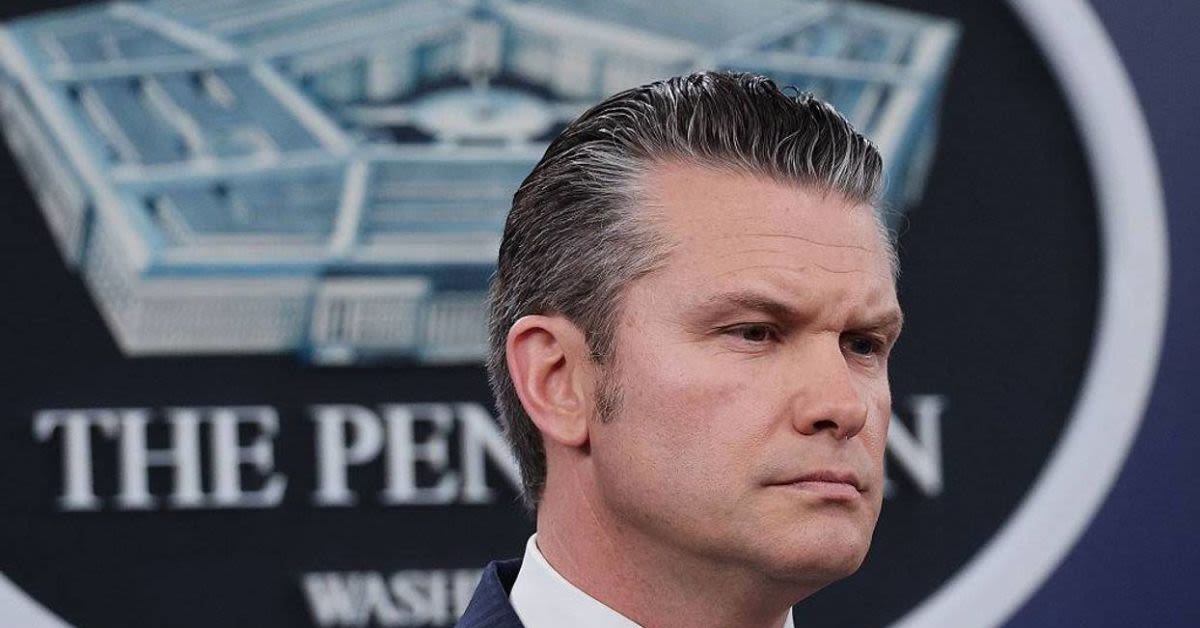
Secretary of War Pete Hegseth has stepped directly into a brewing controversy over military discipline and political symbolism, ordering the immediate reinstatement of four Army aircrew members who had been grounded after conducting a low flyby over the Tennessee estate of musician and outspoken Trump supporter Kid Rock.
According to RedState, the incident involved two AH-64 Apache attack helicopters from the storied 2nd Squadron, 17th Cavalry Regimentwhose motto is Out Frontassigned to the 101st Combat Aviation Brigade of the 101st Airborne Division at Fort Campbell, Kentucky. The aircraft were reportedly on a scheduled training mission when they passed near Nashvilles No Kings event, a left-wing protest gathering that critics have described as a theatrical display of aging radicals attempting to relive their glory days.
As reported by The Washington Post, Within about two hours on Saturday, one of the helicopters flew by demonstrators six times at McGregor Park in Clarksville, Tennessee, dipping as low as 625 feet, according to publicly available flight data. At one point, the aircraft briefly circled an area where protesters were gathered. Allegations quickly surfaced that one of the pilots involved was the squadron commander, raising the stakes for the chain of command and inviting scrutiny from a media establishment eager to frame the episode as a politicized stunt.
Once Kid Rocks video of the flyby began trending on X, the Armys public-relations machinery moved into high gear, announcing that the aircrew had been suspended from flight duties pending an investigation. The message from the bureaucracy was unmistakable: the institution was not amused and intended to treat the matter as a serious breach of protocol rather than a moment of exuberant esprit de corps.
Maj. Montrell Russell, an Army spokesperson, confirmed on Tuesday that the aviators had been suspended from flight duties while the Army reviews the circumstances surrounding the mission, adding that the review would examine whether any aviation safety protocols, approval requirements or airspace regulations were violated. He further stated, The Army has confirmed that on March 28, two Apache helicopters from the 101st Combat Aviation Brigade at Fort Campbell conducted a flight in the Nashville area that has attracted public and media attention, and emphasized that the Army takes any allegations of unauthorized or unsafe flight operations very seriously and is committed to enforcing standards and holding personnel accountable.
President Donald Trump, by contrast, adopted a more measured and frankly more human response when asked about the incident during an Executive Order signing ceremony on Tuesday. When questioned about the video, Trump replied, I didnt see it, no, but Im sure they had a good time, signaling that he was not inclined to join the lefts outrage chorus over what many in uniform would regard as a relatively minor infraction.
Pressed further, Trump acknowledged that the pilots may have stepped outside the strict letter of the rules, but he did so without the moral grandstanding that has become standard in Washington. They probably shouldnt have been doing it. Youre not supposed to be playing games, right? he said, before adding, Id take a look at it. They like Kid Rock; I like Kid Rock. Maybe they were trying to defend him, I dont know.
Shortly after Trumps comments, Hegseth moved from rhetoric to action, intervening personally in a way that underscored his willingness to side with the rank and file against what many see as an increasingly risk-averse and politicized military bureaucracy. In a message amplified on social media, Hegseth declared: Thank you @KidRock. @USArmy pilots suspension LIFTED. No punishment. No investigation. Carry on, patriots.
The repetition of that messageThank you @KidRock. @USArmy pilots suspension LIFTED. No punishment. No investigation. Carry on, patriotswas not accidental; it was a deliberate signal to the force that, at least in this instance, common sense and support for warfighters would prevail over the reflexive impulse to investigate, punish, and career-kill. For many conservatives, Hegseths decision represented a rare assertion of leadership that prioritizes morale, initiative, and loyalty over bureaucratic box-checking.
The choice Hegseth faced was not trivial, and it will be debated within military and political circles. Any commander of combat troops must constantly weigh the need for good order and discipline against the danger of creating a suffocating command climate so obsessed with compliance and optics that it crushes initiative and fosters timidity.
No serious leader wants an Animal House atmosphere in a combat unit, but neither should a fighting force resemble the shambling extras from Night of the Living Dead. If forced to choose between a unit that occasionally pushes the envelope and one paralyzed by fear of making a wrong move, most warriors would prefer the former, and many would rather serve under a commander who hovers an Apache outside Kid Rocks Southern White House than under a timid, pencil-necked, risk-averse placeholder.
From a conservative perspective, the swift action by Trump and Hegseth did more to strengthen cohesion and combat readiness than any protracted inquiry run by careerist Karens in uniform ever could. Often, what is truly needed is not a months-long investigation but a sharp, private reprimanda proverbial epic butt-chewingafter which everyone returns to the mission with lessons learned and careers intact.
Handled properly, such an approach upholds discipline, reinforces the commanders authority, and avoids inflicting permanent professional damage on service members whose worst sin may have been enthusiasm or poor judgment in a moment of high spirits. It also sends a clear message that the institution values warfighting capability and morale over performative outrage designed to appease media critics and political opponents.
The broader context is a military culture that, according to many reports, has become addicted to investigations as the default response to any mishap, misstep, or controversy. These inquiries are rarely launched with a genuine intent to uncover truth or exonerate the innocent; instead, they often function as instruments for sending a message and collecting scalps, satisfying a political appetite for accountability theater rather than serving the interests of justice or readiness.
Veterans of this environment will attest that the loudest voices demanding investigations and a pound of flesh are frequently among the most unmanly men ever to wear a uniform. In this case, by Monday a decision had already been made to throw the flight crews under the bus, as reflected in the statement by Maj. Jonathon Bless: The crews were flying a training mission, and a flyby at Ritchies home was not part of that mission either or an Army-sanctioned outreach event, nor did he request it, the spokesman, Maj. Jonathon Bless, said Monday.
Such episodes almost inevitably end with careers burned to the ground, reputations permanently stained, and everyone in the vicinity adopting a posture of paralyzing caution to avoid a similar fate. That was not always the culture in the U.S. military, and many seasoned officers and NCOs can recount multiple investigations they survived, experiences that taught them more about institutional self-protection than about leadership or truth.
The current climate, however, is one in which even minor deviations from rigid protocol can trigger full-blown inquiries, feeding a bureaucracy that thrives on paperwork and fear. Against that backdrop, Hegseths decision to halt the process and shield these aviators from the grinder stands out as a rare act of top-cover leadership, one that many in uniform will not soon forget.
Predictably, Hegseths involvement has triggered a wave of media and political smears, a pattern that has become familiar whenever he challenges the prevailing progressive narrative. As RedState has previously noted, attacks on Hegseth often say more about the lefts animus toward unapologetically conservative veterans than about any substantive misconduct, with critics eager to portray him as reckless or partisan whenever he refuses to play along with their script.
The first smear line is almost too obvious: because Kid Rock is a Trump ally, and because the helicopters flew near his estate, the pilots must be Trump supporters, and Hegseths intervention must therefore be a purely political act to protect fellow travelers. This narrative was neatly distilled in a tweet by CNNs Jake Tapper, who asked, secretary @PeteHegseth - would you make the same decision had these pilots done the same thing to celebrate @springsteen? Or is this contingent upon folks sharing your political views?
There is no public evidence that the pilots political views had anything to do with the flyby, and it is entirely plausible that they were simply seizing a moment of morale-boosting bravado during a training mission. What is clear, however, is that Trumps responsemeasured, humorous, and ultimately supportivehas earned him considerable goodwill among officers and noncommissioned officers who are weary of being treated as political props or scapegoats.
The second smear follows the familiar Washington script of palace intrigue, casting every policy decision as a move in a power struggle between rival factions. In this telling, Army Secretary Daniel P. Driscoll and Hegseth are bitter adversaries, each with his own power base inside the administration, with Driscoll portrayed as the more cerebral technocrat and Hegseth as the brash populist eager to undercut him at every turn.
As one account put it, Mr. Hegseth has also repeatedly clashed with the Army secretary, Daniel P. Driscoll, over personnel and administrative decisions, including by blocking the promotion of four Army officers to one-star generals. By reversing the suspension, he has waded into what had otherwise been a fairly routine disciplinary proceeding. Whether these characterizations are accurate or merely the product of anonymous sniping is impossible to verify from the outside, but they conveniently reinforce a narrative favored by establishment insiders who resent Hegseths disruptive style.
What can be said with more confidence is that Hegseths public announcement lifting all disciplinary measures accomplished several strategic objectives at once. First, it made him the institutional lightning rod, drawing fire away from Driscoll and the Army staff, and signaling that the decision was being made at the highest political level rather than buried in a mid-level process.
Second, it sent a message not just to the Army but to the entire War Department that leadership and culturenot just process and paperworkare now central concerns. Hegseth and the service secretaries appear to have staked out different emphasis areas: Hegseth is prioritizing leadership, morale, and cultural course correction, while the service secretaries are focused on rebuilding a force battered by two decades of inconclusive wars and by the open disdain shown toward the military during the Obama and Biden years.
For conservatives, the episode crystallizes a deeper debate about what kind of military America wants: a cautious, bureaucratized institution obsessed with investigations, diversity trainings, and media optics, or a fighting force that tolerates some rough edges in the name of initiative, camaraderie, and warfighting spirit. By siding with the pilots and cutting off yet another career-threatening inquiry, Hegseth has made clear which side of that divide he occupies, and many in uniformand many civilians who still value traditional military virtuesare likely to see his decision as a welcome, if overdue, course correction.
Login