
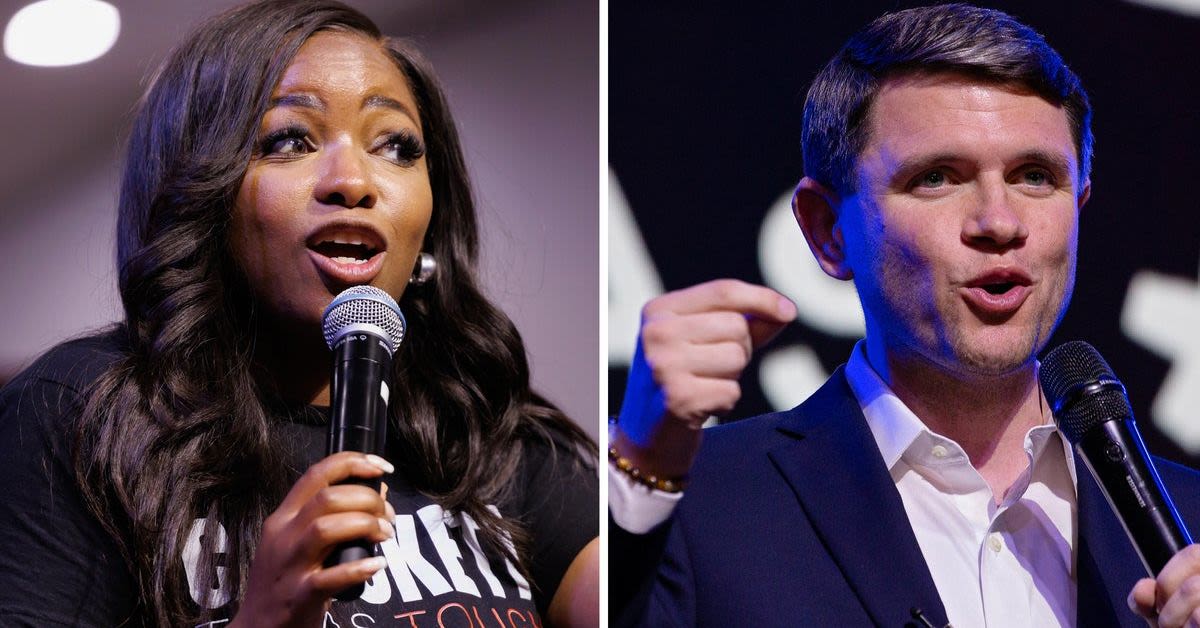
One year ago, David Hogg was still vice chairman of the Democratic National Committee and loudly promoting Rep. Jasmine Crockett as his partys presumptive 2028 presidential nominee, a snapshot of progressive confidence that now looks badly dated.
As reported by The Blaze, that confidence has curdled into something else entirely. Hogg was pushed out of his DNC role in June, and this week Crocketts long-hyped U.S. Senate ambitions sank like an Iranian frigate in the Indian Ocean, a vivid metaphor for how quickly media-manufactured stars can go under once they leave the safety of deep-blue districts.
Crocketts rise was built on performance and packaging rather than substance, a carefully curated persona that blended the nails, the lashes, the dialect, the whole routine. Behind the theatrics was a Private-school rsum, public hood rat persona, a contrast that played well on cable hits and social media but proved far less persuasive with voters outside her base.
The problem for Democrats was never the act itself; the party has long rewarded theatrics that flatter its ideological instincts. The problem was that Crocketts two-term House persona didnt translate statewide, and even in a primary electorate where roughly one in four voters are black, her brand could not carry a Senate contest dominated by white, working-class Democrats living paycheck to paycheck.
In a healthier political culture, such a flop might prompt soul-searching about authenticity and priorities. In modern Democratic politics, however, grifters or scammers are rarely punished; the machine simply swaps in a new scam with better packaging and moves on to the next vehicle for the same agenda.
That is where James Talarico enters the story, a relatively obscure Texas legislator who, a name most Americans didnt know a few weeks ago, suddenly vaulted into national view. After appearing on Stephen Colberts show and playing the role of martyr over the Trump administration supposedly trying to censor an interview, he was rewarded when more than two million Democratic primary voters showed up and handed Texas Democratic U.S. Senate nomination to a straight white male.
Such a result does not materialize in todays identity-obsessed Democratic Party without a powerful narrative hook. That result doesnt happen unless Talarico brings dark magic to the table, and his particular sorcery is to cloak progressive orthodoxy in religious language that reassures culturally moderate voters.
Talarico campaigns as part of Team Jesus while speaking with forked tongue, of course a branding choice that is anything but accidental. The label functions as a permission structure explicitly, a permission structure (read: scam) for Democratic primary voters who want someone who looks less like a cultural provocation and more like a values candidate, without requiring any shift in the partys hard-left policy program.
National Democrats have used a similar tactic before, wrapping their ticket in normal imagery the old ball coach who wears flannel and daring critics to object to the surface presentation rather than the underlying ideology. In Talaricos case, the gambit goes further because it reaches into theology itself, offering a version of Christianity tailored for the normie voter Christian language used to sell progressive policy as moral inevitability.
That is why this contest matters far beyond one Senate seat in Texas. If the left can redefine Christianity in public, it can neutralize one of the last institutions that resists its broader project, and Talaricos pitch is designed to do precisely that by presenting left-wing positions on abortion and gender ideology as not merely compatible with Christian faith but virtually required by it all under a God who, in case you havent heard, is nonbinary.
Talarico may still fall short in November; Texas remains a red state, and recent history shows Democrats can come close and still lose. Yet conservatives should remember that Beto ORourke lost to Ted Cruz by less than three points in 2018, and national Democrats will treat this race as winnable and amplify it accordingly, exporting the messaging well beyond the Lone Star State.
That raises a pressing challenge for believers: So heres the question for the American church: Are you prepared to confront this? A statewide campaign can quickly become a delivery system for doctrinal confusion, especially when many churches, even in red states, insist they dont want to get political, an instinct that easily morphs into an excuse for silence when moral clarity is most needed.
The scale of the problem is already visible in the numbers. More than 1.2 million Texans voted for a candidate whose brand centers on a theological message that would have sounded unthinkable less than a generation ago, prompting the sobering follow-up: So maybe the more urgent question isnt whether the church is prepared. Its whether the church even .
Turnout patterns should also unsettle conservatives who assume Texas will remain safely Republican by default. In a red state, with a major GOP Senate primary featuring an entrenched incumbent, a well-known attorney general, and a sitting congressman, how did that race draw fewer voters than the Democrats contest between the phony preacher and the fake hood rat?
Yes, that happened. And if nothing else, it should serve as a warning: The other side is energized and it is learning how to package its agenda in forms that look familiar enough to pass at a glance, a reminder that cultural and theological counterfeits can only thrive when those who know better choose not to speak.
Login