
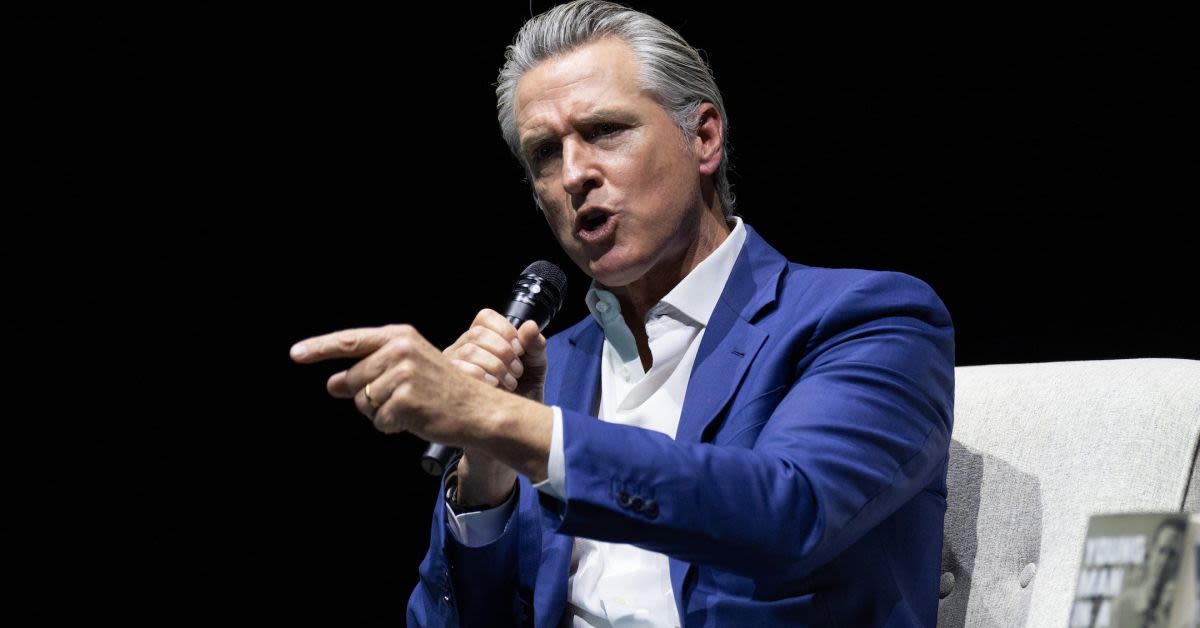
Democratic Gov. Gavin Newsom of California is using the dismissal of Homeland Security Secretary Kristi Noem to argue that President Donald Trump is a weakened force heading into the next political cycle.
Speaking in Portsmouth, New Hampshire, during the latest stop on his national book tour, Newsom declared, "Donald Trump is in retreat," casting the Noem firing as emblematic of a broader unraveling inside Trumps orbit. According to Fox News, he added, "Today is a perfect example the first firing of a high-profile cabinet member," framing the move as a political embarrassment rather than a strategic reset.
Noems ouster stunned Washington, given her status as a MAGA star and loyalist who had been entrusted with executing Trumps signature mass-deportation agenda as part of a sweeping crackdown on illegal immigration. Her removal from the Department of Homeland Security came as criticism of her performance intensified not only from Democrats, but also from some Republicans and figures within Trumps own political circle, underscoring internal tensions over how best to confront the border crisis.
Newsom, a long-standing Trump antagonist widely viewed as a likely Democratic presidential contender in 2028, wasted little time seizing on the news. Hours after the firing became public, he took to social media with a derisive "BYE GIRL!", a taunt that played well with progressive activists but underscored the increasingly coarse tone of Democratic rhetoric toward conservatives.
At his New Hampshire event, Newsom went further, attempting to shift blame for the administrations most hard-edged immigration policies away from Noem and onto one of Trumps closest advisers. He insisted that "the dark heart of the administration is not Kristi Noem, it's Stephen Miller," referring to the White House deputy chief of staff and longtime Trump strategist who has been a central architect of the presidents immigration agenda since the 2016 campaign.
Newsom argued that while Noem may have been the public face of controversial enforcement actions, the ideological blueprint came from elsewhere. "It had Noem's fingerprints all over it, but it was Stephen Miller's handbook, and he needs to be next," he said, invoking Trumps 2025 decision to deploy National Guard troops to California in response to immigration protests as an example of what he views as Millers influence.
Fox News Digital reported that it reached out to the White House for a response to Newsoms remarks but had not received a reply by the time of publication. The silence from Trumps team leaves Newsom free, for now, to define the narrative around Noems dismissal and to cast the presidents inner circle as unstable and extreme.
Newsoms appearance in New Hampshire came just two days after Democrats posted record primary turnout in Texas, a development his party is touting as a sign of momentum heading into the midterm elections. With Republicans defending razor-thin majorities in both the House and Senate, Democrats are eager to portray Trump as a liability rather than an asset to the GOP brand.
The California governor explicitly tied Trump to the surge in Democratic enthusiasm, arguing that the president remains the oppositions most effective mobilizing tool. "Donald Trump is the leader of the get out the vote for the Democratic Party," Newsom emphasized, suggesting that continued association with Trump could cost Republicans in competitive districts and swing states.
Newsoms swing through New Hampshire, which for a century has held the first presidential primary in the race for the White House, inevitably fueled speculation about his own national ambitions. The two-term governor of deep-blue California has been steadily raising his profile, using his book tour to test messages, sharpen contrasts with Trump, and court activists and donors in early-voting states.
His itinerary has mirrored that of a traditional presidential prospect, with recent stops in South Carolina and Nevada in addition to New Hampshire. All three states hold influential early contests on the Democratic primary calendar, and each is jockeying for pride of place in the partys 2028 nominating schedule, making Newsoms presence there anything but accidental.
The tour promotes his memoir, "Young Man in a Hurry," which traces his journey from a childhood marked by dyslexia to his current role as governor and national figure. Yet the rollout has been marred by controversy, reflecting both the polarizing nature of Newsoms politics and the scrutiny that accompanies any would-be presidential contender.
At a recent book event in Los Angeles, Newsom ignited a firestorm by likening Israel to an "apartheid state," language that echoes the far-left and has drawn sharp criticism from conservatives and many pro-Israel Democrats. On Thursday, he attempted to clarify his remarks by saying he was referencing a column by prominent commentator Tom Friedman, offered against the backdrop of ongoing U.S. and Israeli strikes on Iran that have killed numerous senior Iranian officials, including Supreme Leader Ayatollah Ali Khamenei.
Newsom said, "Tom used that word apartheid as it relates to the direction' that Israel leader Benjamin Netanyahu, a Trump ally, "is going, particularly on the annexation of the West Bank." His comments placed him squarely in the camp of Democrats who are increasingly hostile to Netanyahus government, a stance that risks alienating centrist voters and long-standing U.S. allies who view Israel as a critical partner in a volatile region.
The governor also vented his frustration with the conflict while taking another swipe at Trumps leadership. "I'm very angry about this war with all due respect, not because I'm angry the supreme leader is dead, quite the contrary. I'm not naive about the last 37 years of his reign, 47 years since the '79 revolution," he said, before pivoting back to the president.
But taking aim at Trump, Newsom added, "I'm also mindful that you have a president who still is inarticulate and incapable of giving us the rationale of, why, why? Now, what's the end game?" The critique fit neatly into his broader narrative that Trump is unfit for high office, even as many conservatives would counter that Trumps foreign policy record, particularly on Iran and the Abraham Accords, compares favorably to that of Democratic administrations.
Newsom has also faced backlash over remarks made in March at a book event in Atlanta, where he discussed his low SAT scores and struggles reading speeches. Those comments were widely condemned on the right as racially insensitive toward Black Americans, reinforcing conservative concerns that Democratic elites often traffic in condescension while claiming to champion minority communities.
The governor dismissed the uproar, labeling the criticism "MAGA-manufactured outrage." His response underscored his strategy of confronting conservative critics head-on, even at the risk of deepening partisan divides and alienating voters who are weary of constant ideological warfare.
Newsom is hardly alone among Democrats eyeing 2028 who are making early moves in New Hampshire. Former Transportation Secretary Pete Buttigieg, who finished a close second to Sen. Bernie Sanders in the states 2020 Democratic primary, completed a three-day swing through the Granite State in February, maintaining his own foothold with local activists and donors.
Kentucky Gov. Andy Beshear, who visited New Hampshire in the fall of 2025, is returning this weekend, while Rep. Ro Khanna of California has also just wrapped another trip to the state. Their presence highlights the crowded field of ambitious Democrats positioning themselves as the post-Biden future of the party, even as they continue to run on policies that conservatives argue have produced economic strain, cultural division, and weakened U.S. standing abroad.
Polling suggests the race for the 2028 Democratic nomination is wide open, with no clear standard-bearer emerging from the partys fractured coalition. The most recent University of New Hampshire Survey Center poll, conducted in February, showed Buttigieg at 20% support, with Newsom and Rep. Alexandria Ocasio-Cortez of New York tied at 15%.
Former Vice President Kamala Harris, the Democrats' 2024 nominee, and Sen. Mark Kelly of Arizona each registered 10%, while all other potential contenders languished in single digits. For conservatives watching from the sidelines, the early maneuvering and sharp rhetoric from figures like Newsom offer a preview of a Democratic Party that remains fixated on Trump, divided over Israel, and increasingly tethered to progressive orthodoxies that many Americans have already begun to reject at the ballot box.
Login