
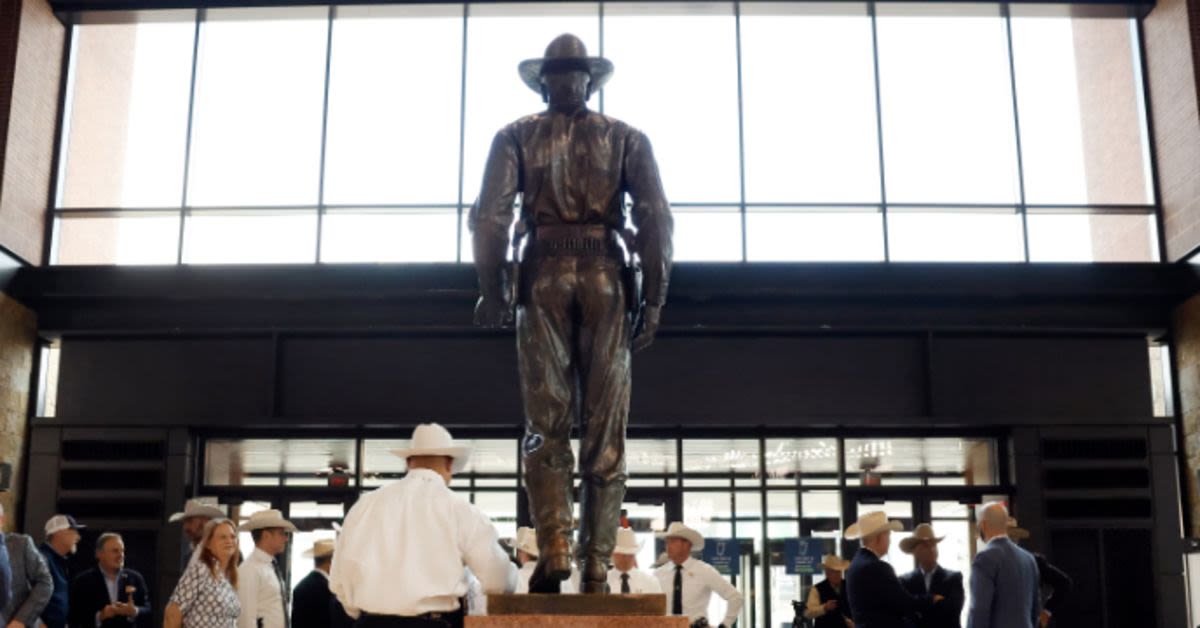
The Texas Rangers baseball club has restored to public view a controversial yet iconic statue honoring the legendary Texas Rangers law enforcement agency, signaling a deliberate stand against the lefts ongoing campaign to erase symbols of traditional American heritage.
On Monday, the team unveiled the One Riot, One Ranger statue at Globe Life Field in Arlington in a ceremony honoring the storied law enforcement organization, according to Western Journal. The bronze figure, long associated with Texas grit and individual courage, had been quietly removed from Dallas Love Field in 2020, at the height of the nationwide push to purge monuments and symbols deemed politically incorrect.
The statue, originally donated to the City of Dallas in 1961, was taken down amid accusations that the Texas Rangers past included episodes of racial injustice. We recognize that the history of the Texas Rangers, like that of our state and nation, includes moments that must be confronted honestly, Russell Molina, a board member of the Texas Ranger Association Foundation, said in a statement, acknowledging the complexity of history without surrendering to demands for erasure.
Molina emphasized that the broader legacy of the Rangers should not be defined by the failings of a few. While not everyone who has served across more than two centuries lived up to the ideal, most did and they deserve to be remembered for their service, sacrifice, and commitment to the people of Texas.
The controversy intensified when author Douglas Swanson claimed that the Ranger who modeled for the statue had participated in state-led efforts to resist school integration. Molina disputed that contention, underscoring how modern progressive narratives often rely on disputed or selective historical claims to justify tearing down longstanding public symbols.
The base of the statue bears the inscription Texas Ranger of 1960, along with the famous phrase One Riot, One Ranger, a motto that has come to symbolize the rugged individualism and personal responsibility that many conservatives see as central to the American character. After its removal, the statue was supposed to be relocated to a planned museum in Waco, but that project never materialized, leaving the monument in storage at Alliance Airport in Fort Worth.
The Texas Ranger Association Foundation eventually partnered with the baseball club to secure a new home for the statue at Globe Life Field, where it now stands as a public tribute rather than a hidden relic. The informal One Riot, One Ranger slogan is widely believed to trace back to an 1896 incident involving Rangers Capt. William McDonald, who was dispatched to halt an illegal prize fight.
When questioned about the apparent lack of backup, McDonald is said to have replied, Hell, I aint enough? Theres only one prize fight. That defiant response has since become part of Texas lore, encapsulating a law-and-order ethos that stands in stark contrast to todays soft-on-crime policies and anti-police rhetoric.
Ray Davis, the majority owner of the Texas Rangers baseball team, framed the statues return as consistent with the organizations core commitments. Our charter as a baseball club and our foundation is we support the following segments of our society: First, its kids, and thats where our focus is. Second is our first responders. And the last is our law enforcement, Davis said on Monday, making clear that the franchise will not distance itself from those who put their lives on the line.
And in Texas, the point of the spear for our law enforcement are the Texas Rangers. We are very proud to be associated with them. And we hope that the over 6 million people who come through our stadium will view what you see here today, he said, underscoring the teams willingness to celebrate law enforcement publicly despite cultural pressure to do the opposite.
Molina stressed that the monument is meant to honor the institution as a whole rather than any single figure. This statue represents all Texas Rangers, not any single individual, Molina said, according to WFAA-TV, pushing back against efforts to reduce the Rangers legacy to one disputed historical claim.
The modern Texas Ranger reflects the diversity, integrity, and professionalism expected of one of the nations oldest and most respected law enforcement organizations. As Davis noted, We have worn the Rangers name since 1972 with pride, a reminder that the franchises identity has long been intertwined with the states law-and-order tradition.
The One Riot, One Ranger statue now joins six other monuments at Globe Life Field, four of which honor individuals: Hall of Fame pitcher Nolan Ryan, catcher Ivan Rodriguez, third baseman Adrian Beltre, and former Arlington mayor Tom Vandergriff. The remaining two statues pay tribute to the teams fans and commemorate the clubs first World Series appearance in 2010, collectively forming a landscape of memory that resists the cultural trend toward tearing down rather than preserving.
Login