
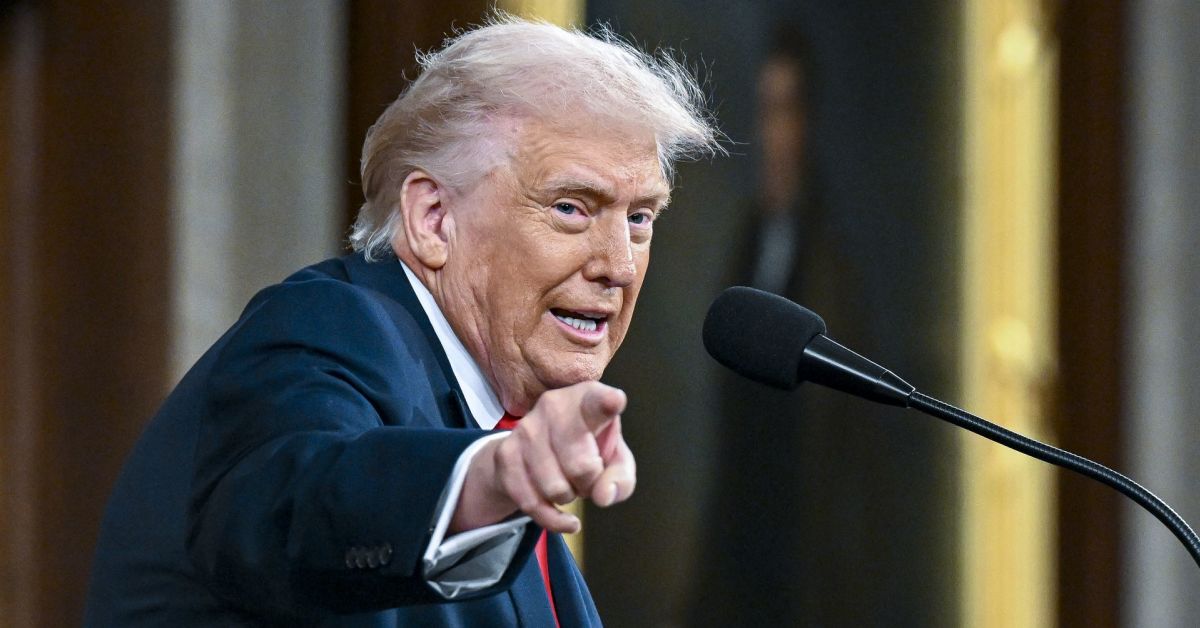
President Donald Trump is confronting a wave of bipartisan outrage after ordering a massive military operation against Iran without first seeking formal authorization from Congress.
In an unannounced video address released early Saturday, Trump revealed that the United States had launched a major campaign designed to ensure that Iran will never obtain a nuclear weapon. According to Daily Mail, the president cautioned that American service members could be killed in the high?risk operation, which he said is being conducted in coordination with Israel and acknowledged that such losses often happen in war.
The offensive, dubbed Operation Epic Fury, began in the early morning hours as reports of explosions rippled across multiple locations in the Middle East. Bombs will be dropping everywhere, warned the president, underscoring the scale of the strikes and signaling that Washington is prepared to project overwhelming force against Tehrans military infrastructure.
Almost immediately, the region showed signs of spiraling instability, with the U.S. base in Bahrainhome to the U.S. Fifth Fleetcoming under attack. Irans Foreign Ministry responded with an explicit threat to target all American military assets in the region, raising the specter of a broader confrontation that could draw in U.S. forces across the Persian Gulf and beyond.
Secretary of State Marco Rubio is said to have briefed the bipartisan Gang of 8 congressional intelligence leaders shortly before the strikes commenced. Yet the administration did not request a formal authorization for the use of military force, even though such approval is widely regarded as a constitutional prerequisite for initiating war.
That omission has triggered a political firestorm on Capitol Hill, where lawmakers from both parties are denouncing what they describe as Trumps illegal strikes. The backlash is particularly striking given that many conservatives traditionally support a robust national defense, but also insist that the executive branch respect constitutional limits and Congresss sole authority to declare war.
Republican Congressman Thomas Massie of Kentucky, a long?time critic of Trump, has joined forces with California Democrat Ro Khanna to push an Iran War Powers resolution to a vote next week. The measure would prohibit U.S. military action against Iran absent prior congressional approval, though it remains uncertain whether it could meaningfully constrain an operation already underway.
Massie took to X shortly after Trumps address, condemning what he called the presidents acts of war unauthorized by Congress. Khanna, in a video posted early Saturday, blasted Trumps illegal regime change war in Iran and demanded that lawmakers immediately return to Washington.
Khanna insisted that the House must convene on Monday to vote on his legislation, pressing colleagues to take a clear public stand. Every member of Congress should go on record this weekend on how they will vote, said Khanna, framing the moment as a constitutional test rather than a mere policy disagreement.
The presidents move also appears to undercut his own repeated assurances that he would not entangle the United States in new foreign conflicts. On the campaign trail, Trump pledged, Im not going to start a war, Im going to stop wars, a promise that helped distinguish him from the interventionist record of prior administrations.
Since returning to office 13 months ago, Trump has frequently highlighted his pursuit of peace, even hinting at aspirations for a Nobel Peace Prize. Only last week, during his State of the Union address, he claimed credit for ending eight wars around the world and has repeatedly touted his efforts to broker a settlement between Russia and Ukraine, efforts that have thus far failed to produce a breakthrough.
Democrats, many of whom have long favored diplomatic engagement with Iran, quickly seized on the strikes as evidence that Trump is dragging the country toward another Middle Eastern quagmire. Others, however, are criticizing the operation from a civil?liberties and constitutional perspective, arguing that even a president pursuing hawkish policies must remain bound by the law.
Arizona Democratic Senator Ruben Gallego lashed out at Trump after the president acknowledged that U.S. troops could die in the operation. We can support the democracy movement and the Iranian people without sending our troops to die, he wrote in a scathing post to X, reflecting the lefts preference for sanctions and political pressure over direct military intervention.
New Jersey Democratic Senator Andy Kim echoed that sentiment, declaring, Americans dont want to go to war with Iran. He added, Trump once again started a cycle of violence that has already escalated and could spiral out of control. This is unacceptable, and pledged to support the Senates version of a War Powers measure spearheaded by Senator Tim Kaine.
Constitution?minded Republicans are also voicing alarm, underscoring that skepticism of unchecked executive war?making is not confined to the left. Kentucky Senator Rand Paul, a leading non?interventionist on the right, warned that the Founders vested the power to declare war in Congress for a reason, to make war less likely.
[M]y oath of office is to the Constitution, so with studied care, I must oppose another Presidential war, Paul wrote on X, signaling that at least some in the GOP will resist any attempt to normalize large?scale military action without a formal vote. His stance reflects a longstanding conservative concern that open?ended conflicts erode both liberty at home and fiscal discipline.
Former Trump ally Representative Marjorie Taylor Greene also broke sharply with the president, blasting the operation as yet another misguided foreign entanglement. Another foreign war for foreign people for foreign regime change. For what? she wrote on X, capturing the frustration of grassroots conservatives who believe Washington should prioritize border security and domestic stability over distant battlefields.
From the Obama era, former Deputy National Security Adviser Ben Rhodes resurfaced to denounce the campaign as an illegal war. A war that has no domestic or international legal basis. A war that Americans do not support. A war in response to no imminent threat. A pointless war, he wrote on X, reinforcing the narrative that the strikes lack both legal grounding and public backing.
Yet not all Democrats are opposed, underscoring how Iran policy scrambles traditional partisan lines. Pennsylvania Senator John Fetterman, a staunch supporter of Israel, has offered rare praise for Trumps massive military campaign, an unusual show of cross?party support that highlights the enduring concernshared by many conservativesthat a nuclear?armed Iran would pose an intolerable threat to American allies and U.S. interests in the region.
Login