
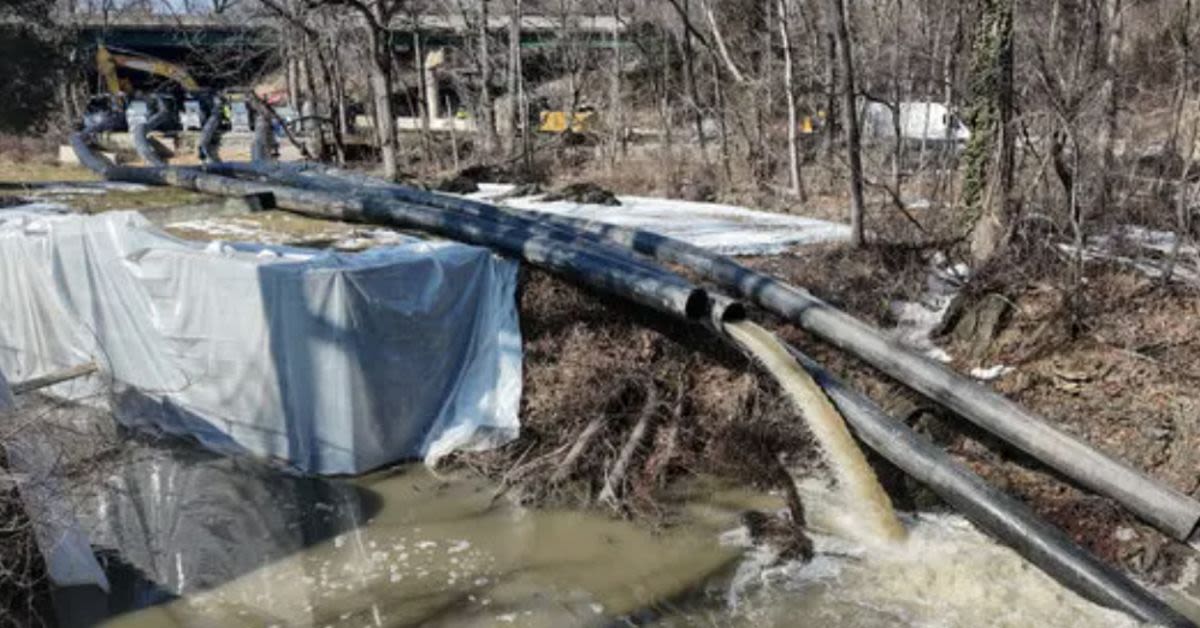
Washington, D.C., is grappling with the largest sewage spill in American history, and residents are being told to take comfort not in cleaner water, but in the diversity credentials of the agency in charge.
According to Western Journal, the rupture of the Potomac Interceptor a 72-inch sewer main near the Clara Barton Parkway in Montgomery County, Maryland has dumped an estimated 240 million gallons of untreated sewage into the Potomac River.
The break, which occurred Jan. 19, has been so severe that national media have dubbed it the Pooptomac disaster, a crude but telling shorthand for a failure that has turned a major waterway into a public-health hazard and a symbol of crumbling infrastructure under progressive governance.
The New York Times reported that The sewage flooded into the river unencumbered for about a week, until D.C. Water, the utility that owns and operates the sewer line, was able to divert it to a section of pipe downstream that runs to a water treatment facility. The paper added that there have been intermittent sewage spills as recently as Feb. 10, and the utility expects it will be four to six weeks before the pipe is repaired, underscoring how long residents and recreational users will be living with the consequences of this breakdown.
Officials insist that drinking water remains safe, but the river itself tells a different story. Initial testing found elevated levels of E. coli and Staphylococcus aureus, the bacteria that causes Staph infections, as well as antibiotic-resistant MRSA, prompting concern about the impact on boating, fishing and other recreational activities that have been flourishing in recent years, the Times noted, a sobering reminder that nature does not care about political talking points.
DC Water, the authority responsible for the failed pipeline, has tried to reassure the public with a flurry of statements and an open letter from its chief executive, David Gadis. In that letter, Gadis insisted his agency had prioritized frequent communication with the public and our oversight partners and claimed to have heard the concerns of residents, a carefully calibrated response that leans heavily on process language rather than accountability.
We recognize that describing response actions and infrastructure details does not erase the environmental impact or the concern this incident caused. For those who live near the river, recreate on it, or work every day to protect it, witnessing this unfold was distressing. We hear that clearly, he wrote, acknowledging the emotional toll while offering little explanation for why a 60-year-old critical pipe was allowed to deteriorate to the point of catastrophic failure.
Gadis went on to frame the disaster as part of a broader national challenge, one that conveniently diffuses responsibility. This incident has also underscored a broader reality facing utilities across the country: much of the infrastructure that protects our waterways was built decades ago, long before todays environmental standards, population growth, and climate pressures, he wrote, before stressing that The Potomac Interceptor more than 60 years old is a critical regional asset, conveying wastewater from across the metropolitan area to the Blue Plains Advanced Wastewater Treatment Plant. Its failure reinforces why sustained investment and vigilance are essential.
That appeal for sustained investment comes as Washington, D.C., now seeks federal assistance to cope with the fallout, even as national media attempt to spin the story into yet another Republicans pounce narrative. President Donald Trump, in a social media post, bluntly tied the crisis to Democratic mismanagement, saying [t]hese Democrat caused Disasters, both River and Shutdown, will only get worse, a comment that has drawn predictable outrage from the left but resonates with residents who see a pattern of neglect on basic governance.
What makes the timing of this disaster particularly galling is a resurfaced 2022 podcast appearance in which Gadis enthusiastically detailed his focus on diversity, equity and inclusion at DC Water. Speaking on Good Day AWWA! an official production of the American Water Works Association he recalled, You know, when I arrived at DC Water, this was an organization that looked very similar to our industry: It was predominately, you know, white male at the top, a remark that framed leadership composition as a problem in need of urgent correction.
Gadis then celebrated the demographic transformation he had overseen. But this is a utility thats you know, more than 70 percent of color work at this utility. And I really believe it has been fantastic, the outcomes have been fantastic, but the people at the top, the chiefs in that C-suite, they should look like the employees that they serve and that they work with. And the same thing with the community, he said, making clear that visual representation in the executive suite was a central priority.
He went further, boasting that his leadership team now mirrors the surrounding population. And so my executive team, you know, looks exactly like the community, it looks like the employees, the staff be it people of color, women, men, and its just a fantastic team that has come together to do a lot of great things here at DC Water and in the community for the customers, he added, language that would fit comfortably in any corporate DEI brochure but now reads very differently against the backdrop of raw sewage pouring into a major river.
The juxtaposition is hard to ignore: a utility that publicly congratulated itself for reducing the number of white male at the top now presides over a historic environmental debacle. No serious observer would argue that race or gender determines engineering competence, yet the relentless emphasis on identity politics raises a basic question about priorities in an agency whose core mission is to keep waste out of the water supply, not to satisfy ideological checklists.
Gadis was appointed in 2018, meaning his 2022 remarks came four years into his tenure, long enough to have assessed and addressed the aging Potomac Interceptor. Another four years have passed, and the result is a broken pipe, a fouled river and a public forced to weigh the value of symbolic representation against the tangible reality of 240 million gallons of untreated sewage, while comments on the resurfaced video have been quietly disabled, suggesting DC Water understands how poorly this all plays with taxpayers.
For residents of the District and neighboring Maryland communities, the promise of an executive team that looks exactly like the community offers little comfort as they confront contaminated waters and curtailed recreation. They are left to hope that, beneath the rhetoric, someone at DC Water is still focused on engineering, maintenance and long-term planning rather than on the latest fashionable acronym out of the HR department.
The Potomac spill lays bare a broader tension in modern governance: whether public agencies exist first to deliver essential services efficiently, or to serve as vehicles for social experimentation and ideological signaling. As the Pooptomac episode continues to unfold, one cannot help but wonder whether the next addition to Gadis leadership circle, in the name of perfect stakeholder representation, will be a single-celled organism of E. coli extraction a darkly comic question that underscores how far the rhetoric of diversity can drift from the basic, nonnegotiable duty to keep the water clean.
Login