
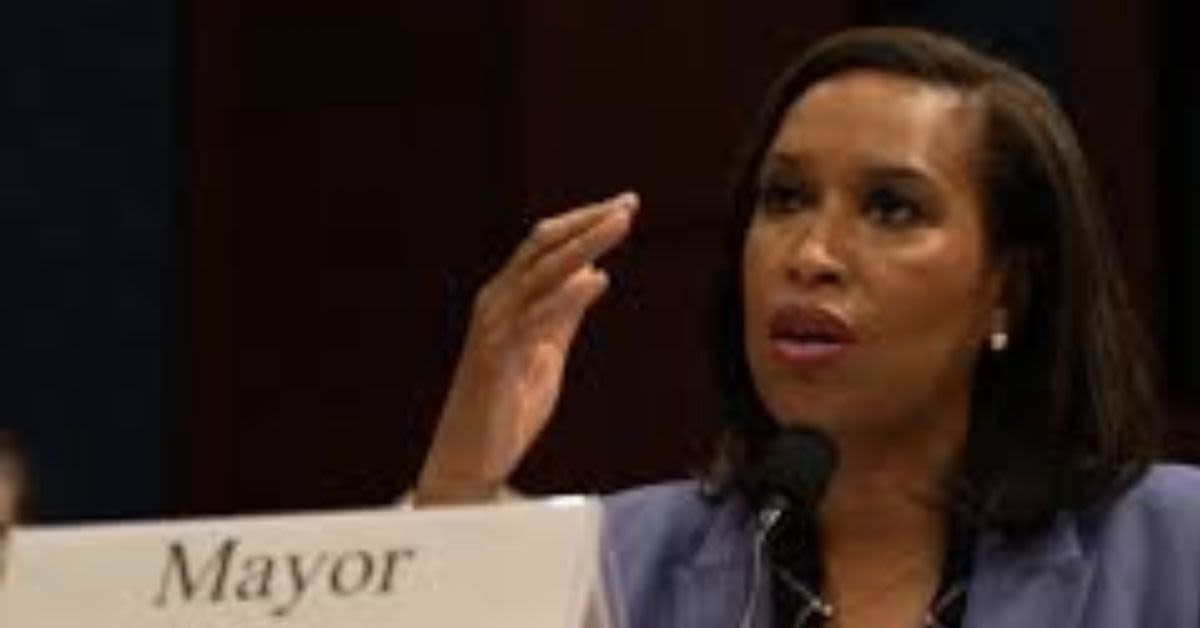
Washington, D.C., Mayor Muriel Bowser on Wednesday declared a disaster emergency over the massive Potomac River sewage spill and formally appealed for federal intervention as the crisis deepens around the nations capital.
According to Fox News, the spill has now grown into the largest sewage discharge in American history, with more than 240 million gallons of untreated waste pouring into the Potomac. President Donald Trump has already rebuked Marylands Democratic Governor Wes Moore for what he views as a failure of leadership, warning that he is concerned the river encircling Washington will still reek when the America250 celebrations begin this summer.
Bowsers letter to the White House, sent Wednesday, requested that Trump issue an emergency disaster declaration to unlock federal resources and expertise to contain and remediate the spill. The move underscores how local authorities, long dominated by progressive leadership, are now turning to the federal government after years of neglecting core infrastructure in favor of ideological priorities.
At a White House press briefing, press secretary Karoline Leavitt underscored Trumps concerns in blunt terms when questioned by Fox News correspondent Peter Doocy. Doocy asked whether Trump is worried the capital will "smell like poop," prompting Leavitt to respond, "Yeah, he is worried about that," before adding, "Which is why the federal government wants to fix it. And we hope that the local authorities will cooperate with us in doing so."
Leavitt made clear that the administration expects regional leaders to stop passing the buck and instead work with Washington to address the crisis. She urged officials in all three affected jurisdictions to "step forward and to ask the federal government for help and to ask for the Stafford Act to be implemented here so that the federal government can go and take control of this local infrastructure that has been abandoned and neglected by Governor Moore in Maryland for far too long."
The press secretary pointed to longstanding structural failures as evidence that the problem is not a sudden accident but the predictable result of mismanagement. "It's no secret that Maryland's water and infrastructure have been in dire need of repair," Leavitt said, noting, "Their infrastructure has received a nearly failing grade in the 2025 report card from the American Society of Civil Engineers. This is the same grade they've received, five years earlier. There has been no improvement under the leadership of Governor Moore. He's clearly shown he's incapable of fixing this problem, which is why President Trump and the federal government are standing by to step in."
Governor Moores office, however, has attempted to deflect responsibility by shifting blame back onto Washington. His team argues that the federal government has direct oversight over DC Water, the Districts water and sewer utility, and therefore bears primary responsibility for the failing system at the heart of the spill.
"Since the last century, the federal government has been responsible for the Potomac Interceptor, which is the origin of the sewage leak. For the last four weeks, the Trump Administration has failed to act, shirking its responsibility and putting people's health at risk," a representative from Moore's office said Monday, adding, "Notably, the presidents own EPA explicitly refused to participate in the major legislative hearing about the cleanup last Friday."
Leavitt, for her part, framed the issue as a test of whether self-described environmental advocates are willing to support decisive federal action rather than partisan posturing. She urged activists and local leaders alike to "pray" that the jurisdictions formally request Trumps involvement so that long-delayed infrastructure repairs and cleanup can finally move forward.
"For all of the environmentalists in the room and across the District of Columbia, let's all hope and pray that this governor does the right thing and ask President Trump to get involved, because it will be an ecological and environmental disaster if the federal government does not step in to help," she said. "But of course, we need the state and local jurisdictions to make that formal request."
As millions of gallons of raw sewage continue to foul one of the nations most symbolic waterways, the standoff highlights a broader clash between progressive governance and basic stewardship of public infrastructure. With America250 festivities approaching and public health at stake, the question now is whether state and local Democratic leaders will set aside political calculations, make the formal requests required under the Stafford Act, and allow the federal government to impose the accountability and competence that have been missing from their own handling of the crisis.
Login