
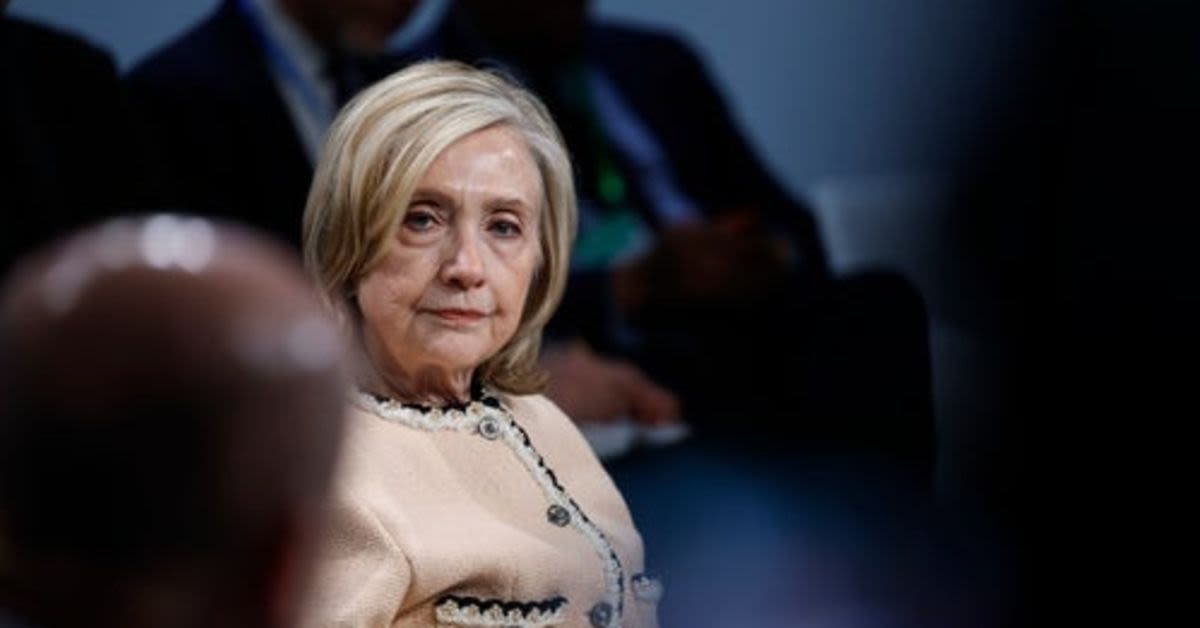
Hillary Clinton used a high-profile security forum in Germany to renew her attacks on President Donald Trump, casting him as a betrayer of Western civilization and international norms.
During a panel at the Munich Security Conference, Clinton was asked whether Americas changing posture toward international law risked opening a new rift within the West. According to The Blaze, the former secretary of state who once championed the Iraq War and other costly foreign interventions seized the opportunity to denounce Trumps efforts to end the Ukraine-Russia war, branding his stance toward Kyiv disgraceful and insisting that Ukraine, which has not held a presidential election in nearly seven years, is fighting for our democracy and our values of freedom and civilization on the front lines.
The discussion, backed by the Rockefeller Foundation and moderated by Bronwen Maddox, director of the London-based think tank Chatham House, soon turned explicitly to Trumps impact on the Western alliance. Maddox pressed Clinton on whether she believed Trump has destroyed the West, prompting the former Democratic nominee to escalate her rhetoric dramatically.
Clinton, who fronted the Obama administrations ill-fated reset with Moscow, replied with evident enthusiasm, He has betrayed the West. He's betrayed human values. He's betrayed the NATO Charter, the Atlantic Charter, the Universal Declaration of Human Rights. Her sweeping condemnation framed Trump not merely as a political opponent but as an existential threat to the postwar order that globalist elites have long sought to preserve.
Maddox then turned to Czech Republic Deputy Prime Minister Petr Macinka, asking whether he shared Clintons dire assessment. Macinka, a right-wing populist, made clear from the outset that he did not share Clintons personal hostility toward the President.
Looking directly at Clinton, Macinka remarked, First, I think you really don't like him. Clinton immediately confirmed his observation, responding, You know that is absolutely true! Not only do I not like him, I don't like him because of what he's doing to the United States and the world, and I think you should take a hard look at it if you think that there is something good that will come out of that.
Macinka then attempted to introduce a perspective that has resonated with many voters across the West who feel alienated by progressive elites and technocratic governance. He argued that Trump and his movement in America are a reaction to policies that really went too far too far from the regular people, too far from reality.
Despite repeated interruptions from Clinton, the Czech official pressed on, suggesting that Trumps rise was fueled by public backlash against cancel culture, the woke revolution, the gender revolution, and aggressive climate alarmism. Clinton cut in again, asking pointedly, Which gender [revolution]? Women having their rights?
Macinka clarified that he was referring to the spread of radical gender ideology into mainstream institutions, a concern shared by many conservatives who see such policies as detached from biological reality and parental rights. Anticipating yet another interruption, he added, Can I please finish my points? I'm sorry that it makes you nervous. I'm really sorry for that.
The exchange drew boos from parts of the audience, reflecting the hostility often directed at dissenting conservative voices in elite international forums. Clinton, undeterred, replied, Doesn't make me nervous. It makes me very, very unhappy.
Macinka went on to challenge Clintons framing of the Ukraine conflict as a crusade for global democracy, arguing instead that Ukraine is fighting for its own national survival and interests. He also cast doubt on the purity of Western motives in the conflict, implicitly questioning whether Washington and Brussels are truly acting out of altruism or out of geopolitical self-interest.
Even as Clinton was castigating him in Germany, Trump was highlighting a different approach to the war, one focused on negotiation and de-escalation rather than endless escalation. On Saturday, he reshared a February 5 message from Steve Witkoff, his special envoy for peace missions, noting that delegations from the United States, Ukraine, and Russia agreed to exchange 314 prisoners the first such exchange in five months. This outcome was achieved from peace talks that have been detailed and productive.
Login