
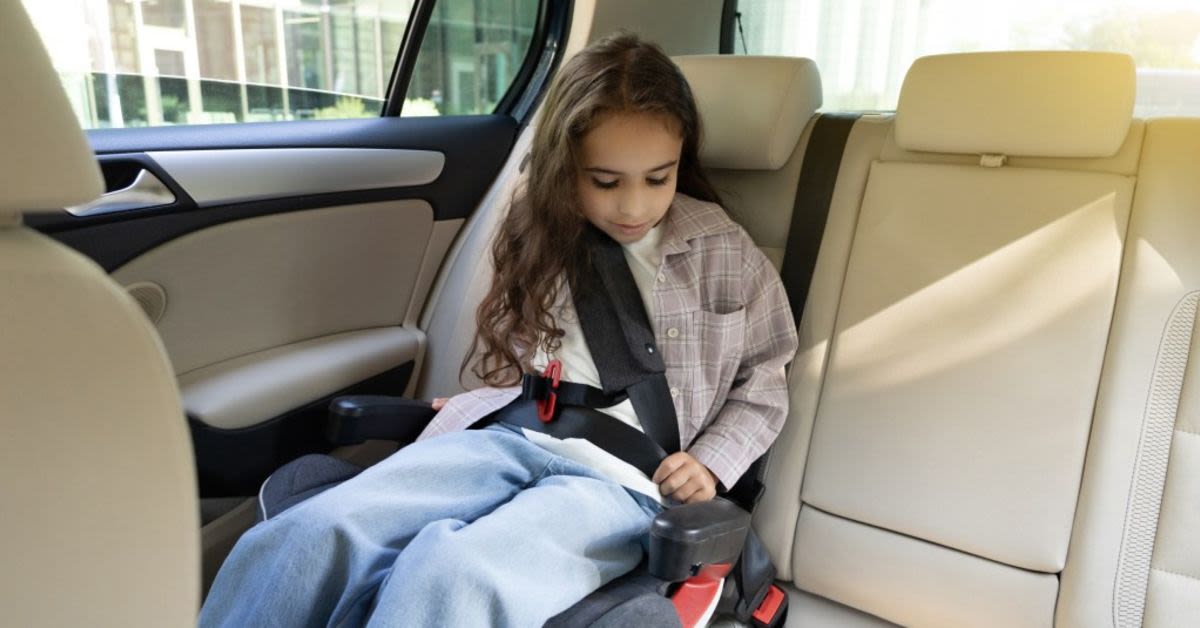
California will soon require children under 16 to pass a five-step seat-belt test or remain in a booster seat, the New York Post reports.
In an opinion column, the paper calls the measure ludicrous nanny-state overreach and says Sacramento should focus instead on fraud, homelessness, overspending, poor affordability and faltering public schools. Gov. Gavin Newsom signed Assembly Bill 435, introduced by Assemblymember Lori Wilson of Suisun City, in October of 2025, and it takes effect in January of 2027.
The law does not automatically place every child in that age group in a booster. Children who can pass all five steps may ride with a standard seat belt, while those who fail even one step must stay in an appropriate child restraint. Existing rules for younger children remain in place, including booster-seat requirements that generally cover kids up to age 8 and under 4 feet, 9 inches tall.
Under the new standard, a child must be able to sit with a back flat against the vehicle's seat and bend the knees over the edge of the seat. The shoulder belt has to fit snugly across the middle of the chest and shoulder, rather than the neck, and the lap belt must sit low across the hips and touch the thighs.
The child also has to maintain that position for the entire trip. Drivers are the ones who must see that those conditions are met, and a first violation carries a $100 base fine that, with penalty assessments and court fees, can exceed $500, plus a point on the driver's record.
Wilson has argued that motor vehicle crashes are "the second leading cause of unintended injury related deaths among children" and that "extending the required age for booster use and implementing straightforward testing can significantly enhance child safety." Safety experts have told CalMatters that height requirements alone are not a reliable guide to whether a seat belt fits, given differences in vehicle designs and airbag systems.
The Automobile Club of Southern California and AAA Northern California, Nevada and Utah backed the bill. "The degree of protection obtained by child restraints depends on correct use and fit," the organizations said.
Federal research is often cited on the same point. The National Highway Traffic Safety Administration found in 2015 that about 46% of car seats are misused, and a 2021 study by AAA and the National Safety Council found that 90% of children under 10 using adult lap-and-shoulder belts should still have been in booster seats.
The opinion column is unconvinced. It says California already regulates booster seats for younger children and that it has seen no evidence of a rash of older kids or teens killed or injured because of ill-fitting seat belts. "Besides, what teen wants to be infantilized in a booster seat?" the paper asks.
The column also floats a satirical picture of a small, slightly built teenager old enough to drive, strapped into a booster and straining to reach the brakes, and says the scene is not far from Babylon Bee territory. It argues that the measure fits a broader pattern of state rules limiting Californians' choices on driving, showering, cooking, home heating and cooling, shopping and sorting garbage.
That is the Post's opinion, not a claim that every 15-year-old with a learner's permit will be legally required to drive from a booster seat. The statute is a passenger-fit rule: if the belt does not pass the five-step test, the child must remain in a booster or other approved restraint until turning 16.
The column still dismisses the change as political virtue signaling in place of solutions to the state's larger crises. Supporters, including Wilson, say the test is a straightforward way to make sure a seat belt actually fits before a child leaves the booster behind.
Login