
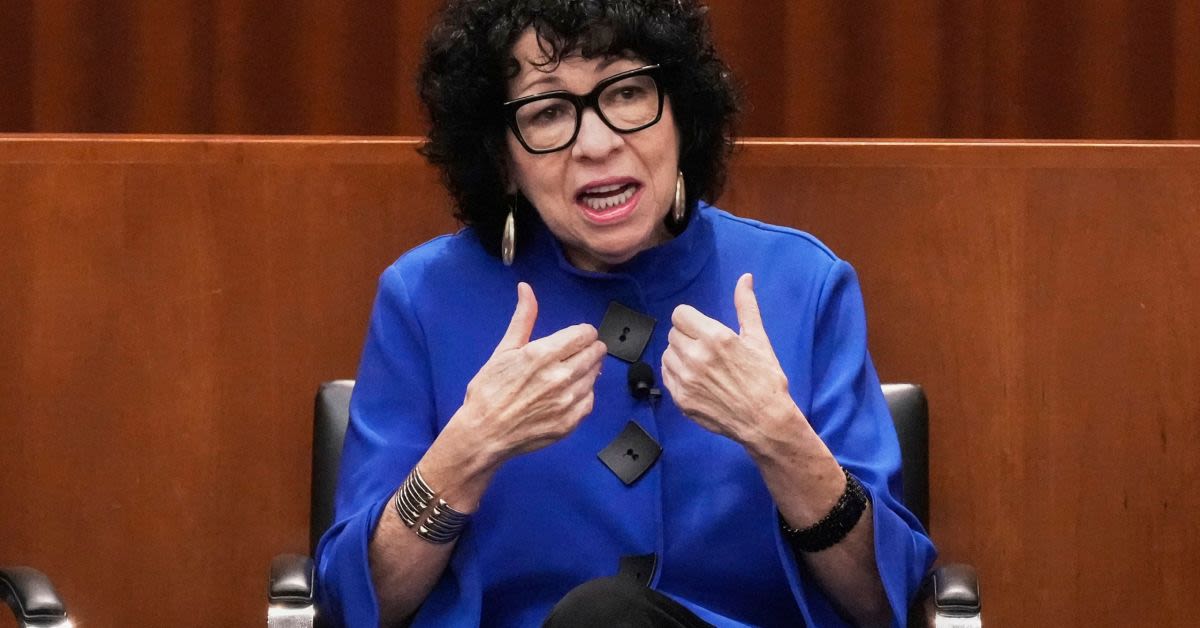
Justice Sonia Sotomayor offered a revealing look at how she believes the Supreme Court should approach the Constitution, and her critics are seizing on it.
Sotomayor made the remarks in Philadelphia while receiving the Benjamin Franklin Medal from the American Philosophical Society, the scholarly organization Franklin founded in 1743. She took questions onstage from David Tatel, a retired judge on the U.S. Court of Appeals for the District of Columbia Circuit.
Much of the discussion centered on the court's landmark birthright citizenship decision. In that case, the justices struck down President Trump's executive order that sought to deny automatic citizenship to children born to parents in the country illegally or temporarily.
The judgment was 6-3. Chief Justice John Roberts wrote that such children are "citizens at birth" under the Fourteenth Amendment, joined by Sotomayor and Justices Elena Kagan, Ketanji Brown Jackson, and Amy Coney Barrett.
Justice Brett Kavanaugh agreed the order could not stand but based his vote on federal law rather than the Constitution. Justices Clarence Thomas, Samuel Alito, and Neil Gorsuch dissented.
That split meant only five justices squarely embraced the constitutional reading. According to The Gateway Pundit, Tatel pressed Sotomayor on how close the court came to adopting a theory long regarded as "fringe".
Sotomayor's answer drew immediate attention. "We have a court focused on sort of legal theory rather than one focused on where and what we as a society have achieved in terms of our understanding," she said.
"Not what some legal theory posits we should have understood," she continued. She also argued that whatever debates surrounded the Fourteenth Amendment when it was adopted, "it got settled by history."
To conservative critics, those comments capture the core of their disagreement with the court's liberal wing. Originalists argue that judges must be bound by the text and original meaning of the Constitution, not by evolving societal views.
Supporters of Sotomayor's approach see it differently. They argue that more than a century of precedent and practice, dating back to the 1898 case United States v. Wong Kim Ark, had already settled the meaning of birthright citizenship.
The justice also spoke candidly about her relationship with her colleagues during the event, as reported by The Philadelphia Inquirer. "I believe my colleagues genuinely believe what they're doing is what's best for the country," she said, before adding, "I don't believe my colleagues are right."
Sotomayor, who was nominated by former President Barack Obama, has become known for sharp dissents. She described her style bluntly: "I'm very direct."
She also weighed in on lifetime appointments for justices. "It's not up to me, it's up to you," she told the audience, noting that the United States stands apart from other democracies in granting them.
Sotomayor's remarks come as the court's conservative majority continues to reshape American law. Her comments about "legal theory" are likely to fuel the long-running debate over how judges should interpret the nation's founding document.
For now, the birthright citizenship ruling stands. President Trump has urged Congress to address the issue through legislation instead.
Login