
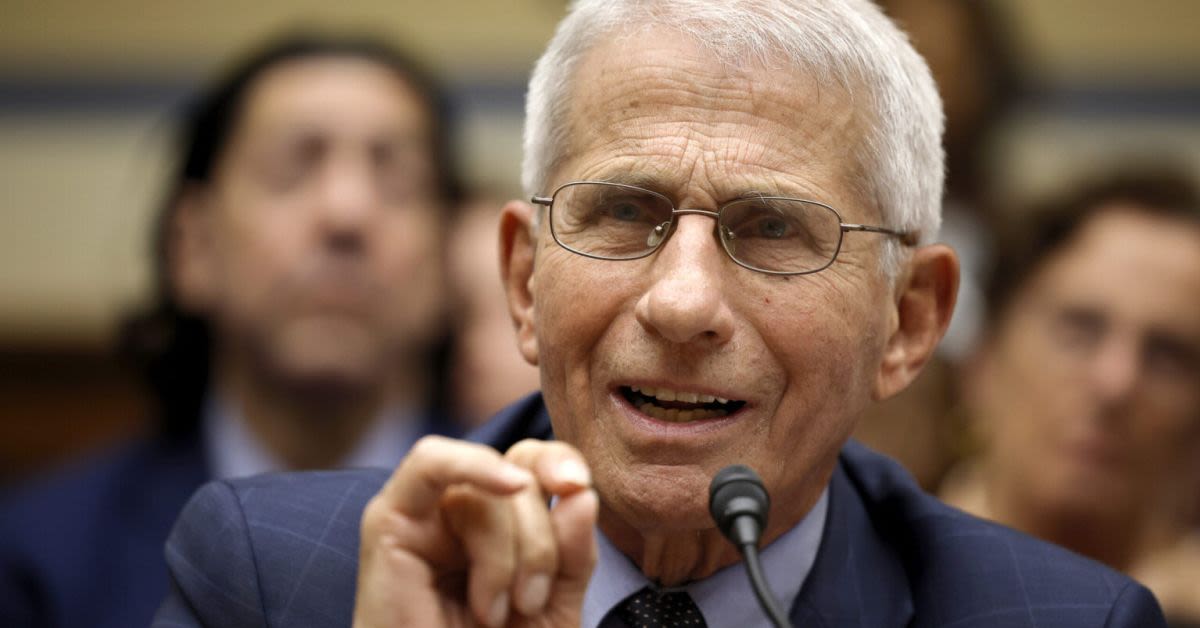
Federal health officials want a leading medical journal to investigate whether Dr. Anthony Fauci quietly helped shape a landmark COVID origins paper.
The National Institutes of Health has asked Nature Medicine to examine claims that Fauci, former NIH Director Francis Collins and British scientist Jeremy Farrar made significant contributions to "The Proximal Origin of SARS-CoV-2" without being credited. According to the Daily Mail, the letter also asks the journal to consider whether the paper should be corrected or retracted.
NIH Director Jay Bhattacharya is calling for a "formal, independent investigation" into allegations of ghostwriting and undisclosed contributions. The letter was first obtained by the German outlet WELT, and it gives the journal 30 days to lay out an investigation plan and timetable.
"Intellectual contributions play a central role in shaping the scientific story," Bhattacharya said. "Authorship and acknowledgement in scientific publications must accurately and ethically reflect all substantive input."
The paper was published in March 2020, in the earliest and most frightening months of the pandemic. It argued that the available evidence did not support the idea that the virus was deliberately engineered or manipulated in a laboratory.
Its five named authors were Kristian Andersen, Andrew Rambaut, Ian Lipkin, Edward Holmes and Robert Garry. Fauci, Collins and Farrar do not appear on the byline or in the acknowledgments.
The new request leans on a recent advisory opinion from the Department of Health and Human Services on authorship and attribution. According to that opinion, correspondence showed Farrar convened an early February 2020 call involving Fauci, Collins and several of the authors, then stayed involved as the paper developed.
The opinion said Fauci and Collins received and discussed early drafts and scientific questions. Farrar, it said, helped coordinate drafting and circulation and made at least one direct edit to the manuscript.
Emails released in earlier congressional investigations had already shown the three men took part in discussions as the paper came together. Those same emails showed they had privately weighed the possibility of a laboratory accident before the paper was published.
That gap between private conversations and public messaging is exactly what critics have hammered for years. The Proximal Origin paper was widely cited by public health officials, journalists and politicians who brushed aside the possibility that the virus came from a lab in Wuhan, China.
Fauci, then director of the National Institute of Allergy and Infectious Diseases, pointed to the paper during an April 2020 White House briefing on the origins of COVID-19. For many Americans, it became the official answer to a question that was never truly settled.
Fauci has previously testified that he received drafts of the paper but did not edit the manuscript. Co-author Kristian Andersen told the House Select Subcommittee on the Coronavirus Pandemic that Fauci did not prompt the paper to disprove a lab leak, and that early discussions focused on testing competing hypotheses.
Democratic investigators have also pointed to interviews in which the authors said Fauci and Collins did not lead, oversee or influence the drafting. The scientists involved have consistently disputed Republican claims that the paper was steered to bury the lab-leak theory.
There is no indication that Fauci broke any laws. The NIH request does not establish that he ghostwrote the paper or that its conclusions were knowingly false.
Instead, the question is whether the roles of powerful outside contributors were properly disclosed under the rules every other scientist is expected to follow. That is no small matter when the paper in question helped shape how the world talked about the deadliest pandemic in a century.
The move is the latest step by Bhattacharya, a longtime critic of the federal pandemic response, to reexamine the Fauci era at the agencies he now oversees. Nature Medicine will now decide whether the scientific record needs to change.
Login