
When a newly elected senator invoked Thomas Jefferson to explain his plans for his swearing-in, Florida's governor answered with a history lesson of his own.
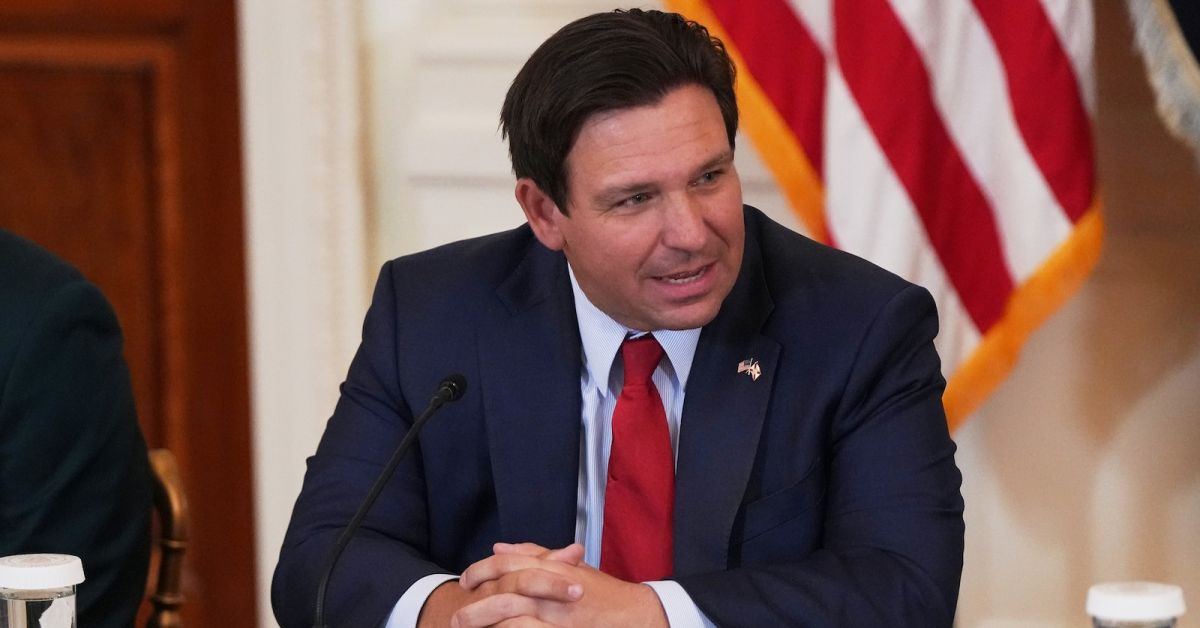
Gov. Ron DeSantis (R-FL) responded to Sen.-elect Abdul El-Sayed (D-MI), who said in a widely shared interview clip that he plans to take the oath of office on the Quran. El-Sayed pointed to Jefferson's personal copy of the Islamic holy book as part of his explanation.
El-Sayed said he would "likely swear on the Quran," adding, "Which Quran? We're not sure."
"I mean, Thomas Jefferson had a copy of the Quran," he said. "So when Keith Ellison was sworn in to Congress, he swore in on that copy."
"There's also the first the University of Michigan holds the first Quran in the state of Michigan," he added. "It's very, very old, and that might be the choice. So I don't know."
DeSantis, who shared the clip on X, offered a very different picture of Jefferson's experience with the Muslim world. "Thomas Jefferson and John Adams met the Tripoli Ambassador in London and asked why Muslims were attacking nations who had done them no harm," DeSantis wrote.
The governor then quoted from a letter the two diplomats sent to John Jay, dated March 28, 1786. In it, Jefferson and Adams recounted asking the ambassador about the grounds for his nation's attacks on American shipping. "We took the liberty to make some inquiries concerning the Grounds of their pretentions to make war upon Nations who had done them no Injury, and observed that we considered all mankind as our friends who had done us no wrong, nor had given us any provocation," the letter reads.
The ambassador's reply is the passage DeSantis highlighted. "The Ambassador [of Tripoli] answered us that it was founded on the Laws of their Prophet, that it was written in their Koran, that all nations who should not have acknowledged their authority were sinners, that it was their right and duty to make war upon them wherever they could be found, and to make slaves of all they could take as Prisoners, and that every Musselman who should be slain in battle was sure to go to Paradise," Jefferson and Adams wrote.
DeSantis closed with a pointed coda. "Jefferson would go on to wage war against the Barbary pirates (terrorists) during his presidency," he wrote.
The full letter, preserved by the National Archives' Founders Online project, shows the meeting was also a hard-nosed negotiation. The ambassador told the Americans that 30,000 guineas for his employers and 3,000 for himself were the lowest terms on which a perpetual peace could be made, payable in cash.
Jefferson and Adams wrote that the demands exceeded their expectations, and those of Congress, "so much that we can proceed no further without fresh instructions." The standoff foreshadowed the conflict Jefferson would later wage as president.
The exchange builds on the controversy that erupted when El-Sayed first revealed his oath plans. He will be the first Muslim elected to the U.S. Senate. His victory has drawn praise from a former spokesman for the Muslim Brotherhood's political party in Egypt, who described El-Sayed as a model for Muslims advancing their cause "from within the political system," according to Breitbart News.
DeSantis has become increasingly outspoken since the midterm elections, in which Rep. Byron Donalds (R-FL) won the race to succeed him. Term limits will force DeSantis out of the governor's office, and while he has made no formal announcement, speculation continues that he is keeping the door open to another presidential run in 2028.
His post spread quickly among conservatives, drawing hundreds of thousands of views on X within hours. The governor's response quoted El-Sayed's original clip directly, putting the two men's readings of Jefferson side by side.
Login