
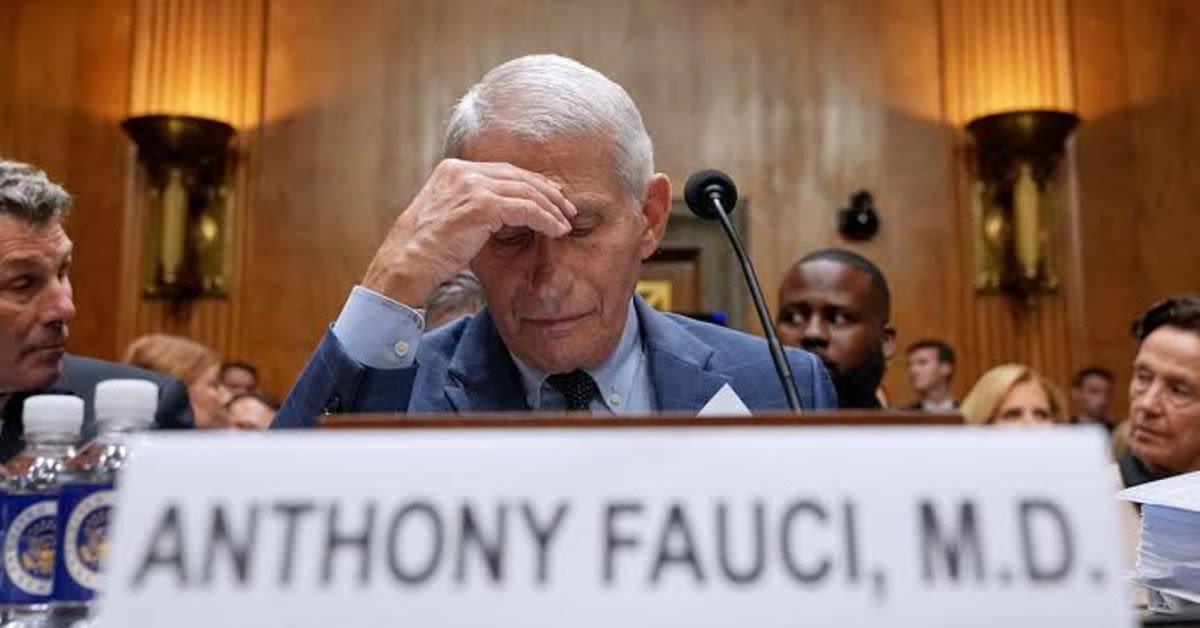
The agency Anthony Fauci ran for four decades is getting a new leader, and the man choosing him is not mincing words about its past.
National Institutes of Health Director Jay Bhattacharya is elevating the interim head of the National Institute of Allergy and Infectious Diseases to become its permanent director, according to The New York Post. The move signals a pivot away from biodefense research and back toward immunology basics.
Bhattacharya is appointing John Powers, a 20-year veteran of NIAID and its fourth director in the last four years, to usher in a new era at the agency. He said the change will end what he bluntly called the "mad science experiments" of former director Anthony Fauci.
In an official NIH announcement, Bhattacharya said Powers "will bring a focus on rigor, transparency, and research outcomes to leading the institute into the future." The release noted that Powers has served at NIAID since 1999 as an infectious diseases attending physician and will shepherd the institute's annual budget of $6.56 billion.
Fauci ran NIAID for 40 years and had great success in developing life-saving treatments for HIV. He also oversaw the biodefense and emerging infectious disease research that came to take up the largest portion of the institute's annual budget.
"There's a strict adherence to the work to make sure that it doesn't we don't conduct, you know, just bluntly, mad science experiments," Bhattacharya told the outlet in an interview. "No more dangerous gain of function will happen under John's leadership."
Scrutiny of taxpayer funding for that research intensified during the COVID-19 pandemic, leading to fierce debates in Congress between Fauci and lawmakers over its possible role in creating the virus that causes the disease. As recently as fiscal year 2025, roughly one-third of NIAID's budget, or more than $2.2 billion, went to biodefense research programs, which will now be run by the Department of War.
"We're now purely a civilian agency," Bhattacharya affirmed. "We're moving to shift the portfolio so it's more balanced toward infectious diseases that Americans actually get."
Powers recalled his earlier years as a clinician. "I was there when HIV patients were dying. And we made tremendous progress in that area," he said.
"But right now we're able to send HIV patients home with one pill once a day. And we're focusing much more now on implementation research, which means we're trying to get interventions to people who really need it," Powers added.
Bhattacharya and Powers said they have combed through more than 8,000 research grants to make sure none of the lab work involved dangerous experiments that would be classified as biodefense. Bhattacharya described exactly what he wants the agency to leave behind.
"Biodefense is research to go find emerging diseases in the middle of nowhere, bring them into labs, make them more transmissible, make them more able to infect humans and then develop sort of hypothetical poorly tested countermeasures to pretend like we can address them if they if they happen to emerge," he explained. "We're out of that business altogether."
"There were civilian justifications, but those justifications were far-fetched, right? The idea that we could prepare for all pathogens out there they're literally in the trillions and somehow develop countermeasures for all the most important ones by making them more pathogenic," he added.
Fauci has repeatedly denied in congressional testimony that his agency ever funded such experiments at the Wuhan Institute of Virology, located in the city where COVID-19 emerged in late 2019. Bhattacharya and other scientists have disputed that claim or said it is impossible to know what Chinese scientists were researching under the U.S.-funded grant.
As the face of the nation's public health response to COVID, Fauci denounced his critics as sowing distrust in science itself, "because I represent science." His private diary entries, however, showed him expressing uncertainty about natural spillover theories.
Emails uncovered through congressional investigations also revealed that Fauci operated a "secret back channel" with his senior adviser, David Morens, as Morens was trying to get the grant for research at the Wuhan lab reinstated. In June 2024 testimony, Fauci disavowed Morens, saying he "knew nothing" of the alleged use of a private Gmail account to discuss official government grants.
Morens pleaded guilty in August to charges of concealing federal records about those grants, which are critical to discovering the true origin of COVID-19. The month before, Fauci invoked the Fifth Amendment more than 100 times in congressional testimony.
"What happened in the pandemic didn't feel like science to me," Bhattacharya said, adding that Fauci's actions were at "the root of a lot of the distrust that Americans have over the NIH." He continued, "It felt like a perversion of science that focused more on power, rather than on truth."
That distrust also stemmed from heavy redactions by NIH officials to records requests from journalists, scientists and the public. "We've been working closely with Congress in delivering a whole bunch of records from that era," Bhattacharya said.
Powers noted that the shift would also move NIAID away from "setting policy," another point of disagreement during the pandemic. "As a practicing physician, I think there's still some outstanding questions that remain to be addressed about things like masks," he said. "Our job is to actually help support the research that would answer those questions."
"But our job is not to tell everybody what to do," he added. "Our job is to provide them with the information to make the best decisions."
Login