
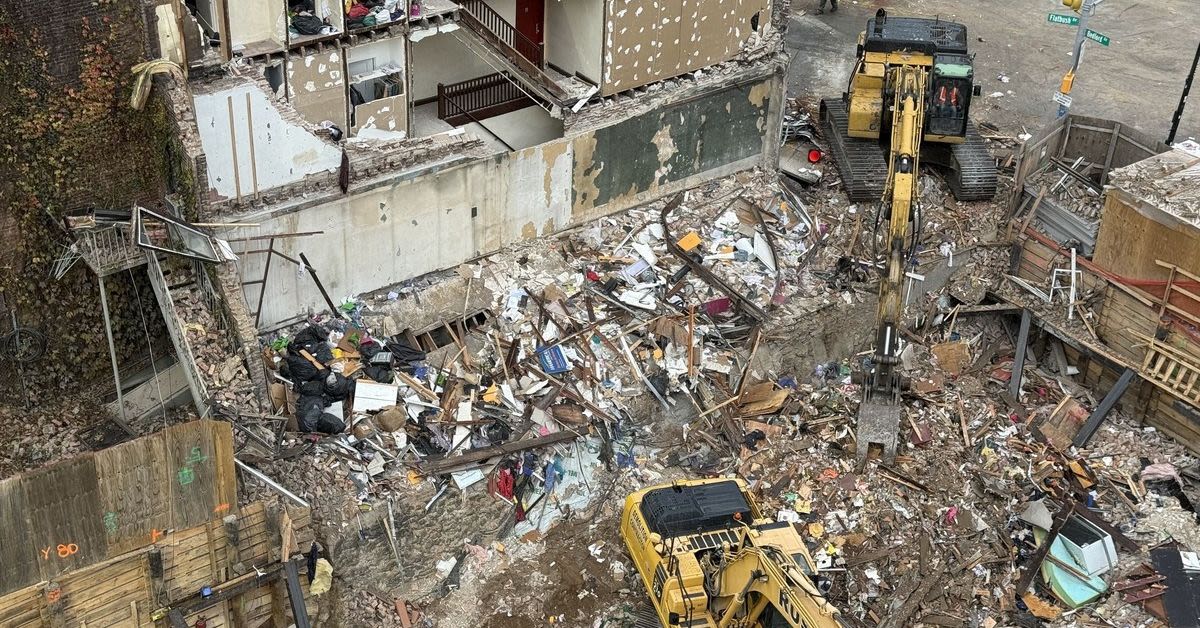
The man who owned the Brooklyn building that crumbled this week, killing eight people, carries a paper trail that city officials can no longer ignore.
Olufemi Falade, the owner of the three-story building at 1321 Flatbush Ave. that collapsed onto an adjacent construction site on Wednesday, owes more than $450,000 in fines, unpaid taxes and water bills, The New York Post reported. Six adults and two children died in the disaster, and 18 others were injured.
Falade has the dubious distinction of landing on the New York City public advocate's annual "Worst Landlords Watchlist" six times. Nearly all of his debt was racked up at the very building that came down.
A review of city records found that he owes $170,000 in fines issued by the Department of Buildings in 2019 for improperly displayed signs. He also owes the city $114,945 in unpaid water bills accumulated over several years and $113,526 in property taxes dating to 2021.
The tab does not end with the city. Falade owes the Internal Revenue Service another $49,269 in unpaid personal federal income taxes, according to a 2010 lien, plus $4,316 in personal income taxes to New York State.
City officials are still working to determine who is at fault for the collapse. Investigators are examining the excavation next door, and the Department of Buildings has since issued a full stop-work order at the neighboring lot.
The city had signed off on deep excavation plans for that site even though they lacked key structural support. The Department of Buildings approved the plans in March for the lot at 2625 Bedford Ave., where a developer intended to put up a new mixed-use building.
Records show the plans called for extensive shoring and bracing along most of the lot, including the backyard of 1321 Flatbush Ave. Crucially, however, the blueprints did not include any hard reinforcements right alongside the building that collapsed.
Falade's record as a landlord stretches back decades. In 2006, he was sentenced to 12 days in jail and fined $50,000 for civil contempt after failing to fix more than 1,800 violations, including vermin infestations, exposed wires and leaking pipes, at 12 Brooklyn buildings he owned at the time.
The Flatbush Avenue building itself had 98 open violations with the city's Department of Housing Preservation and Development before it fell. Those included a leaky roof, defective doors, bedbug infestations and exposed wiring, according to HPD records.
The leaky roof violations date as far back as 1976 and continued to be issued through earlier this year. The problems, in other words, were neither new nor hidden.
Falade bought the 96-year-old building in 1999 under the entity "Femi Realty Corp," city property records show. In November 2024, he transferred ownership to another entity he controls, "Isolag Realty Corp," signing the deed as both seller and buyer with no money changing hands.
Legal experts say shifting properties between shell companies to dodge fines and taxes is common among rogue landlords. The maneuver, however, does not erase the debt.
Massimo D'Angelo, a longtime real estate attorney with Blank Rome, said the city's housing and buildings agencies must do a better job of sharing safety files to strengthen enforcement. "There has to be unity between HPD and DOB files, and particularly for structural oversight violations," D'Angelo said.
He also questioned whether the city's penalties carry any real weight. "This guy was rotting in jail for 12 days and it didn't cure the problem. The city's remedies are too slow," he said.
Falade did not return messages seeking comment. For the families of the eight people killed, the question of how a building with decades of documented neglect remained occupied is likely to grow only louder.
Login