
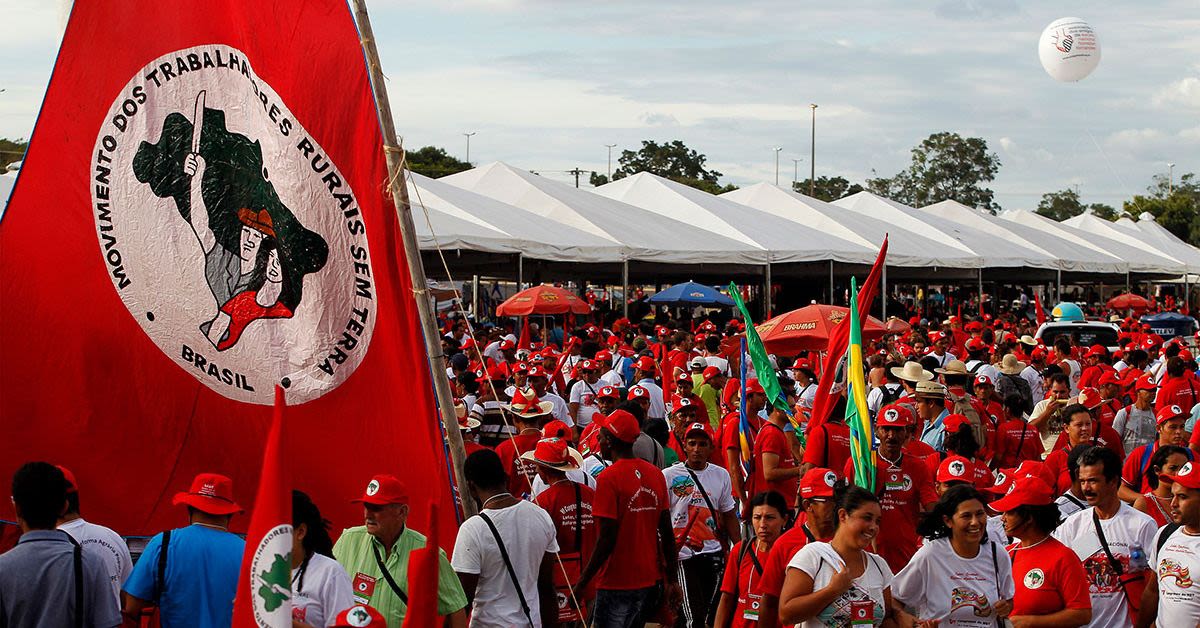
Brazils radical Landless Workers Movement is no longer just a domestic force in Latin Americas largest nation; it is now actively grooming American activists to import its militant tactics to the United States.
According to the New York Post, last weeks presidential runoff in Brazil delivered a narrow but symbolically potent victory for the countrys leftist president, Luiz Incio Lula da Silva, over right-wing challenger Flvio Bolsonaro, son of jailed former president Jair Bolsonaro.
Lula, as he is widely known, is among Latin Americas most far-left leaders, maintaining close ties with authoritarian regimes in China and Iran and championing a hard-edged socialist agenda that has long alarmed conservatives at home and abroad. Among the most jubilant supporters of Lulas latest win were militants from the Landless Workers Movement the Movimento dos Trabalhadores Rurais Sem Terra, or MST a radical agrarian-reform organization that mobilized aggressively on his behalf.
The MST, which has spent decades undermining private property rights in Brazil, saw Lulas victory as a green light to deepen its campaign of land seizures, ideological indoctrination, and confrontation with the countrys agricultural sector. For American leftists, MSTs organizing prowess is not merely a distant curiosity but a model to be studied, replicated, and scaled.
This past July, MST hosted delegations of some of the United States most energetic and influential activist groups, offering them an inside look at the methods that have helped transform MST into Latin Americas largest progressive mass movement. Those methods are not the peaceful, civic-minded tactics that many Americans associate with legitimate protest.
Instead, they include invasions and mass destruction of private farmland, illegal occupations of government buildings, and violent clashes with political opponents actions that, if carried out on U.S. soil, would likely be prosecuted as serious crimes and could reasonably be described as a form of civil terrorism. The July delegation in Brazil brought together members of 13 youth organizations from the United States and Puerto Rico, alongside activists from across Europe.
Over three intensive weeks, participants were immersed in MSTs organizational culture and subjected to rigorous political indoctrination designed to train them as disciplined cadres rather than mere sympathizers. Activists studied revolutionary solidarity, collective discipline, and the mechanics of building a multigenerational Marxist-Leninist movement composed of active learners and militants. The program was not framed as a neutral educational exchange but as a training ground for future organizers who would carry MSTs ideological and tactical blueprint back to their home countries.
During a report back session with the U.S.-based support group Friends of the MST last month, American participants spoke openly about their eagerness to adapt MSTs methods for use in the United States. MST representatives welcomed this enthusiasm, making clear that recruiting and training activists from across the U.S. is part of a deliberate strategy to cultivate a coordinated stateside movement with national reach.
Established in 1984, MST has long courted controversy in Brazil for its aggressive challenge to property rights and the rule of law. Central to the organizations philosophy is the claim that agriculturally productive land must be forcibly redistributed to the poor because current ownership patterns are supposedly a lingering legacy of colonialism and therefore illegitimate.
MST portrays its land-reform campaigns, Marxist-Leninist rural public schools, and network of cooperatives as essential tools for achieving racial and environmental justice. With nearly 2 million members, it is now the largest grassroots movement in Latin America, a scale that gives it significant leverage over Brazils political and social landscape. While MST backed Lulas campaign, its leaders are explicit that elections are only one front in a broader class struggle.
Prior to the presidential runoff, Rodrigo Sue, MSTs international coordinator, declared that class conflict would continue regardless of who won, though he conceded that a Bolsonaro victory would have halted agrarian reform efforts and given the MST many difficulties, a likely reference to the former presidents push to classify MSTs farmland occupations as domestic terrorism. For those unfamiliar with MSTs record, that label may sound extreme, but the groups history of direct action is undeniably radical and often destructive. Members once cut down several thousand orange trees during a protest against Cutrale, one of the worlds largest orange juice producers, inflicting economic damage not on some abstract system but on a lawful enterprise employing thousands.
MST and its allies have repeatedly occupied research nurseries, destroying greenhouses and seedlings to oppose the potential expansion of industrial eucalyptus production. In the early 2000s, the movement occupied farmland belonging to the family of former Brazilian President Fernando Henrique Cardoso an action so brazen that Lula himself criticized it, despite his ideological sympathy for the group.
The movement has also been associated with violent clashes involving political opponents and has occupied government buildings as part of its campaigns. These are not isolated incidents but part of a pattern in which the ends of social transformation are used to justify the means of intimidation, vandalism, and coercion.
MST has not limited its outreach to the July delegation; it has hosted numerous international groups over the years. A 2023 delegation included several figures who would later join Zohran Mamdanis mayoral administration in New York among them Ana Maria Archila and Gianpaolo Baiocchi, who now serve as commissioner and deputy commissioner, respectively, in the Mayors Office for International Affairs, and Cea Weaver, director of the Mayors Office to Protect Tenants.
Most of the organizations that participated in the July trip have remained conspicuously quiet about their experience, a silence that raises questions about what, precisely, they learned and intend to implement. A few, however, have spoken more openly, including the Los Angeles Tenants Union, known for militant organizing, occupations, and rent strikes that already push the boundaries of lawful protest in the United States.
Desis Rising Up & Moving (DRUM), another participant, was an early supporter of Mamdani, and a former DRUM political director now serves in the mayors administration as a senior aide. The organization itself maintains a hardline police-abolitionist stance, aligning it with the most radical elements of the American left on law enforcement and public safety.
The first half of the July program focused on ideological and organizational education, while the latter half immersed participants in MST settlements across various Brazilian territories. The Americans reported being deeply impressed by MSTs daily rituals, which they said embodied the spirit of the struggle, the collective discipline of organicity, and the avoidance of top-down power structures through a decentralized team model known as the base nuclei. These rituals began each day with tributes to past revolutionaries and the sharing of poems about the struggle, a blend of political theater and emotional conditioning that reportedly left some brigade participants in tears.
The goal was not merely to inspire but to bind individuals to the collective through shared narratives of sacrifice, oppression, and revolutionary destiny. Within the base nuclei, activists were shown how education and action kept members accountable to their comrades.
As one activist explained, the challenge was getting the people to move the ways that we need them to, to sustain but also to move [the movement] forward in a settlement where basic needs were met but work still had to be done to maintain the site. American activists initially found the base nuclei confusing but eventually came to appreciate them as a mechanism for preventing a patriarchal structure from emerging.
They praised the model for ensuring that issues were taken seriously and for offering a structure they believed could be scaled to their organizing efforts back home. For MST, political formation begins in the crib, with the indoctrination of the very young into a socialist worldview.
MST militants insisted that instilling socialist and humanist values in children was essential to steering them away from what they view as the corrupting influence of capitalism. One older militant elaborated at length on the movements approach to educating the next generation.
The youth need the fastest possible support. They are interested in knowing their history.
I believe that capitalist society holds back the youth. It hides their history from them.
If they dont know their history, they become lost. They dont know where to go.
So, I think one of our tasks is to make youth learn their history, the history of their country and their family and to teach them to never stop seeking social transformations. Always collective, always aiming at the community, never seeking improvements only for oneself, always seeking transformation to improve the surrounding community.
This is the message. The trio of ritual, organicity, and base nuclei seemed to many activists like the Communist ideal made real. One brigade participant recalled, I would send my family videos and theyd be like, you know, you dont have to do this, we can send you money.
Like they dont have to scrub the floor. Like weve never seen you work this hard. The delegates might have been less starry-eyed had they known more about the funding behind the very institution hosting them.
The Florestan Fernandes National School, MSTs flagship training center and the site of much of the delegations program, was funded in part by tech-billionaire-turned-far-left-financier Neville Roy Singham, a figure whose global network has been linked to coordinated propaganda and influence operations. The MST delegation closely follows the playbook of many foreign-influence trips associated with Singhams network.
Activists visit leftist organizations abroad, absorb their tactics and ideology, and then return home with a mandate to implement the lessons learned in their own political environments. And implement they are expected to do: the youth brigades marching orders are to help build up the power of the MST, whether through fundraising, election security, or other initiatives passed to them through the Friends of the MST organization.
The language of election security in this context is particularly notable, given how often such rhetoric has been used by the left to justify aggressive, sometimes disruptive, interventions in democratic processes. A brigade member from DRUM described his role as part of a broader effort to counter what he called a globally coordinated far Right.
I think a lot of us left this brigade and left Brazil with this feeling that we see the place of our work in the US, right in the heart of empire and the way it connects to work that people are doing in other parts of the world, . . . and it inspires us to keep going, to keep fighting, to keep pushing. Milena Polini, an MST organizer, echoed these sentiments, urging attendees to strengthen both Friends of the MST and their own organizations while building a broader struggle in the United States. She linked this domestic agenda explicitly to international solidarity efforts in Cuba, Venezuela, Palestine, Haiti, and other hotbeds of anti-Western, anti-capitalist agitation.
As Brazil moves deeper into what could become a fourth Lula term, Friends of the MST and allied U.S. groups are positioning themselves as defenders and exporters of the movements methods. Their growing ties, training programs, personnel exchanges, and ongoing coordination with American left-wing organizations warrant far closer scrutiny, particularly as the U.S. State Department increases its focus on other Latin American activist networks with transnational ambitions.
The central question for policymakers, law enforcement, and the public is whether MSTs model of occupations, cadre formation, and ideological education will remain confined to study trips and rhetorical solidarity. Or whether, under the influence of foreign-funded networks and radicalized youth cadres, those tactics will begin to surface as coordinated, MST-inspired direct action on American soil, challenging not only public order but the foundational principle of private property that undergirds a free society.
Login