
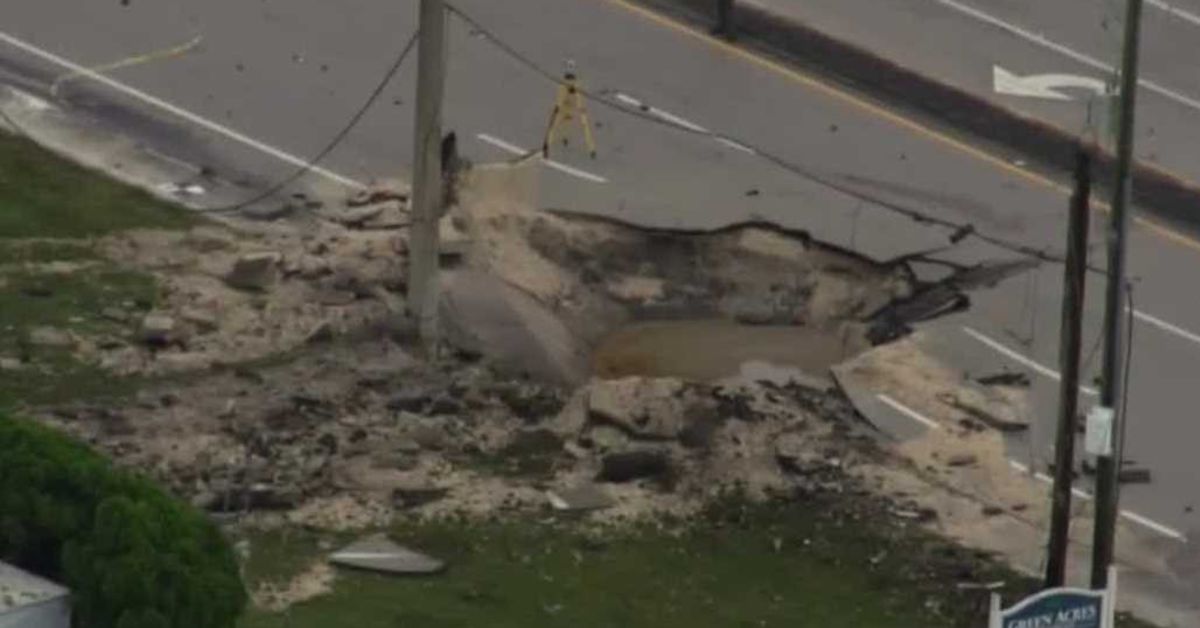
A midair breakup triggered by a violent thunderstorm is emerging as the leading theory behind a Learjet crash near Palm Beach, Florida, that killed nine people and left a conservative community already wary of federal aviation oversight demanding answers.
According to the Daily Mail, the twin-engine Learjet 60 went down just a few miles from President Donald Trumps Mar-a-Lago estate, nose-diving into a busy intersection and erupting into a fireball that was captured on harrowing video.
The crash, which carved a crater into the roadway and scattered debris across a wide area, has intensified scrutiny of how federal regulators and pilots manage severe weather, especially in an era when many Americans already distrust Washingtons bureaucracies.
Investigators with the National Transportation Safety Board (NTSB) said at a Monday press conference that they believe severe weather was a significant factor in the disaster, pointing to a powerful thunderstorm that battered the aircraft shortly before it broke apart.
Officials disclosed that the crew had requested a climb of 2,000 feet after encountering the storm, a decision that may have placed the jet in an aerodynamically precarious zone as it tried to outclimb the weather instead of diverting around it.
The doomed flight, a roughly $2 million business jet traveling from Austin, Texas, to North Eleuthera in the Bahamas, ended eight miles from Mar-a-Lago, underscoring how close the catastrophe came to one of the most prominent landmarks of the conservative movement.
Despite the dramatic impact and the jets fiery disintegration by the roadside, authorities said no one on the ground was killed or injured, though one man suffered a leg injury after being struck by debris near the crash site.
Inside the cockpit, the final moments were recorded in chilling audio that has since circulated among aviation observers and the public, offering a rare, raw window into the terror of a crew losing control at high altitude.
The co-pilot, 20-year-old Nathalia Gadelha Filgueiras, could be heard screaming as the aircraft plunged, while the pilot beside her recited the Lords Prayer, saying who art in heaven, hallowed be thy name as the jet fell from the sky.
As the situation deteriorated, Filgueirass voice shifted from professional urgency to sheer panic, reflecting the speed with which a modern jet can transition from stable flight to unrecoverable descent.
She radioed, Seven two two bravo delta, we're descending 8,000... mayday mayday... we're descending 10,000ft per minute, a rate of descent far beyond what any aircraft can safely sustain.
Seconds later, the crisis intensified as the Learjet accelerated beyond safe limits, a scenario that can strip control surfaces and overwhelm even experienced pilots.
Declaring emergency, declaring emergency, we are in an overspeed condition, she cried, as the controllers in Miami tried to steady her with calm instructions and reassurances.
The descent only grew more violent, and Filgueirass final transmissions captured the sense of helplessness in the cockpit as the aircraft rolled and dropped at catastrophic speed.
Descending 20,000ft per minute... we're going to crash into the ground, she said, before adding, We are descending 22,000ft, and we are banking 60 degrees, a bank angle that meant the jet was effectively flying sideways.
An air traffic controller responded, I'm here with you, talk to me, in a last attempt to keep the crew focused on any possible recovery.
But the effort came too late, and Filgueiras screamed, We're out of time, in what became her final, haunting transmission before the jet slammed into the roadway and exploded.
The Daily Mail has chosen not to release the final seconds of the audio, describing them as extremely distressing, a rare restraint in an age when sensationalism often trumps decency.
That editorial decision has been welcomed by many who believe the media too often exploits tragedy, even as others argue that full transparency is necessary to expose the realities of aviation risk and regulatory failure.
Family members of Filgueiras confirmed to the New York Post that the young aviator was at the controls when the aircraft went down, fulfilling a dream that had defined her short life.
Filgueiras grew up in Palm Beach County and had been profiled in local media after earning her pilots license in 2023 at just 17, a milestone she celebrated with the confidence and pride of a young woman breaking into a demanding profession.
In a previous interview with CBS12, she admitted she bragged about the achievement to her friends, explaining that they would tell her, Oh, you cant drive, and Im like, Yeah, but I can fly.
Her story resonated with many in the community who value personal ambition, merit, and the pursuit of excellenceprinciples that align closely with conservative ideals of individual responsibility and hard work.
Her mother, Camila, frequently shared images of Nathalia and her siblings traveling on private jets, reflecting a family culture that embraced aviation and the freedom it represents.
She loved the freedom. It was completely different seeing the world from the top, Camila told The New York Times, capturing the sense of wonder that draws so many to the skies despite the inherent risks.
Her stepfather, Thiago, told the New York Post that Nathalia had texted her fellow-pilot boyfriend just ten minutes before the crash, warning him: I've got turbulence, I've got ice.
That brief message now stands as a grim indicator of the conditions the crew was facing, and a reminder that even advanced aircraft can be humbled by nature when decisions are made under pressure.
The identities of the other eight people killed on board have not yet been released, leaving multiple families in agonizing limbo as they await official confirmation.
Authorities have said only that all nine occupants perished in the crash, while one man on the ground suffered a leg injury from flying debris but survived, a small mercy in an otherwise total loss.
Weather data from the National Weather Service in Miami showed poor conditions in the West Palm Beach area on Sunday afternoon, with overcast skies, rain, lightning, and easterly winds at 15 mph gusting to near 25 mph, though visibility remained around seven miles.
Air traffic controllers in Miami had already warned pilots in the area of moderate precipitation... to the southeast that they described as pretty nasty, granting them permission to deviate left and right to avoid the worst of the storm cells.
Despite those warnings, the Learjet crew appears to have attempted to climb above the weather rather than make a wider diversion, a choice that some aviation experts now question.
Some have suggested that the aircraft may have encountered a phenomenon known as coffin corner while trying to climb between or above two storm systems, a risky maneuver in a light business jet.
Coffin corner occurs at high altitude when an aircrafts minimum safe speed and maximum safe speed converge into a very narrow band, leaving pilots with almost no margin for error.
If the jet flies too slowly, it can stall; if it flies too fast, it can exceed structural limits or lose aerodynamic stability, and in either case the aircraft can quickly become uncontrollable.
Former pilot and tech entrepreneur Martin Varsavsky, who now runs an AI firm, posted on X that he believed the storm cells in the area were clearly visible on radar and should have been avoided.
The radars clearly showed those cells; in light jets, the rule is to deviate with a good margin, not to fly through them this could be an error by the woman who was piloting, he wrote, adding, What storms do by changing the outside temperature is that airplanes can no longer stay aloft at the same speed. It's called the coffin corner. Or they become very difficult to keep under control.
His comments, while controversial to some, reflect a broader debate within aviation about training, judgment, and the pressures pilots face to maintain schedules or satisfy clients, especially in the private and charter sector.
For many conservatives, the incident raises questions about whether current regulatory frameworks and training standards are truly focused on safety and personal accountability, or whether they are bogged down in bureaucratic box-checking that fails to address real-world risks.
The Federal Aviation Administration (FAA) has dispatched a team to support the NTSBs investigation, a standard move in major accidents but one that will be closely watched by those skeptical of federal agencies transparency.
Transportation Secretary Sean Duffy confirmed on Sunday that federal investigators would be on the ground, even as local officials warned that the road where the jet crashed may not reopen for at least a month due to the extensive damage.
In the chaotic aftermath, social media speculation spiraled, with rumors spreading that rock star Lenny Kravitz had been on board the ill-fated jet.
His representative, Carleen Donovan, was forced to intervene, telling the Daily Mail: The reports are untrue and incorrect, underscoring how quickly misinformation can compound tragedy in the digital age.
Flight tracking data showed the Learjets path originating in Austin, Texas, before heading toward the Bahamas and then abruptly terminating near West Palm Beach.
The sudden end to the track, combined with the extreme descent rates reported by the crew, supports the theory of a catastrophic loss of control, possibly exacerbated by icing and turbulence in the storm.
As investigators sift through wreckage and analyze cockpit voice and flight data recorders, families are left to grapple with the loss of loved ones and the knowledge that the final minutes were filled with terror.
For many in Palm Beach County and beyond, the death of a young, ambitious pilot like Nathalia Filgueiras is particularly painful, symbolizing both the promise and the peril of a profession that has long been associated with freedom, opportunity, and American ingenuity.
The crash near Mar-a-Lago has inevitably drawn national attention, not only because of its proximity to the presidents estate but also because it highlights enduring questions about risk, responsibility, and the role of government in regulating complex technologies.
As the NTSB and FAA proceed, those who value limited but effective government will be watching closely to see whether the final report focuses on practical lessonsweather avoidance, training, and pilot decision-makingor defaults to the kind of vague, bureaucratic language that too often obscures accountability and leaves grieving families without the clear answers they deserve.
Login