
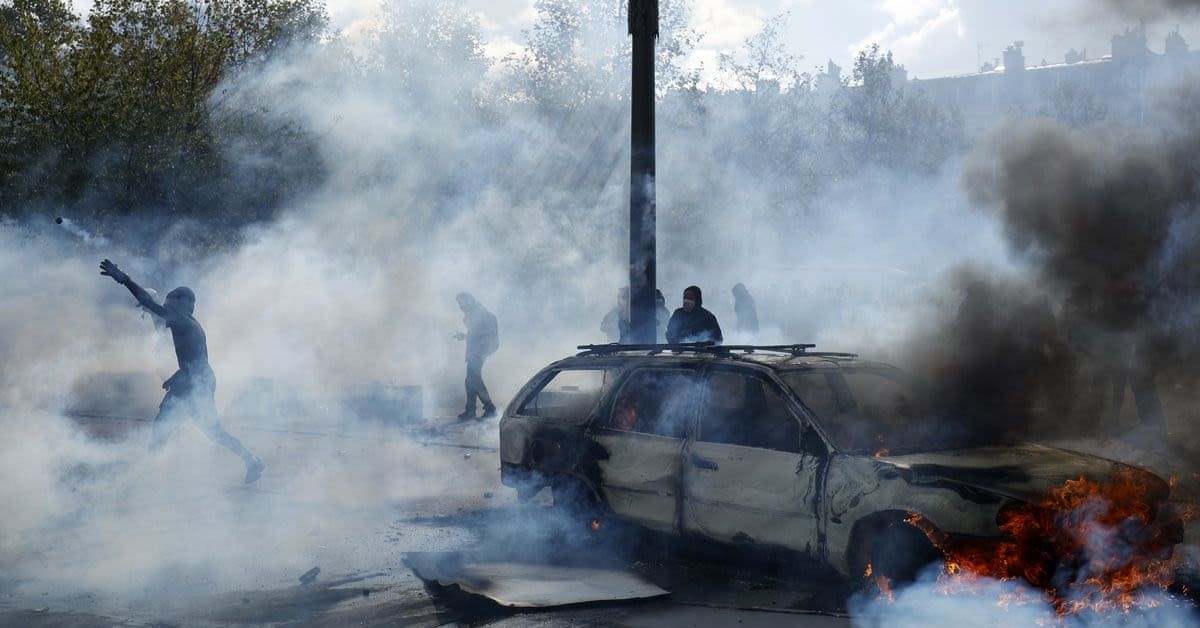
A vast network of radical Antifa cells and allied far-left organizations is mobilizing across France to turn this weekends demonstrations into a coordinated campaign of disruption, with hundreds of actions planned and a clear intent to escalate confrontation in the streets.
According to Fox News, roughly 50 self-identified Antifa groups are now working in concert with a broader constellation of communist, socialist, Trotskyist, revolutionary-left and anti-Israel organizations to mount a two-pronged offensive. They are preparing an anti-fascist village targeting conservative leader Marine Le Pens National Rally congress in the city of Orlans, while simultaneously driving nationwide Acte II protests designed to replicate and expand upon last weeks violent riots.
A Fox News Digital investigation has mapped 287 groups within Frances expanding protest ecosystem, including 50 explicitly Antifa organizations, 27 openly communist, socialist, Trotskyist or revolutionary-left entities, 24 labor unions and a growing coalition of far-left anti-Israel, migrant-rights, environmental, feminist, transgender and other activist groups. Despite the demonstrations being billed as youth-focused and centered on education, just 27 student and youth organizations appear among the signatories, underscoring how heavily professional agitators and ideological cadres dominate the movement.
This French mobilization is not occurring in isolation but rather as part of a broader transnational campaign of unrest orchestrated by communist, socialist and leftist networks in Greece, Italy, Spain, India and other countries. Fox News Digital has compiled a running directory of the organizations involved in what has been dubbed Chaos Inc. and is continuing to update that roster as new groups and alliances emerge.
The scale of the current effort marks a dramatic escalation from the 54 organizations initially identified in last weekends riots. The number of Acte II actions has surged to 649 planned protests as of early Friday morning in Paris, including targeted disruptions at 21 train stations, three ports, two oil depots and one refinery, signaling a deliberate strategy to hit critical infrastructure and maximize economic and social pressure.
Dozens of pages of planning documents and social media posts reviewed by Fox News Digital show that this is not a spontaneous outpouring of discontent but a carefully structured campaign with funding streams, logistical support and a communications backbone. The presence of organized fundraising, coordinated transportation, youth outreach, pre-produced propaganda materials and centralized information hubs reveals that the mobilization was being assembled days before demonstrators were set to flood the streets with hammer-and-sickle banners and Palestinian flags.
Complicating the security picture, a French administrative court reportedly overturned a ban on street protests issued by Paris police. The order was not made public, and it remains unclear whether its scope would have extended to other cities that have imposed similar restrictions, leaving authorities and citizens alike uncertain about the legal framework governing the coming unrest.
Even as this weekends actions are being finalized, organizers are already looking ahead to further escalation. Planning is underway for an Acte III on Oct. 31, a broader strike and blockade operation on Nov. 5 and a Europe-wide mobilization on Nov. 20, suggesting a sustained campaign rather than a one-off protest cycle.
Within France, the current wave of activism is being channeled through two principal streams: the Ciao Fachos, or Good-bye Fascists, coalition converging on Orlans, and the Acte II, or Action 2, campaign led by Yellow Vest organizers who helped drive last weeks mayhem. Groups have formally signed onto rosters for both tracks, with lists of organizations and delegations heading to Orlans to confront the National Rally gathering.
Macron must leave and make way for the people! the Acte II organizers proclaimed, in a call that explicitly seeks to topple the sitting government rather than simply influence policy. They urged Yellow vests, high school students, university students, workers to join demonstrations, roundabouts and blockades, everywhere in France, language that blends populist rhetoric with the disruptive tactics that have become a hallmark of the Yellow Vest and Antifa alliance.
The current situation echoes earlier concerns in the United States about the violent potential of far-left networks. Last September, after the murder of conservative leader Charlie Kirk by an alleged leftist gunman, President Donald Trump issued an executive order designating Antifa as a domestic terrorist organization, followed by National Security Presidential Memorandum 7, which warned that the groups and entities that perpetuate this extremism have created a movement that embraces and elevates violence to achieve policy outcomes, including justifying additional assassinations.
Despite the visible global footprint of groups openly using the Antifa label, former FBI Director Christopher Wray told Congress in 2020 that Antifa was not a group or an organization but rather a movement or an ideology. In the United States, far-left activists often exploit this ambiguity, waving ANTIFASCIST flags while avoiding a single formal national structure called Antifa, a tactic that has fueled denials that any coherent Antifa organization exists at all.
In Europe, however, activists are far less coy about their identity and structure. They openly organize under the Antifa name, march behind antifascist banners and display Antifa flags emblazoned with local chapter emblems, and a Fox News Digital investigation has uncovered a sprawling, interconnected network now mobilizing for another weekend of protests in France and beyond.
The U.S. government has already recognized the threat posed by some of these European formations. Last November, the State Department designated four European groups linked to Antifa Antifa Ost in Germany; the International Revolutionary Front, or Informal Anarchist Federation, in Italy; and Armed Proletarian Justice and Revolutionary Class Self Defense in Greece as Foreign Terrorist Organizations and Specifically Designated Global Terrorists, accusing them of organizing or carrying out bombings, shootings and other politically motivated attacks.
Globally, Antifa chapters present themselves as defenders against fascism, a term that once had a precise historical meaning but has been increasingly weaponized. Critics argue that these groups rely on threats, intimidation, harassment, violence, destruction and even murder, making them coercive, authoritarian and profoundly dangerous, while the word fascism itself has been turned into a catch-all slur for Western democracies, echoing the propaganda narratives of Russia, China and the Islamic Republic of Iran.
The rhetorical drift is evident in the rhetoric of prominent far-left figures. For example, late last year, Neville Roy Singham, an American-born communist tech tycoon now living in China, took the stage at the Golden Tulip Hotel in Shanghai for a Global South conference and denounced the alleged fascism of the United States, framing American constitutional democracy as morally equivalent to authoritarian regimes.
Recent U.S. diplomatic reporting suggests that Washington is watching the French situation closely. Days ago, Fox News Digital reported exclusively that an internal State Department assessment warned that antifascist groups could participate in a potentially more confrontational protest this weekend, one that could expose further security shortcomings and deepen political tensions in an already polarized France.
On the ground, the organizations themselves are now revealing the infrastructure they have built to sustain this agitation. On Friday night, a bus is scheduled to depart Marseille at about 9 p.m. local time for Orlans, in a journey organized by La Riposte Antifasciste Marseille, a group founded in October 2023 with a declared strategy of massification of anti-fascism, whose leaders tell supporters that Anti-fascism is everyone's business, and they are joined by Marseille Unite Communiste Libertaire.
Other organizing materials promote collective transportation from Paris, Saint-Denis, Stains, Brest and other cities, underscoring the degree of coordination behind what is often portrayed as grassroots spontaneity. These logistical preparations chartered buses, centralized sign-up forms, coordinated departure points offer a far more concrete measure of organization than simply spotting similar flags or slogans at scattered demonstrations.
On Saturday morning at 8 a.m., in Bagnolet, a suburb just outside Paris, the Assemble Antifasciste de Bagnolet, or Bagnolet Antifascist Assembly, plans to gather at the town hall, Mairie de Bagnolet, on Rue Hoche for a two-hour bus ride to Orlans. Its online registration form advertises 50 free seats, indicating that donors or allied organizations are underwriting the cost of travel for activists.
La Marche des Solidarites, or The March for Solidarity, is functioning as an online hub, directing supporters in the Paris region to buses leaving Saturday morning from Place de la Rpublique in Saint-Denis and Stains, in coordination with #NousToutes and Carr Citoyen. On Instagram, Saint-Denis Antifa, Carr Citoyen and Marche des Solidarites are steering followers to a fundraising page on the Solidaire website, where organizers have raised about $13,300 to cover expenses for the Saturday action, including the printing of mobilization materials: leaflets, posters, etc. and a truck/sound system for a large procession of the solidarity march.
Grassroots fundraising is being supplemented by local events designed to draw in younger supporters. The Saint-Denis Antifa group, for instance, sold crpes at the Saint-Denis Hip-Hop Festival last week to raise money for the protest, blending cultural outreach with political radicalization.
Behind the scenes, organizers have centralized the machinery of mobilization online, with adults deliberately carving out space for minors. They are telling high-school students that free places are for you, a phrase that suggests both targeted recruitment of youth and an effort to shield them from the financial costs of participation.
The Marche des Solidarits repository on antiracisme-solidarite.org describes itself as a platform containing all the information to mobilize, including calls, signatories, visuals, etc. Ciao Fachos has gone even further, with internal documents calling for tractages, collages, runions publiques, rcoltes de fonds, transports collectifs distributing leaflets, putting up posters, holding public meetings, fundraising and organizing collective transportation a full-spectrum approach to agitation.
The group also urges activists to physically obstruct National Rally supporters from distributing literature at markets or posting campaign materials on walls. In parallel, the network has promoted encrypted Signal channels, mirroring tactics used by far-left activists in the United States to coordinate logistics, share sensitive information and evade law-enforcement monitoring.
The weekend schedule is tightly choreographed, with Antifa groups such as Loiret Antifasciste promoting a detailed program that goes well beyond a single counter-protest. The groups own declaration states that the objective is larger than opposing one National Rally convention, framing the effort as part of a broader political struggle.
Building a mouvement antifasciste, or antifascist movement, is described as a collective responsibility, with calls for a united political front that fuses disparate grievances into a single anti-conservative, anti-capitalist project. For Saturday, organizers have advertised a full slate of activities, and on Sunday, Ciao Fachos has promoted another demonstration marching toward COMet, the venue hosting the National Rally gathering.
The Association France Palestine Solidarit has announced that its members will form a Palestinian contingent during Saturdays demonstration and operate a stand at the antifascist village until 10 p.m. Protest leaders deliberately chose Oct. 17 as a key date to memorialize a 1961 demonstration in Paris by Algerian martyrs that turned deadly, a symbolic linkage that casts todays far-left agitation as part of a long anti-colonial struggle.
The coalition in Orlans includes a dense array of anti-Israel and migrant-rights organizations: Urgence Palestine Orlans, AGIR POUR LA PALESTINE, Union juive franaise pour la paix, FASTI, Droits Devant!!, Coordination Sans-Papiers 75, La Cimade Aix-en-Provence, Tous Rfugis, GASPROM-ASTI Nantes, ASTI Orlans, the Association des Travailleurs Maghrbins de France and UJFP, the French Jewish Union for Peace, which is actively promoting the demonstration. The CGT Paris, the Paris branch of one of Frances largest labor confederations, is organizing transportation to the protest and has published the Loiret Antifasciste coalitions call for an antifascist movement, while Solidaires 37, the Indre-et-Loire branch of the left-wing labor federation, is arranging pay-what-you-can transport from Tours.
These coalition lists show how explicitly antifascist organizations are embedded within a much larger political bloc that spans unions, NGOs, identity-based groups and radical parties. The Orlans demonstration is not the only focal point, however, as explicit Antifa organizations are also mobilizing directly for local Acte II actions across the country.
Fox News Digital has separately identified antifascist groups attached to specific Acte II demonstrations. In Angoulme, Action Antifasciste 16, also known as Action AntiFa16, appears as an official collaborator on an Oct. 24 Acte II announcement alongside NPA Charente, Rvolution Permanente Angoulme, Maison des Peuples et de la Paix, Fanfare en lutte d'Angoulme and Organisation de Solidarit Trans Angoulme.
In Caen, the Caen Antifa Squad is listed as a collaborator on another announcement explicitly advertising ACTE II 24 OCTOBRE. The visible presence of Antifa groups at these events provides a connective tissue between the nationwide Yellow Vest mobilization and the broader antifascist ecosystem.
One of the key figures attempting to fuse these various grievances is Benjamin Ball, editor of the website that coordinates the Yellow Vest action map. Our role is to make sure that the social anger aggregates, Ball recently told French media, adding that organizers want representatives of different sectors to be received at the lyse, a statement that underscores the movements ambition to force direct engagement with the presidency.
French Antifa activism overlaps heavily with anarchist, communist, anticapitalist and revolutionary-socialist networks, whose organizations frequently cooperate in demonstrations and campaigns. The Oct. 24 coalition illustrates these connections, bringing together groups that share a hostility to free markets, traditional institutions and national sovereignty.
Union Communiste Libertaire, a libertarian-communist organization advocating revolutionary political change, has joined the mobilization. The revolutionary socialist Nouveau Parti anticapitaliste, or NPA, is promoting the Orlans demonstration, and its publication L'Anticapitaliste has reported that dozens of organizations are mobilizing against the RN congress.
La France Insoumise, the French Communist Party, Union pour la Reconstruction Communiste and Le Poing Lev all appear within the wider local coalition. The alliance also includes labor organizations, environmental activists and student groups, such as Fdration Syndicale tudiante, a left-wing student union already involved in Frances October student revolt, which is now joining the mobilization.
Extinction Rebellion France is represented through its le-de-France branch, whose agitators rappelled down the Marianne statue and hoisted a vest with an anti-police message, creating the iconic image now being used to fuel the next phase of activation. Feminist organizations such as NousToutes are also involved, with current social-media content promoting transportation to Orlans and distributing mobilization resources.
Organized labor is providing yet another layer of infrastructure for the protests. Alongside CGT Paris and Solidaires 37, the expanded roster includes CNT Fdration ducation, CNT 49, CNT Education 93, SNETAP-FSU, Solidaires 44, Solidaires 35, SUD Protection Sociale 93 and CGT ArianeGroup Issac, among other labor organizations that are lending logistical support and institutional legitimacy to the far-left push.
VISA 93, part of the Vigilance et Initiatives Syndicales Antifascistes labor-antifascist network, has promoted union transportation for the demonstration, further blurring the line between traditional labor activism and militant street agitation. Meanwhile, as Antifa and other leftist groups prepared for the weekend, French authorities moved against at least one suspected violent extremist.
Police arrested a 34-year-old man, Hodei Docampo Ciarra, this week in the town of Val d'Issoire (Haute-Vienne), suspecting him of being one of the rioters who devastated City Hall in Limoges by torching the building. French police said he was allegedly involved in the ultra-left, and officers detained him at about 6:15 a.m. as he got out of bed at his parents home, a reminder that behind the slogans and banners are individuals willing to translate radical ideology into arson, destruction and potentially worse.
As France braces for another weekend of orchestrated unrest, the emerging picture is one of a disciplined, well-funded and ideologically driven network that has learned to exploit legal ambiguities, youth discontent and institutional support from unions and NGOs. For conservatives who value public order, national sovereignty and the rule of law, the convergence of Antifa, revolutionary socialists, anti-Israel activists and radical labor factions around a shared campaign of disruption raises urgent questions about whether Western democracies are prepared to confront a movement that openly embraces and elevates violence to achieve policy outcomes, even as some officials still insist on treating it as a mere ideology rather than a coordinated threat.
Login