
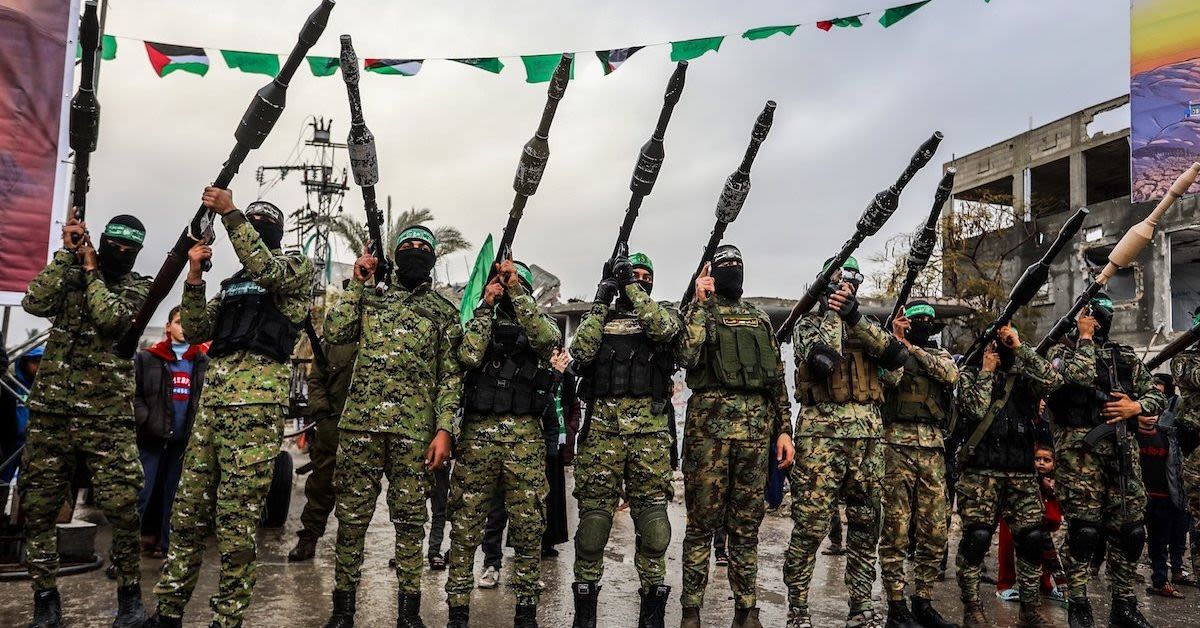
Hamas has issued a stark new threat to replicate the October 7 atrocities against Israel, even as the Islamist organization faces intensifying military, diplomatic, and financial pressure to disarm.
According to Ynet, the warning was delivered through UN humanitarian coordinator Dr. Ramiz Alakbarov, who was instructed by senior Hamas officials during a meeting at his Gaza office last week to relay the message directly to Israels leadership. The group declared that it would be ready to unleash further violence against targets in Israel, Judea, Samaria, and even abroad whenever the opportunity arises, a chilling pledge that underscores Hamass continued commitment to terrorism rather than any genuine pursuit of peace.
Hamas leaders reportedly told Alakbarov that the organization is under severe financial strain and is steadily losing its grip over the Gaza Strip, a decline they attributed largely to ongoing Israeli military operations and the gradual shifting of the Yellow Line demarcating the border. They also expressed anger at Palestinian Authority President Mahmoud Abbas, whose decision to cancel elections scheduled for late November has deepened internal Palestinian political tensions and further exposed the dysfunction of the Palestinian leadership.
Alakbarov is understood to have subsequently met Major General Yoram Halevy, Israels Coordinator of Government Activities in the Territories (COGAT), to pass on the threat from Hamas. Insiders have described the message as unprecedented in its bluntness, a sign that the terror group is attempting to project strength and deterrence even as it admits to serious internal weakness.
The escalation in rhetoric comes just days after Israel announced that its forces had killed Tamer Muhammad Ibrahim al-Sabbagh, a Hamas terrorist involved in the abduction and murder of 22-year-old German-Israeli civilian Shani Louk on October 7. Al-Sabbagh was identified as the final member of a Hamas cell held responsible for her death, with three other members killed earlier in the conflict and another captured by Israeli forces, underscoring Israels ongoing campaign to systematically dismantle Hamass operational infrastructure.
Louks fate became one of the most harrowing symbols of Hamass brutality after infamous photographs taken by AP freelance photographer Ali Mahmud showed a half-naked woman, later identified as Louk, lying unconscious face-down in the back of a pickup truck in Gaza. Footage of her being paraded through the streets by armed men spread rapidly online, becoming one of the symbols for Hamas' atrocities and raising concern over her welfare, and galvanizing international outrage over the groups barbaric tactics.
The young tattoo artist had been kidnapped from the Nova music festival near Reim on October 7, 2023, and died in the Gaza Strip after being taken across the border by terrorists. In late October 2023, forensic examiners confirmed her death when they identified a fragment of her skull, and in May 2024 Israel Defense Forces (IDF) soldiers operating in Gaza located her remains and returned them to Israel for burial, providing a measure of closure to her grieving family.
According to the IDF, al-Sabbagh had continued to pose a serious threat even after the initial onslaught, having carried out advanced attacks on Israeli troops and civilians and acted to restore Hamass capabilities 'in systematic violation of the ceasefire'. The terrorist was eliminated in order to remove the threat he posed, the IDF stated, framing the strike as a necessary act of self-defense in the face of a group that openly rejects ceasefire terms while exploiting any lull in fighting to rearm.
Meanwhile, the Board of Peace and international mediators have reiterated their demands that Hamas disarm as a core condition of the US-brokered ceasefire framework. That agreement envisions the eventual reconstruction of Gaza, but only if Hamas relinquishes its weapons and Israel can be assured that the territory will not again become a launchpad for massacres like those of October 7.
So far, negotiations have stalled, with mediators unable to secure terms under which Hamas would surrender its arsenal and Israel would withdraw its troops, a deadlock that reflects the fundamental problem of trying to negotiate with an organization that still glorifies mass murder. Israeli airstrikes have intensified in recent weeks, with at least 1,500 Palestinians reported killed in Gaza since the ceasefire by the territorys health officials, while Israel says four of its soldiers have fallen during the same period.
Palestinian authorities now claim that more than 74,000 people have been killed in Israels assault on Gaza, launched after Hamas terrorists murdered 1,200 people during the October 7 atrocities, though those casualty figures come from institutions closely tied to Hamas and are widely viewed with skepticism by many in the West. Against this backdrop, Hamass vow to repeat the October 7 massacre, rather than accept disarmament and a path to reconstruction, reinforces a grim reality: so long as a terrorist regime is allowed to entrench itself in Gaza, Israeli civilians will remain in the crosshairs, and any hope for genuine peace will be held hostage to the groups violent, uncompromising ideology.
Login