
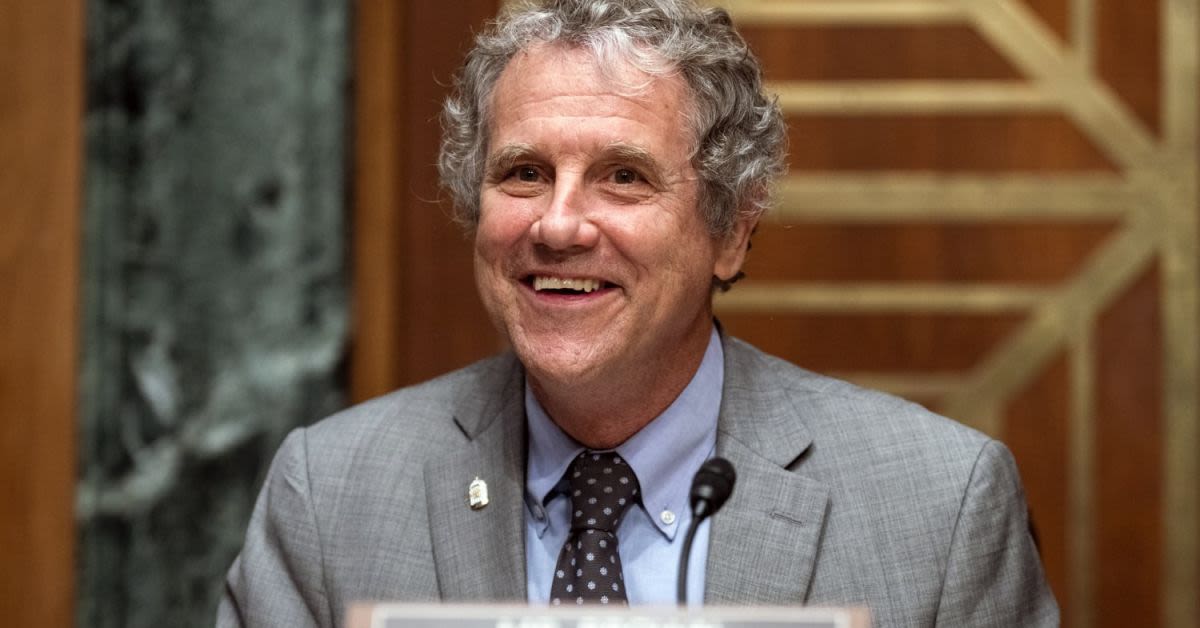
Ohio Democrat Senate nominee Sherrod Brown has made opposition to Ohios booming data center industry a centerpiece of his campaign against Republican Sen. Jon Husted, even as his own household benefits financially from mutual funds tied to the very tech giants driving that growth.
According to Breitbart, Browns August 2026 Personal Financial Disclosure shows that his wife, Pulitzer Prize-winning journalist and author Connie Schultz, holds between $265,002 and $550,000 in two mutual funds with indirect exposure to Amazon, Microsoft, Nvidia, Meta, and Googles parent company, Alphabet. Those five corporations are at the heart of major data center projects across Ohio, projects that Brown has attacked as harmful to ratepayers, farmland, and local resources while simultaneously denouncing the tax incentives that helped lure them to the state.
Brown, who is challenging Husted in Ohios U.S. Senate race, has repeatedly castigated the Republican for his role in bringing data centers to Ohio, framing the issue as a clash between corporate interests and ordinary families. He has raised alarms about the potential impact of these facilities on electricity costs, water consumption, and agricultural land, as well as the billions in tax breaks that state officials have deployed to attract them.
Yet Browns own disclosure, provided to Breitbart News, undercuts his populist rhetoric by revealing that Schultz is invested in two mutual funds that profit from the expansion of the same technology companies he vilifies on the campaign trail. These funds, while diversified, are significantly weighted toward Big Tech firms that are aggressively building and operating data centers throughout the Buckeye State.
According to the filing, Schultz holds between $250,001 and $500,000 in the Invesco Select Risk: Growth Investor Fund Class A (AADAX), a multi-asset mutual fund marketed to investors seeking long-term capital appreciation with a higher risk profile than the broader stock market. That funds strategy leans heavily on exchange-traded funds and global equity vehicles that, in turn, hold substantial positions in the leading technology names powering the data center boom.
The four largest underlying holdings of AADAX, which together account for 48.95 percent of its assets, are the Invesco S&P 500 Revenue ETF (RWL), Invesco Russell 1000 Dynamic Multifactor ETF (OMFL), Invesco Global R6 (OGLIX), and Invesco NASDAQ 100 ETF (QQQM). These four vehicles function as the primary engines of AADAXs exposure to the U.S. and global equity markets, particularly the high-growth technology sector.
RWL represents 15.73 percent of AADAXs assets, while OMFL accounts for 12.01 percent, OGLIX for 11.82 percent, and QQQM for 9.39 percent. In practical terms, this means nearly half of Schultzs largest mutual fund position is effectively tethered to the performance of these four underlying funds and, by extension, to the fortunes of the tech titans dominating the digital economy.
The four underlying funds have varying levels of exposure to Amazon, Microsoft, Nvidia, Meta, and Alphabet, but the concentration is significant. The five companies account for 10.56 percent of RWLs holdings, 20.41 percent of OMFLs holdings, 25.88 percent of OGLIXs holdings, and 28.9 percent of QQQMs holdings, according to fund holdings reported as of July 31 and September 17, 2026.
Browns disclosure further identifies between $15,001 and $50,000 held by Schultz in the Nuveen Lifecycle Index 2020 R6 (TLWIX), another mutual fund designed for investors nearing or in retirement. While more conservative in allocation, this fund also channels a meaningful share of its assets into equities that include the same Big Tech firms Brown targets rhetorically.
Approximately 28.66 percent of TLWIX is invested in the Nuveen Equity Index W (TEQWX), which has approximately 21.59 percent of its holdings in Amazon, Microsoft, Nvidia, Meta, and Alphabet. That structure means Schultzs second fund, though smaller, still provides notable indirect exposure to the data center leaders reshaping Ohios economic landscape.
Despite this financial entanglement, Brown has used his social media presence to hammer Husted over data centers, casting the Republican as a willing accomplice of corporate interests. On September 13, Brown wrote on X, Jon Husted gave out billions of dollars in sweetheart tax cuts to bring data centers to Ohio Ohioans wont stand for it.
Earlier, on September 4, Brown escalated his rhetoric, writing, Jon Husted led the charge to force data centers on Ohio, and were all paying the price. The message was clear: Brown wants voters to see Husted as the architect of a policy regime that privileges multinational tech firms at the expense of local communities.
On September 2, Brown again took to X to position himself as the voice of public unease, writing, Ohioans are sounding the alarm about data centers and Im listening. He then sharpened the populist edge of his argument, declaring, They dont want to see our utility bills spike, our water sucked up, or our farm land devoured.
Brown followed that message with a promise of activist representation in the Senate, telling voters, You deserve a senator who will fight to defend our communities and protect our resources and thats what Im going to do. The framing is classic progressive populism: a crusade against corporate power, even as his own households investments are buoyed by the same corporate expansion.
On July 28, Brown posted a campaign video that depicted Husted as the political face of Ohios data center surge, effectively turning the states economic development strategy into a liability. Jon Husted gave out-of-control tax breaks to data centers and Ohioans are paying the price, Brown wrote in the accompanying post.
These attacks have intensified just as the technology companies represented in Schultzs mutual fund investments continue to expand their data center operations and infrastructure spending across Ohio. The timing underscores a tension between Browns public denunciations and the private financial interests that stand to gain from the very projects he condemns.
Amazon, one of the largest players in the sector, is expected to invest more than $23 billion in Ohio data center expansion by 2030. That scale of investment reflects a long-term commitment to the states digital infrastructure and positions Ohio as a key hub in Amazon Web Services national and global network.
An April 2025 analysis by the Cincinnati Enquirer, using information from Data Center Map, found that Amazon Web Services had 56 planned or operational data centers across Ohio, more than any other technology company in the state. This extensive footprint has made Amazon the most visible symbol of the data center boom that Brown now seeks to weaponize politically.
Amazon previously announced a $10 billion investment in Ohio infrastructure, saying the expansion would support employment opportunities in the construction and operation of data centers and related industries. The company identified positions including engineering operations managers and security specialists, while also pointing to jobs supported in telecommunications, facilities maintenance, and electricity generation.
Microsoft, another major holding within Schultzs mutual fund exposure, has also continued investing heavily in Ohios data center industry, including projects in Licking County. These investments have been touted by state and local officials as catalysts for job creation, tax revenue, and broader economic growth.
According to Microsofts June 2026 economic-impact report, the company has three campuses consisting of three data centers that are expected to be operational by the end of 2029. The report listed $55 million in economic activity, 450 local jobs supported, and $40 million in labor income associated with construction since 2024.
Microsoft also reported investing $1.4 million in community initiatives since 2024, signaling an effort to present itself as a long-term civic partner rather than a distant corporate landlord. Looking ahead, Microsoft projected approximately 350 construction roles annually and 2.2 million work hours associated with its data center projects, underscoring the scale of the build-out.
Once operational, each Microsoft data center facility is expected to employ approximately 50 workers annually, providing stable, high-skilled jobs in regions that often struggle to attract such employment. Microsoft further stated that property tax revenue from its first data center building at each campus is expected to place the company among Licking Countys ten largest property taxpayers.
Nvidia, another company represented in Schultzs mutual fund holdings, announced a major investment in an Ohio data center project in August 2026, further deepening Big Techs footprint in the state. The semiconductor giants role is particularly significant given its dominance in the high-performance chips that power artificial intelligence and advanced computing.
The company said it would invest $1.5 billion in SB Energy, which is developing the PORTS-Pike Technology Campus in Pike County, Ohio. Under the arrangement, SB Energy will build, own, and operate the data center under a 20-year lease to OpenAI, with the facility designed to host Nvidia computing infrastructure.
Separately, Reuters reported on August 17 that Nvidia would provide a guarantee of up to $105 billion for OpenAIs Ohio data center. That guarantee underscores both the scale of the project and the strategic importance of Ohio in the emerging AI and cloud-computing ecosystem.
Meta, the parent company of Facebook and another key Big Tech name in Schultzs indirect portfolio, has also invested in several data center projects across Ohio, including facilities in New Albany and Bowling Green. These projects have been pitched as engines of local development, bringing construction work, permanent jobs, and long-term tax revenue.
Metas New Albany campus consists of five data centers spanning approximately 2.5 million square feet, making it one of the more substantial digital infrastructure complexes in the region. In February 2026, Meta announced a multiyear agreement with Corning worth up to $6 billion to supply fiber-optic cables for its data centers, including its New Albany operations.
Metas Bowling Green data center represents an investment of more than $800 million and is expected to support approximately 100 operational jobs once completed, along with 1,000 skilled trades workers during peak construction. According to a Meta project overview, the company worked with FirstEnergy and Williams to plan for the facilitys energy needs and ensure it would pay the full cost of the electricity used by the data center so consumers would not be negatively affected.
Meta said it would also pay the full cost of water and wastewater services and support additional renewable-energy projects to match its electricity consumption with 100 percent clean and renewable energy. Those commitments stand in stark contrast to Browns portrayal of data centers as unmitigated threats to local utilities and natural resources.
Google, whose parent company Alphabet is likewise represented in Schultzs mutual fund holdings, began constructing its New Albany data center facility in 2019, further cementing Ohios status as a digital infrastructure hub. Since breaking ground on the facility, Google reports having invested more than $20 billion across Ohio, a figure that encompasses data centers, offices, and other operations.
The company also reported more than $16 million in philanthropic contributions to Ohio organizations and nonprofits and more than 16,000 volunteer hours contributed by its employees since 2006. These figures highlight the broader civic and charitable footprint that often accompanies large-scale corporate investment, a dimension largely absent from Browns campaign broadsides.
Former Rep. Tim Ryan (D-OH) shed light on Browns political calculus during an October 13 appearance on NewsNations Elizabeth Vargas Reports, saying Brown pinned Jon Husted on that data center issue very early in this campaign and that it had been hard for Jon to get out of that. Ryan said Husted, as lieutenant governor, oversaw economic development in Ohio and helped bring data centers to the state through tax credits and other incentives.
Ryan also acknowledged the projects economic benefits, calling data centers a great source of jobs and noting that construction workers really want to build them. That admission from a fellow Democrat underscores the central tension in Browns strategy: while he attacks Husted for championing data centers, many Ohio workers, local governments, and even his own household investments are aligned with the industrys success.
For conservatives, the picture is clear: Husteds approach reflects a traditional pro-growth, pro-investment philosophy that leverages tax policy to attract long-term private capital, while Browns posture combines anti-corporate rhetoric with personal financial entanglements that raise questions about sincerity and consistency. As Amazon, Microsoft, Nvidia, Meta, and Google continue to pour billions into Ohio, the race increasingly turns on whether voters prefer a model of limited government that welcomes job-creating investment or a progressive critique that demonizes the very economic engine fueling the states digital future.
Login