
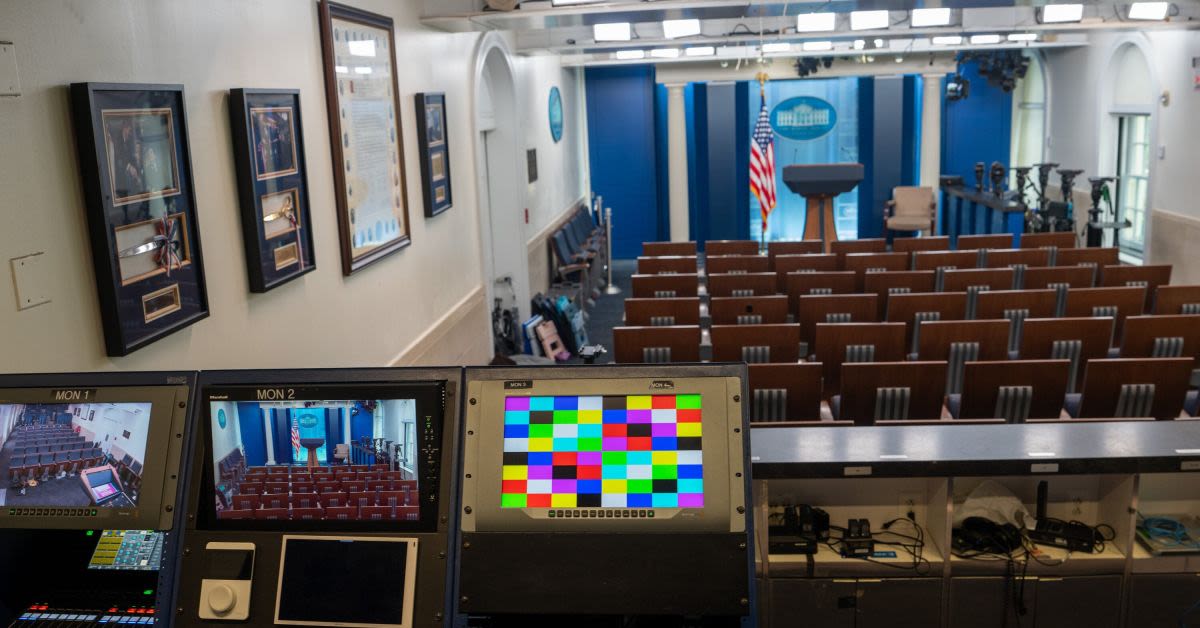
President Donald Trump is again weighing whether to relocate the White House press corps from its historic quarters inside the executive mansion, a step that would dramatically reshape how the media covers the presidency and further test an already fraught relationship between the administration and the press.
According to CBS News, two individuals close to the president say the idea of moving reporters to another building has been under active discussion, though no final decision has been made. Outside allies have been urging the change, including former Trump strategist Steve Bannon, who has reportedly been among those pressing the case in recent weeks.
The talks, first disclosed by The New York Times, come as the administration continues to challenge what it views as a hostile and partisan press corps. White House communications director Steven Cheung underscored that sentiment in a statement, declaring, "America is rightly distrustful of the fake news media because they fabricate stories based off lies and sources who are not even privy to any type of information. All options remain on the table, and we will make an announcement when appropriate."
For more than a century, reporters have maintained dedicated workspaces inside the White House, a physical presence that symbolizes both transparency and accountability. The current briefing room, built during the Nixon administration, famously sits atop a swimming pool installed under President Franklin D. Roosevelt.
Mr. Trump has openly mused about reversing that renovation, recently posting a before-and-after image on Truth Social hinting that the briefing room could once again become a pool. The suggestion plays into his long-running critique of the Washington press corps, which he has frequently accused of bias and dishonesty.
The notion of moving the press corps is not new for this administration. Ahead of Mr. Trumps first term, aides floated shifting briefings to a larger venue in the Eisenhower Executive Office Building, adjacent to the West Wing, arguing that a bigger space could expand access beyond the entrenched Beltway outlets.
At the time, incoming chief of staff Reince Priebus told NBC News that holding news conferences in the Eisenhower building was under consideration, though the plan was ultimately shelved. Mr. Trump later explained to Fox News that media backlash prompted him to retreat, recalling, "The press went crazy, so I said, 'Let's not move it.'"
The revived proposal surfaces after more than a year of clashes between the administration and major news organizations over access to the White House. Last month, Mr. Trump attempted to bar CNN, MS NOW and Politico from the White House complex, accusing them of unfair coverage and briefly stripping their reporters of credentials.
A federal judge quickly intervened, restoring access and ruling that the ban likely violated the First Amendment and the outlets right to due process. Even so, the administration has continued to periodically exclude CNN from the small television press pool, a five-network rotation that covers presidential travel and events and shares footage with other outlets.
The media landscape surrounding these disputes is itself in flux, with corporate consolidations reshaping who owns what. (CNN and CBS News are both part of Skydance, the parent company formed by the merger of Paramount and Warner Bros. Discovery.)
Tensions over access have not been confined to the White House. More than a year ago, the administration blocked the Associated Press from the Oval Office and other key areas after the wire service refused to adopt Mr. Trumps preferred label for the Gulf of Mexico, the "Gulf of America."
The Pentagon has mirrored this more restrictive posture, imposing new conditions on reporters seeking daily access to the building. Last year, the military demanded journalists sign an agreement that included a pledge not to "solicit" sensitive information, a requirement most outlets rejected, prompting them to vacate the building rather than accept the constraints.
After a judge struck down those Pentagon rules earlier this year, the Defense Department responded by ending unescorted access for reporters altogether. Chief Pentagon spokesman Sean Parnell announced that a "new and improved press workspace will be established in an annex facility outside the Pentagon, but still on Pentagon grounds."
For conservatives who have long argued that legacy media act less like neutral watchdogs and more like partisan actors, the prospect of relocating the White House press corps fits into a broader effort to reset the balance of power between elected officials and unelected media gatekeepers. Whether the administration ultimately moves reporters out of the West Wing or simply continues to tighten access, the ongoing fight underscores a central question of this presidency: who truly speaks for the American people, and who merely claims to speak in their name.
Login