
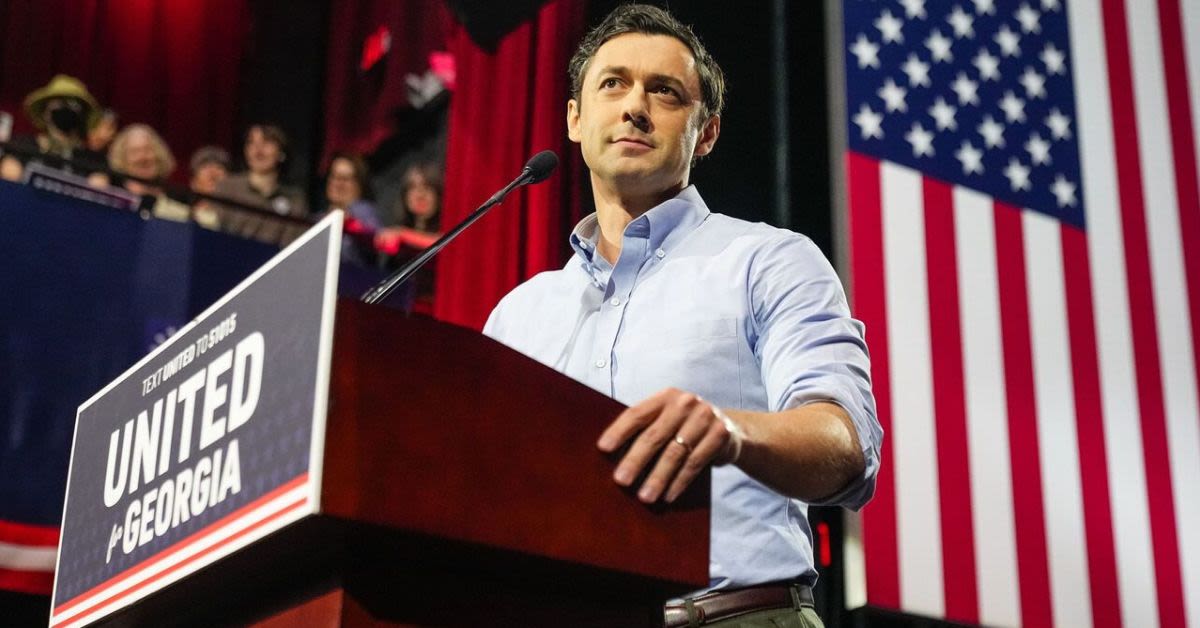
Sen. Jon Ossoff used a high-stakes Senate debate in Georgia on Tuesday night to shut down mounting speculation that he is positioning himself for a 2028 presidential bid, insisting his focus remains solely on winning another six-year term.
The first-term Democrat, facing Republican Rep. Mike Collins in a closely watched contest, was pressed on whether he would commit to serving a full term if reelected. According to Newsmax, Ossoff replied bluntly, I have zero interest in running for president, adding, I'm not running for president. I'm running for re-election to the Senate.
His categorical denial comes as party insiders and liberal commentators increasingly float his name among a short list of potential 2028 Democratic contenders, alongside Pennsylvania Gov. Josh Shapiro, California Gov. Gavin Newsom, and former Vice President Kamala Harris. That chatter has grown louder as Ossoff has cultivated a national profile and emerged as one of his partys more visible critics of President Donald Trump, a posture that plays well with the Democratic base but raises questions about his long-term ambitions.
Once viewed as one of the most endangered Democrats on the 2026 map, Ossoff has recently opened a lead in most public polls, easing party anxieties about holding his seat and potentially reclaiming control of the Senate. For conservatives, however, his rising fortunes underscore the stakes in Georgia, a state that has become a pivotal battleground where Democrats have advanced by tacking left while still trying to project moderation to swing voters.
The debate itself highlighted that ideological divide, as the candidates clashed over the economy, abortion, public safety, the Jeffrey Epstein files, and the ongoing war in Iran. Ossoff repeatedly tried to tie Collins to Trump and his policies, attacking the presidents economic agenda even as many conservatives credit Trump-era deregulation and tax cuts with fueling pre-pandemic growth.
On trade, Ossoff criticized Collins support for Trumps tariffs, echoing the Democratic Partys long-standing hostility to protectionist measures that seek to shield American workers and industries from unfair foreign competition. Collins pushed back, defending the tariffs and arguing that imported cotton has damaged Georgias agricultural sector, a reminder that many on the right see targeted tariffs as a tool to counter predatory trade practices rather than a blanket rejection of free markets.
The exchange over the Epstein scandal injected an even sharper edge into the debate. Collins highlighted Ossoffs financial backing from billionaire Reid Hoffman, the LinkedIn co-founder who has poured millions into Democratic causes and has faced scrutiny over his ties to Epstein.
Hoffman previously told The Wall Street Journal that he met with Epstein once to raise money for the Massachusetts Institute of Technology and regretted the meeting. Ossoff, seeking to turn the attack back on Republicans, responded by saying Trump's name appears a thousand times in the Epstein files, a line clearly aimed at tarnishing the president and, by extension, Collins alignment with him.
Ossoffs aggressive posture toward Trump has become a defining feature of his political brand this year. That stance has helped him consolidate support among progressive activists and national Democratic donors, even as it risks alienating moderate and conservative-leaning Georgians who remain wary of the leftward drift of the Democratic Party on cultural and economic issues.
His insistence that he is not eyeing the White House is not new. In June, Ossoff told The Atlanta Journal-Constitution that he had no interest in a presidential run and dismissed the 2028 speculation as fantasy football, language that suggests he understands how talk of higher office can backfire with voters who want their senators focused on state concerns, not personal ambition.
History, however, offers reasons for skepticism about such denials. During and after his 2004 Senate campaign, Barack Obama repeatedly said he would not run for president, only to launch the 2008 campaign that carried him to the White House, a precedent that conservatives note whenever rising Democrats claim disinterest in national office.
For Republicans, the Georgia race is not only about blocking a potential future presidential aspirant but also about halting the advance of a Democratic agenda they see as increasingly dominated by coastal elites and Silicon Valley billionaires like Hoffman. Collins has framed the contest as a choice between a senator with far-left connections and a conservative willing to fight for Georgias farmers, small businesses, and working families against both Washington overreach and global economic pressures.
Ossoff, for his part, is betting that his emphatic rejection of 2028 talk, combined with his attacks on Trump and his defense of the Biden-era Democratic record, will be enough to reassure swing voters while keeping the partys progressive base energized. Whether voters accept his claim that he has zero interest in running for president may depend less on his words than on how he governs if returned to the Senate, and on whether Democrats view him as a useful standard-bearer in a party still searching for a post-Biden identity.
Login