
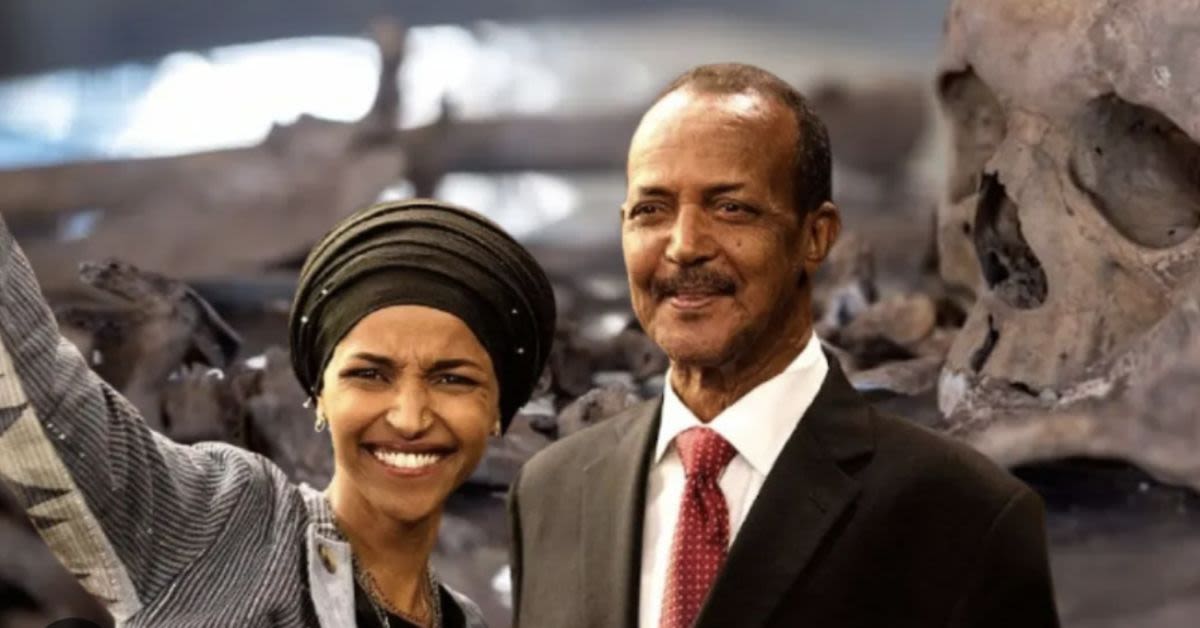
An already explosive federal immigration probe targeting Democratic Rep. Ilhan Omar has taken a darker turn with new allegations that her late father served as a senior officer in a brutal Somali dictatorship accused of slaughtering up to 200,000 people.
According to Western Journal, the latest claims come from Mohamed Haji Ingiriis, an Oxford University historian and specialist in the Somali civil war, who told the New York Post that Omars father misrepresented himself as a refugee when he entered the United States. Ingiriis asserted that, far from being a mere victim of the countrys chaos, Nur Omar Mohamed also known as Nur Said Elmi Mohamed was in fact a full colonel in the armed forces of Marxist dictator Siad Barre, whose regime terrorized Somalia for decades before its collapse in 1991.
Federal agents raided Omars Minnesota home on Monday as part of an investigation into whether she falsely claimed to be a minor when she obtained U.S. citizenship through her father in 2000. Public records and media profiles had long listed Omars birth year as 1981, but after a viral video raised questions about her naturalization path, she abruptly asserted that she was born in 1982, the New York Post reported.
That one-year discrepancy is not a trivial matter, because if Omar was born in 1981 she would have been 18 or 19 at the time of her naturalization and therefore ineligible to derive citizenship as a minor through her father. Omar has insisted that her birth records were destroyed amid the civil war that ravaged Somalia, but Mondays raid appears aimed at determining whether she knowingly maintained a false birthdate for years, according to the Post.
The fresh allegations about her fathers past, while unlikely to carry direct legal consequences for Omars own status, further complicate the moral and political dimensions of the case. They also raise uncomfortable questions about how thoroughly U.S. authorities vetted certain asylum seekers from conflict zones during the 1990s, particularly those with ties to authoritarian regimes.
Omar has long portrayed her father as an educator who fled persecution and brought his family to America in 1995 after escaping to Kenya. Ingiriis, however, painted a starkly different picture, telling the New York Post that Nur was a full colonel in Barres military and a loyal functionary of a regime that killed up to 200,000 people before it was toppled.
Nur Said was a military officer who was loyal to the regime until the end, Ingiriis said, directly contradicting the congresswomans narrative of a family fleeing oppression. He was part and parcel of those who caused and created the mayhem they fled to live comfortably in the United States.
Ingiriis said Nur received formal military training either in the former Soviet Union or in Egypt, both key backers of Barres socialist government during the Cold War. He reportedly remained in uniform until the dictators fall, and a former fellow officer, Yusuf Ismail Faraton, told a Minnesota outlet in 2020 that Nur had played a significant role in Somalias war with neighboring Ethiopia.
He only fled when the dictatorship fell in 1991, Ingiriis told the New York Post, underscoring that Nur did not abandon the regime until it was already collapsing. He was the beneficiary of the military regime and should not have been given asylum whatsoever.
Under U.S. law, refugee status is barred to any person who ordered, incited, assisted or otherwise participated in the persecution of any person on account of race, religion, nationality, membership in a particular social group, or political opinion. Ingiriis argued that for Nur to obtain asylum, he would have had to conceal or lie about his role in Barres forces, given that he assisted the dictator to remain in power for so long and was protecting his career and his colonel position.
I think it is very wrong for the United States to host war criminals, Ingiriis said, voicing a concern many conservatives have raised for years about lax refugee screening and the importation of foreign conflicts onto American soil. This creates a constant resentment and sadness among the real victims who were terrorized by the military regime under which Nur Said loyally served.
Omars father eventually made his way to the United States after first escaping to Kenya, where many Somalis sought refuge during the civil war. He died in 2020, leaving behind a public image carefully curated by his daughter that is now being challenged by those who lived through the same bloody era.
The Minnesota lawmaker, a prominent member of the progressive Squad, has responded to the raid and the broader investigation by casting herself as the target of a political vendetta orchestrated by President Donald Trump. For ten years, Trump has targeted me with baseless lies and smear campaigns. This is just the latest escalation in his campaign of political intimidation, she said, insisting that federal law enforcement is being weaponized to silence her.
I will not be silenced, Omar declared, doubling down on her familiar posture as a victim of supposed right-wing persecution rather than addressing the substance of the allegations about her background. Her critics, however, argue that this is a deflection from serious questions about potential immigration fraud, family history, and the integrity of the refugee system.
Trump, for his part, denied any role in the raid while reiterating his longstanding criticism of the congresswomans conduct and rhetoric. Ive always found her to be totally crooked, personally, but [the raid] has nothing to do with me, he told reporters, distancing himself from the Justice Departments actions even as he offered a blunt assessment of her character.
I think shes a terrible person, just a complainer, he added. She comes from a country that is a non-country, and then she comes over here, and she complains about our Constitution. I think shes a terrible person, but thats really up to the DOJ. I have nothing to do with it.
For conservatives, the unfolding controversy underscores several longstanding concerns: the reliability of asylum claims from failed states, the adequacy of vetting for refugees and their families, and the double standard that often shields progressive darlings from the scrutiny applied to their political opponents. If a Republican lawmakers parent had been credibly accused of serving as a colonel in a regime responsible for mass killings, the media and the left would almost certainly demand exhaustive investigations and immediate accountability.
Instead, Omars allies have rushed to frame the matter as yet another example of xenophobia and Islamophobia, even as a Somali scholar with no apparent conservative agenda insists that war criminals like Nur should never have been granted safe haven. Whether the Justice Department ultimately pursues charges related to Omars citizenship or her fathers alleged misrepresentations, the episode raises profound questions about truth, transparency, and the standards applied to those who seek to lead the country that gave them refuge.
As the investigation proceeds, Americans are left to weigh the competing narratives: a self-styled refugee-turned-congresswoman claiming persecution by a president, and a historian of her homeland asserting that her family benefited from and helped sustain one of Africas most repressive regimes. For a nation that prides itself on both compassion and the rule of law, the Omar case is rapidly becoming a test of whether political favoritism and identity politics will override the basic expectation that those who come here, and those who serve in Congress, must be honest about who they are and where they came from.
Login